
Mouse CXCL1/GRO alpha/KC/CINC-1 Antibody
R&D Systems, part of Bio-Techne | Catalog # MAB4532
Recombinant Monoclonal Antibody.

Scientific images may be resized, cropped, or adjusted for brightness or contrast for presentation purposes. These updates are limited to presentation and do not affect the underlying scientific interpretation of the data. Where available, additional source data may be provided upon request.
Conjugate
Catalog #
Key Product Details
Validated by
Biological Validation
Species Reactivity
Validated:
Mouse
Cited:
Transgenic Mouse
Applications
Validated:
Intracellular Staining by Flow Cytometry
Cited:
Immunohistochemistry
Label
Unconjugated
Antibody Source
Recombinant Monoclonal Rabbit IgG Clone # 1174A
Product Specifications
Immunogen
E. coli-derived recombinant mouse CXCL1/GRO alpha/KC/CINC‑1
Asn29-Lys96
Accession # P12850
Asn29-Lys96
Accession # P12850
Specificity
Detects mouse CXCL1/GRO alpha/KC/CINC‑1 in direct ELISAs.
Clonality
Monoclonal
Host
Rabbit
Isotype
IgG
Scientific Data Images for Mouse CXCL1/GRO alpha/KC/CINC-1 Antibody
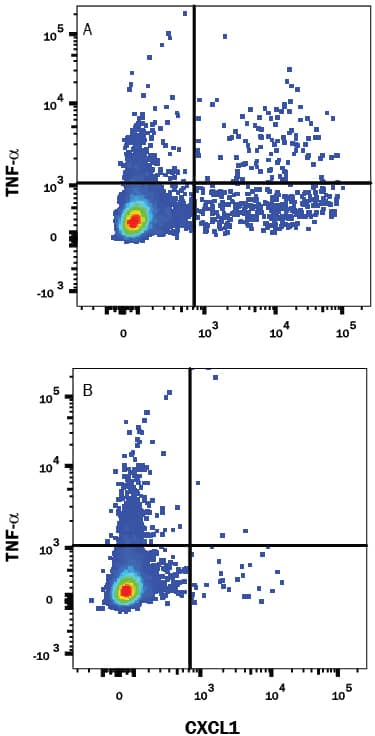
Detection of CXCL1/GRO alpha/KC/CINC-1 in Mouse Splenocytes by Flow Cytometry.
Mouse splenocytes either (A) treated with 1 µg/mL LPS and Brefeldin A for 4 hours or (B) untreated were stained with Rabbit Anti-Mouse CXCL1/GROa/KC/CINC-1 Monoclonal Antibody (Catalog # MAB4532) followed by Phycoerythrin-conjugated Anti-Rabbit IgG Secondary Antibody (Catalog # F0110) and Rat Anti-Mouse TNF-a Fluorescein-conjugated Monoclonal Antibody (Catalog # IC410F). To facilitate intracellular staining, cells were fixed and permeabilized with FlowX FoxP3 Fixation & Permeabilization Buffer Kit (Catalog # FC012).Applications for Mouse CXCL1/GRO alpha/KC/CINC-1 Antibody
Application
Recommended Usage
Intracellular Staining by Flow Cytometry
0.25-1 µg/106 cells
Sample: Mouse splenocytes treated with LPS and Brefeldin A were fixed and permeabilized with FlowX FoxP3 Fixation & Permeabilization Buffer Kit (Catalog # FC012).
Sample: Mouse splenocytes treated with LPS and Brefeldin A were fixed and permeabilized with FlowX FoxP3 Fixation & Permeabilization Buffer Kit (Catalog # FC012).
Reviewed Applications
Read 1 review rated 3 using MAB4532 in the following applications:
Formulation, Preparation, and Storage
Purification
Protein A or G purified from cell culture supernatant
Reconstitution
Reconstitute at 0.5 mg/mL in sterile PBS. For liquid material, refer to CoA for concentration.
Formulation
Lyophilized from a 0.2 μm filtered solution in PBS with Trehalose. *Small pack size (SP) is supplied either lyophilized or as a 0.2 µm filtered solution in PBS.
Shipping
Lyophilized product is shipped at ambient temperature. Liquid small pack size (-SP) is shipped with polar packs. Upon receipt, store immediately at the temperature recommended below.
Stability & Storage
Use a manual defrost freezer and avoid repeated freeze-thaw cycles.
- 12 months from date of receipt, -20 to -70 °C as supplied.
- 1 month, 2 to 8 °C under sterile conditions after reconstitution.
- 6 months, -20 to -70 °C under sterile conditions after reconstitution.
Background: CXCL1/GRO alpha/KC/CINC-1
KC, a member of the alpha (CXC) chemokine subfamily, was initially identified as an immediate early gene induced in mouse fibroblasts by platelet‑derived growth factor. KC cDNA encodes a 96 amino acid (aa) residue precursor protein with a predicted secretory signal peptide that is removed to yield the mature protein. The protein sequence of mouse KC shows approximately 63% identity to that of mouse MIP-2. KC is also approximately 60% identical to the human GROs. It has been suggested that mouse KC and MIP-2 are the orthologs of the human GROs and rat CINCs. In addition to mouse fibroblasts, KC is expressed in macrophages and endothelial cells. Mouse KC is a potent neutrophil attractant and activator. The functional receptor for KC has been identified as CXCR2. Based on the pattern of KC expression in a number of inflammatory disease models, KC appears to have an important role in inflammation. KC was found to be involved in monocyte arrest on atherosclerotic endothelium and may also play a pathophysiological role in Alzheimer’s disease. Many chemokines are substrates for selective proteolysis at the amino-terminus by various proteases including dipeptidyl peptidase IV or matrix metalloproteases, resulting in truncated chemokine isoforms with different (both enhanced or reduced) bioactivities. The naturally occurring 68 aa N-terminal truncated isoform of mouse KC is reported to be a more potent synergistic growth stimulant for CFU-GM.
Alternate Names
CINC-1, CINC1, GRO alpha, KC, MGSA-alpha
Gene Symbol
CXCL1
UniProt
Additional CXCL1/GRO alpha/KC/CINC-1 Products
Product Documents for Mouse CXCL1/GRO alpha/KC/CINC-1 Antibody
Product Specific Notices for Mouse CXCL1/GRO alpha/KC/CINC-1 Antibody
For research use only
Loading...
Loading...
Loading...
Loading...
Loading...
Loading...