
Human VSIG4 Antibody
R&D Systems, part of Bio-Techne | Catalog # MAB46462

Scientific images may be resized, cropped, or adjusted for brightness or contrast for presentation purposes. These updates are limited to presentation and do not affect the underlying scientific interpretation of the data. Where available, additional source data may be provided upon request.
Conjugate
Catalog #
Key Product Details
Species Reactivity
Human
Applications
Blockade of Receptor-ligand Interaction
Label
Unconjugated
Antibody Source
Monoclonal Mouse IgG2A Clone # 528912
Product Specifications
Immunogen
Mouse myeloma cell line NS0-derived human VSIG4
Arg20-Pro283
Accession # Q9Y279
Arg20-Pro283
Accession # Q9Y279
Specificity
Detects human VSIG4 in direct ELISAs.
Clonality
Monoclonal
Host
Mouse
Isotype
IgG2A
Scientific Data Images for Human VSIG4 Antibody
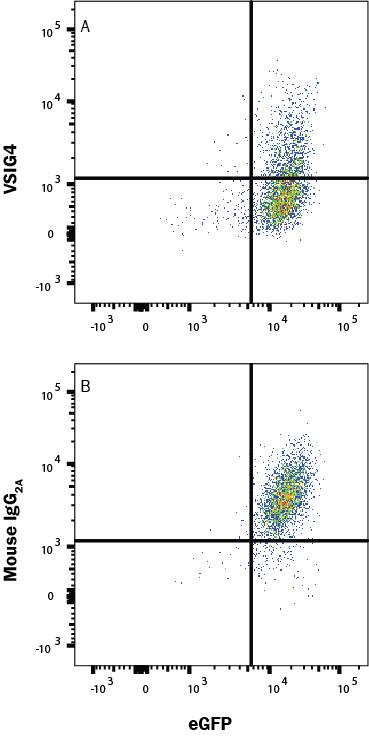
Siglec-7 protein binding to VSIG4-transfected Human Cell Line is Blocked by VSIG4 Antibody. In a functional flow cytometry test.
Recombinant Human Siglec-7/Fc protein (1138-SL) binds to HEK293 human embryonic kidney cell line transfected with recombinant human VSIG4 and eGFP. (A) Binding is completely blocked by 50 µg/mL of Mouse Anti-Human VSIG4 Monoclonal Antibody (Catalog # MAB46462) but not by (B) Mouse IgG2A Isotype Control (MAB003). Protein binding was detected with Mouse Anti-Human IgG Fc APC-conjugated Monoclonal Antibody (FAB110A). Staining was performed using our Staining Membrane-Associated Proteins protocol.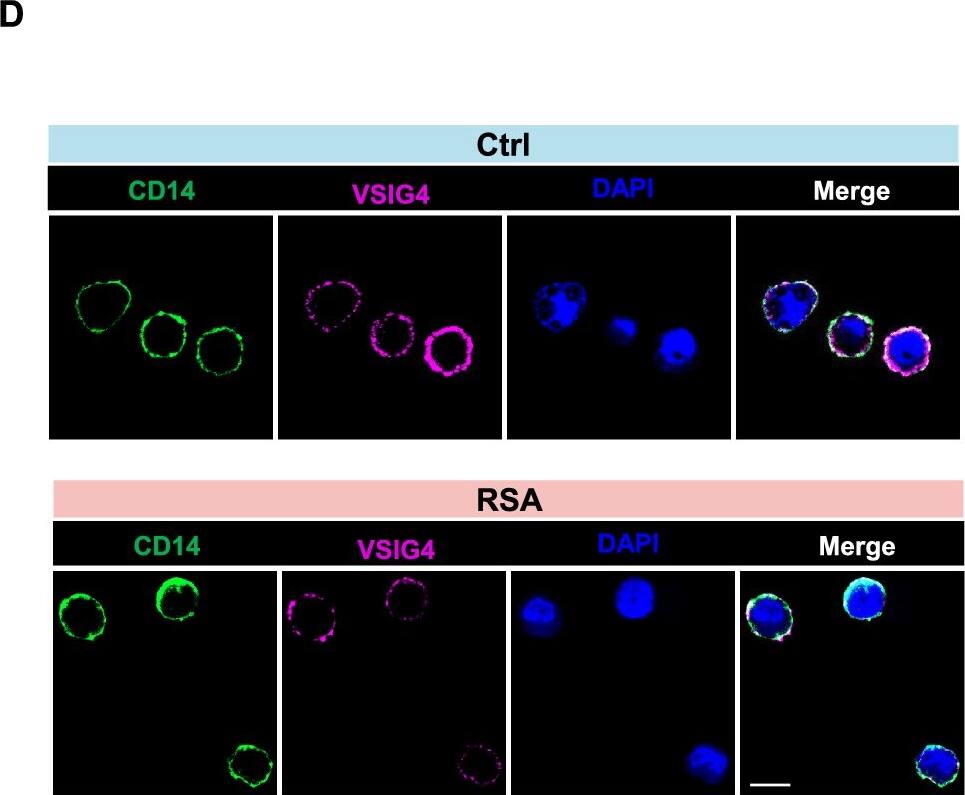
Detection of Human VSIG4 by Immunocytochemistry/ Immunofluorescence
VSIG4 blockade impairs C3b induced macrophages polarization. A Uniform manifold approximation and projection (UMAP) of single-cell RNA-seq from human decidual immune cells isolated from patients with RSA and healthy controls. The single-cell RNA sequencing data used in this study were previously published by Guo [9]. B Feature plot showed ICAM1 and VSIG4 expression in the different clusters between Ctrl vs. RSA as defined in (A). C Gene expression levels of VSIG4 and ICAM1 in decidual macrophages from normal pregnancies and RSA patients. D CLSM images showing the expression of VSIG4 protein in decidual macrophages from normal pregnancies and RSA patients. Scale bars = 5 μm. E Statistical histogram of VSIG4 mean fluorescence intensity of each decidual macrophages from normal pregnancies (n = 3) and RSA patients (n = 3). F Gene expression levels of IL1B, IL6 and TNF in macrophages with or without the addition of VSIG4 blocking antibody during co-culture with dNK. G Representative mean fluorescence intensity of CD80 (upper panel) or CD206 (lower panel) in macrophages with or without the addition of VSIG4 blocking antibody during co-culture with dNK. Experiments were repeated for 3 independent times. P values have been determined by two-tailed paired t-test Image collected and cropped by CiteAb from the following open publication (https://translational-medicine.biomedcentral.com/articles/10.1186/s1296…), licensed under a CC-BY license. Not internally tested by R&D Systems.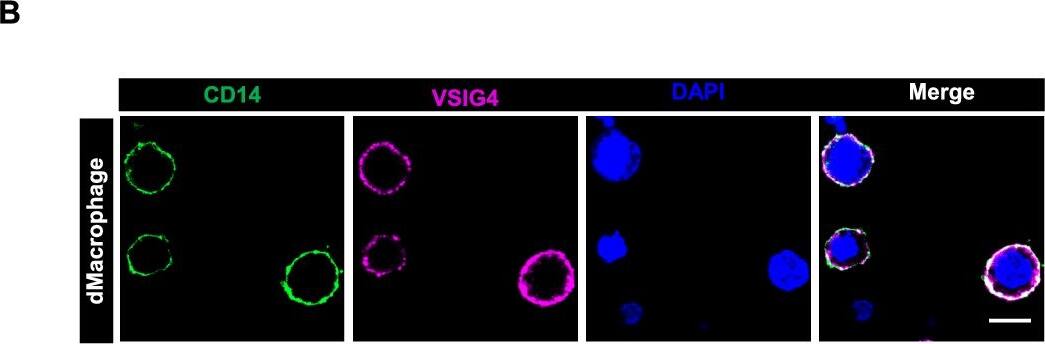
Detection of Human VSIG4 by Immunocytochemistry/ Immunofluorescence
dNK cells from normal pregnancy express the natural ligand of VSIG4. A Gene expression levels of VSIG4 in peripheral blood NK cells (pNK), peripheral blood monocytes (pM), decidual macrophages (dM), and decidual NK cells (dNK). B Fluorescence image depicting the expression of VSIG4 protein on decidual macrophages. C Biological processes that are significantly enriched in Sankey dot pathway enrichment analysis of the upregulated genes of dNK relative to pNK. D Heat map of differential genes in complement and coagulation cascade pathways, n = 3 per group. E Gene set enrichment analysis (GSEA) revealed an increase in complement and coagulation cascade pathways (enrichment plot: COMPLEMENT AND COAGULATION CASCADES PATHWAYS, HSA04610) in dNK cells compared with pNK cells, n = 3 per group. F qPCR validation of the differential expression of the C3 gene in dNK cells and pNK cells. G CLSM images showing the secretion of C3b in pNKs and dNKs. The images were captured using the same parameters. Scale bars = 5 μm. H Statistical histogram of C3b mean fluorescence intensity of each decidual or peripheral NK cell. P values have been determined by two-tailed unpaired t-test Image collected and cropped by CiteAb from the following open publication (https://translational-medicine.biomedcentral.com/articles/10.1186/s1296…), licensed under a CC-BY license. Not internally tested by R&D Systems.Applications for Human VSIG4 Antibody
Application
Recommended Usage
Blockade of Receptor-ligand Interaction
50 µg/mL
Sample: In a functional flow cytometry test, 50 μg/mL of Mouse Anti-Human VSIG4 Antibody(Catalog # MAB46462) will block the binding of Recombinant Human Siglec-7/Fc protein (Catalog # 1138-SL) to HEK293 human embryonic kidney cell line transfected with recombinant human VSIG4.
Sample: In a functional flow cytometry test, 50 μg/mL of Mouse Anti-Human VSIG4 Antibody(Catalog # MAB46462) will block the binding of Recombinant Human Siglec-7/Fc protein (Catalog # 1138-SL) to HEK293 human embryonic kidney cell line transfected with recombinant human VSIG4.
Formulation, Preparation, and Storage
Purification
Protein A or G purified from hybridoma culture supernatant
Reconstitution
Reconstitute at 0.5 mg/mL in sterile PBS. For liquid material, refer to CoA for concentration.
Formulation
Lyophilized from a 0.2 μm filtered solution in PBS with Trehalose. *Small pack size (SP) is supplied either lyophilized or as a 0.2 µm filtered solution in PBS.
Shipping
Lyophilized product is shipped at ambient temperature. Liquid small pack size (-SP) is shipped with polar packs. Upon receipt, store immediately at the temperature recommended below.
Stability & Storage
Use a manual defrost freezer and avoid repeated freeze-thaw cycles.
- 12 months from date of receipt, -20 to -70 °C as supplied.
- 1 month, 2 to 8 °C under sterile conditions after reconstitution.
- 6 months, -20 to -70 °C under sterile conditions after reconstitution.
Background: VSIG4
References
- He, J.Q. et al. (2008) Mol. Immunol. 4041.
- Vogt, L. et al. (2006) J. Clin. Invest. 116:2817.
- Langnaese, K. et al. (2000) Biochim. Biophys. Acta 1492:522.
- Helmy, K. et al. (2006) Cell 124:915.
- Entrez protein Accession # EAX05393, NP_001093901, CAI42052, CAI4205, EAX05394.
- Tanaka, M. et al. (2008) Clin. Exp. Immunol. 154:38.
- Lee, M.Y. et al. (2006) J. Leukoc. Biol. 80:922.
- Gorgani, N.N. et al. (2008) J. Immunol. 181:7902.
- Walker, M.G. (2002) Biochim. Biophys. Acta 1574:387.
- Wiesmann, C. et al. (2006) Nature 444:217.
- Katschke, K.J. et al. (2007) J. Exp. Med. 204:1319.
- Small, A.G. et al. (2016) Swiss Med Wkly. 5:146.
- Roh J. et al. (2017) Oncotarget. 8:58122.
- Kim K.H. et al. (2016) Autophagy. 12:1647.
Long Name
V-Set and Immunoglobulin Domain Containing 4
Alternate Names
Z39IG
Gene Symbol
VSIG4
UniProt
Additional VSIG4 Products
Product Documents for Human VSIG4 Antibody
Product Specific Notices for Human VSIG4 Antibody
For research use only
Loading...
Loading...
Loading...
Loading...