
Human OX40 Ligand/TNFSF4 Antibody
R&D Systems, part of Bio-Techne | Catalog # MAB10541



Scientific images may be resized, cropped, or adjusted for brightness or contrast for presentation purposes. These updates are limited to presentation and do not affect the underlying scientific interpretation of the data. Where available, additional source data may be provided upon request.
Conjugate
Catalog #
Key Product Details
Validated by
Biological Validation
Species Reactivity
Validated:
Human
Cited:
Human
Applications
Validated:
Neutralization, Flow Cytometry, Immunocytochemistry, CyTOF-ready
Cited:
Immunohistochemistry, Neutralization, Flow Cytometry, ELISA Capture
Label
Unconjugated
Antibody Source
Monoclonal Mouse IgG1 Clone # 159403
Product Specifications
Immunogen
Mouse myeloma cell line NS0-derived recombinant human OX40 Ligand
Gln51-Leu183
Accession # P23510
Gln51-Leu183
Accession # P23510
Specificity
Detects human OX40 Ligand in direct ELISAs. In direct ELISAs, no cross-reactivity with recombinant human (rh) APRIL, rhBAFF, rhCD27 Ligand, recombinant mouse (rm) CD27 Ligand, rhCD30 Ligand, rmCD30 Ligand, rhCD40 Ligand, rmEDA, rhFas Ligand, rmFas Ligand, rhGITR Ligand, recombinant cotton rat TNF-alpha, rhTNF-alpha, rmTNF-alpha, recombinant porcine TNF-alpha, recombinant rat TNF-alpha, rhTRAIL, rhTRANCE, rmTRANCE, or rhVEGF is observed.
Clonality
Monoclonal
Host
Mouse
Isotype
IgG1
Endotoxin Level
<0.10 EU per 1 μg of the antibody by the LAL method.
Scientific Data Images for Human OX40 Ligand/TNFSF4 Antibody
Detection of OX40 Ligand/ TNFSF4 in Human Mature Dendritic Cells by Flow Cytometry.
Human mature dentritic cells differentated from human peripheral blood mononuclear cell derived CD14+cells treated with 20 ng/mL Recombinant Human IL-4 (Catalog # 204-IL) and 50 ng/mL Recombinant Human GM-CSF (Catalog # 215-GM) for 7 days and 1 µg/mL LPS, 20 ng/mL Recombinant Human TNF-a (Catalog # 210-TA), and 20 ng/mL Recombinant Human IL-1 beta/IL-1F2 (Catalog # 201-LB) for last 24 hours were stained with Mouse Anti-Human OX40 Ligand/TNFSF4 Monoclonal Antibody(Catalog # MAB10541, filled histogram) or isotype control (Catalog # MAB002, open histogram), followed by Goat F(ab)2 Anti-Mouse IgG (H+L) Allophycocyanin (Catalog # F0101B).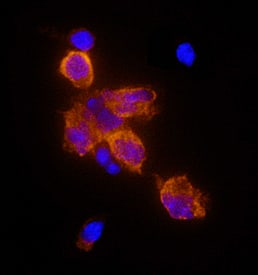
OX40 Ligand/TNFSF4 in Human PBMCs.
OX40 Ligand/TNFSF4 was detected in immersion fixed human peripheral blood mononuclear cells (PBMCs) stimulated with LPS using Mouse Anti-Human OX40 Ligand/ TNFSF4 Monoclonal Antibody (Catalog # MAB10541) at 25 µg/mL for 3 hours at room temperature. Cells were stained using the NorthernLights™ 557-conjugated Anti-Mouse IgG Secondary Antibody (orange; Catalog # NL007) and counterstained with DAPI (blue). View our protocol for Fluorescent ICC Staining of Non-adherent Cells.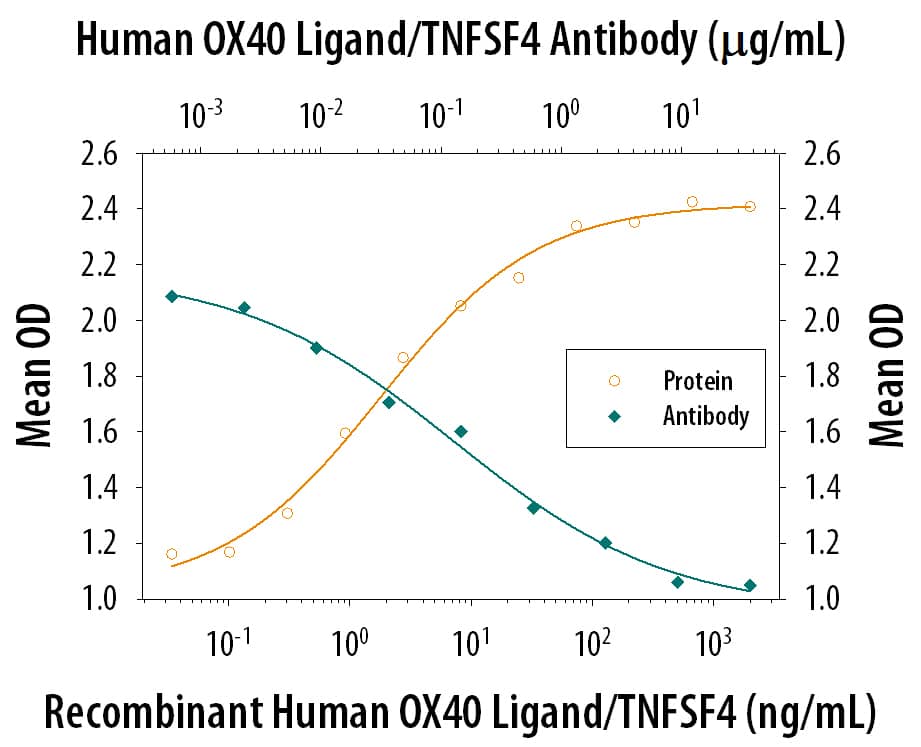
IL‑8 Secretion Induced by OX40 Ligand/TNFSF4 and Neutralization by Human OX40 Ligand/TNFSF4 Antibody.
Recombinant Human OX40 Ligand/TNFSF4 (Catalog # 1054-OX) induces IL-8 secretion in the HT1080 human fibrosarcoma cell line transfected with human OX40 in a dose-dependent manner (orange line) as measured by Human IL-8 Duoset (Catalog # DY208). IL-8 Secretion elicited by Recombinant Human OX40 Ligand/TNFSF4 (10 ng/mL) is neutralized (green line) by increasing concentrations of Mouse Anti-Human OX40 Ligand/TNFSF4 Monoclonal Antibody (Catalog # MAB10541). The ND50 is typically 0.1-0.6 µg/mL.Applications for Human OX40 Ligand/TNFSF4 Antibody
Application
Recommended Usage
CyTOF-ready
Ready to be labeled using established conjugation methods. No BSA or other carrier proteins that could interfere with conjugation.
Flow Cytometry
2.5 µg/106 cells
Sample: Human mature dentritic cells differentated from human peripheral blood mononuclear cell derived CD14+ cells treated with Recombinant Human IL‑4 (Catalog # 204-IL), Recombinant Human GM‑CSF (Catalog # 215-GM), LPS, Recombinant Human TNF‑ alpha (Catalog # 210-TA), and Recombinant Human IL‑1 beta/IL‑1F2 (Catalog # 201-LB)
Sample: Human mature dentritic cells differentated from human peripheral blood mononuclear cell derived CD14+ cells treated with Recombinant Human IL‑4 (Catalog # 204-IL), Recombinant Human GM‑CSF (Catalog # 215-GM), LPS, Recombinant Human TNF‑ alpha (Catalog # 210-TA), and Recombinant Human IL‑1 beta/IL‑1F2 (Catalog # 201-LB)
Immunocytochemistry
8-25 µg/mL
Sample: Immersion fixed human peripheral blood mononuclear cells stimulated with LPS
Sample: Immersion fixed human peripheral blood mononuclear cells stimulated with LPS
Neutralization
Measured by its ability to neutralize OX40 Ligand/TNFSF4-induced IL-8 secretion in the HT1080 human fibrosarcoma cell line transfected with human OX40. Muller, N. et al. (2008) FEBS Journal 275:2296. The Neutralization Dose (ND50) is typically 0.1-0.6 μg/mL in the presence of 10 ng/mL Recombinant Human OX40 Ligand/TNFSF4.
Formulation, Preparation, and Storage
Purification
Protein A or G purified from hybridoma culture supernatant
Reconstitution
Reconstitute at 0.5 mg/mL in sterile PBS. For liquid material, refer to CoA for concentration.
Formulation
Lyophilized from a 0.2 μm filtered solution in PBS with Trehalose. *Small pack size (SP) is supplied either lyophilized or as a 0.2 µm filtered solution in PBS.
Shipping
Lyophilized product is shipped at ambient temperature. Liquid small pack size (-SP) is shipped with polar packs. Upon receipt, store immediately at the temperature recommended below.
Stability & Storage
Use a manual defrost freezer and avoid repeated freeze-thaw cycles.
- 12 months from date of receipt, -20 to -70 °C as supplied.
- 1 month, 2 to 8 °C under sterile conditions after reconstitution.
- 6 months, -20 to -70 °C under sterile conditions after reconstitution.
Background: OX40 Ligand/TNFSF4
OX40 Ligand (OX40L), also known as gp34, is a type II transmembrane glycoprotein designated TNFSF4 within the TNF superfamily. Human OX40L cDNA encodes a 183 amino acids (aa) polypeptide with an amino-terminal cytoplasmic domain (aa 1-23) and a carboxy-terminal extracellular domain (aa 51-183). It shares 46% aa sequence identity with the mouse counterpart. OX40L is expressed on the surface of activated B cells, T cells, dendritic cells and endothelial cells. Like other TNF superfamily members, membrane-bound OX40 Ligand exists as a homotrimer. OX40L binds to OX40 (CD134), a member of the TNF receptor superfamily that is expressed predominantly on activated CD4+ T cells. OX40 Ligand is one of the group of co-stimulatory molecules in the immune system that includes B7, CD40 Ligand, CD30 Ligand, CD27 Ligand and 4-1BB Ligand. OX40 appears as a late activation-induced T cell surface antigen, and its major function of OX40-OX40L interaction may be to transmit a late co-stimulatory signal to promote the survival and proliferation of activated CD4+ T cells and prolong the immune response. Engagement of OX40 on activated T cells in situ in tumors has been shown to augment immune responses and subsequent tumor regression.
References
- Godfrey, W.R. et al. (1994) J. Exp. Med. 180:757.
- Baum, P.R. et al. (1994) EMBO J. 13:3992.
- Al-Shamkhani, A. et al. (1997) J. Biol. Chem. 272:5275.
- Kjaergaard, J. et al. (2000) Cancer Res. 60:5514.
Alternate Names
CD252, gp34, TNFSF4
Gene Symbol
TNFSF4
UniProt
Additional OX40 Ligand/TNFSF4 Products
Product Documents for Human OX40 Ligand/TNFSF4 Antibody
Product Specific Notices for Human OX40 Ligand/TNFSF4 Antibody
For research use only
Loading...
Loading...
Loading...
Loading...
Loading...
Loading...