
Human/Mouse/Rat Glutathione Peroxidase 4/GPX4 Antibody
R&D Systems, part of Bio-Techne | Catalog # MAB5457


Conjugate
Catalog #
Key Product Details
Species Reactivity
Validated:
Human, Mouse, Rat
Cited:
Human, Mouse, Rat, Transgenic Mouse
Applications
Validated:
Western Blot
Cited:
Western Blot
Label
Unconjugated
Antibody Source
Monoclonal Mouse IgG2B Clone # 565320
Product Specifications
Immunogen
E. coli-derived recombinant human Glutathione Peroxidase 4
Gly74-Phe168
Accession # P36969
Gly74-Phe168
Accession # P36969
Specificity
Detects endogenous human, mouse and rat GPX4 in Western blots.
Clonality
Monoclonal
Host
Mouse
Isotype
IgG2B
Scientific Data Images for Human/Mouse/Rat Glutathione Peroxidase 4/GPX4 Antibody
Detection of Human/Mouse/Rat Glutathione Peroxidase 4 by Western Blot.
Western blot shows lysates of mouse, human, and rat liver tissue. PVDF membrane was probed with 0.5 µg/mL of Human/Mouse/Rat Glutathione Peroxidase 4 Monoclonal Antibody (Catalog # MAB5457) followed by HRP-conjugated Anti-Mouse IgG Secondary Antibody (Catalog # HAF007). A specific band was detected for Glutathione Peroxidase 4 at approximately 21 kDa (as indicated). This experiment was conducted under reducing conditions and using Immunoblot Buffer Group 2.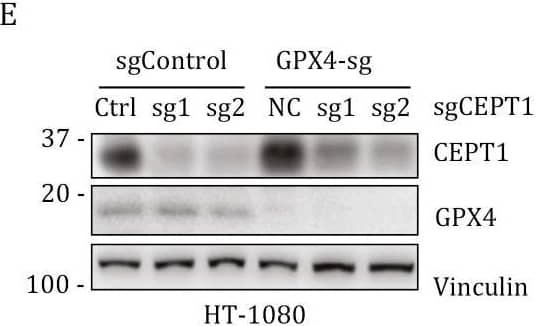
Detection of Glutathione Peroxidase 4/GPX4 by Western Blot
CEPT1 inhibits ferroptosis. (E) Western blot analysis of indicated protein levels in control (sgCtrl) and CEPT1-GPX4 single and double knockout HT-1080 cells. (F and G) Relative lipid peroxidation and cell death by PI staining in the control (sgCtrl) and CEPT1-GPX4 single or double knockout HT-1080 cells with or without 5 µmol/L ferrostatin-1 (Fer-1) for 48 (F) or 72 (G) h. (H) Cell death was measured by PI staining in 786-O cells overexpressing CEPT1 or transfected with empty vector (EV) treated with DMSO or 50 nmol/L RSL3 for 24 h. (I) Cell death was measured by PI staining in 786-O cells overexpressing CEPT1 or transfected with empty vector (EV) cultured in cystine-containing (+Cystine) or cystine-free (−Cystine) medium for 24 h. (J) Cell death was measured by PI staining in 786-O cells overexpressing CEPT1 or transfected with empty vector (EV) with treatment of DMSO or 10 µmol/L erastin for 24 h. (K) Tumor volumes over time in control (sgControl) and CEPT1-knockout (sgCEPT1) HT-1080 cells-derived xenografts under the indicated treatments. (L) End-point weights of HT-1080 xenograft tumors with indicated genotypes treated with IKE or vehicle. (M–O) Representative immunochemical images (M) from HT-1080 xenograft tumors with indicated genotypes treated with IKE or vehicle and corresponding immunoreactive scores of cleaved caspase-3 (N) or 4-HNE (O). Image collected and cropped by CiteAb from the following open publication (https://academic.oup.com/proteincell/article/15/9/686/7618045), licensed under a CC-BY license. Not internally tested by R&D Systems.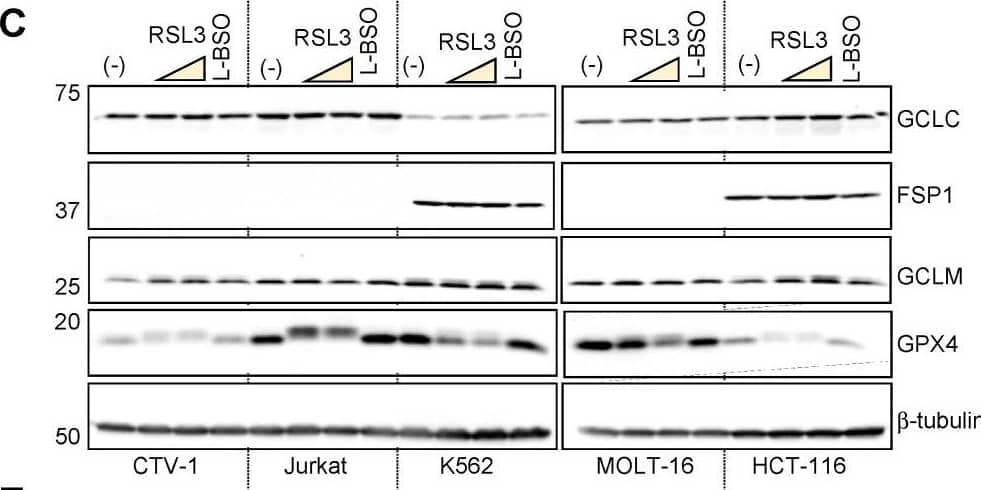
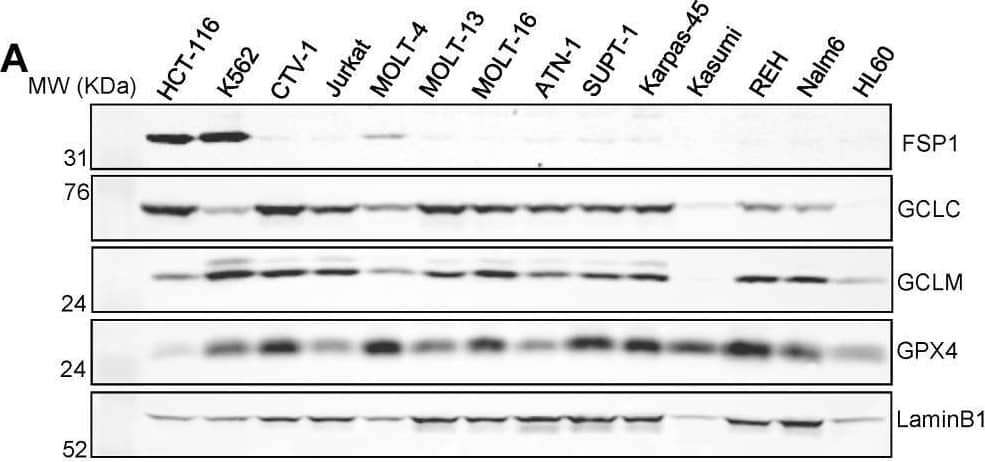
Detection of Glutathione Peroxidase 4/GPX4 by Western Blot
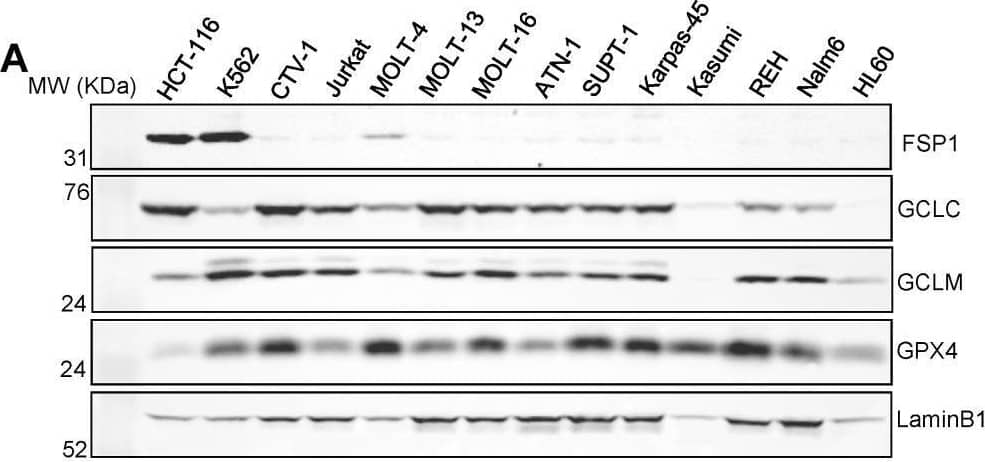
FSP1 is silenced in acute lymphoblastic leukemia (ALL) cell lines. A. Immune blot detection of FSP1, GCLC, GCLM, and GPX4 in total protein extracts from the cell lines depicted in the figure. LaminB1 was used as loading control. B. RT-qPCR analysis of the expression of FSP1 in MOLT-16, CTV-1, Jurkat and HCT-116. Data are plotted as expression relative to the level of RNA detected in MOLT-16 (mean ± SD, one-way ANOVA corrected for multiple comparison using a Tukey test, ****P < 0.0001, ***P = 0.0004). C. Immune blot detection of FSP1, GCLC, GCLM, and GPX4 in total protein extracts from the cell lines exposed to 1S,3S-RSL3 (RSL3) or l-buthionine sulfoximine (L-BSO) for 24 h. The concentrations used were 0.25 and 1 μmol L−1 RSL3 for CTV-1, Jurkat, K562 and HCT-116. For MOLT-16 RSL3 was used at 0.05 and 0.25 μmol L−1. L-BSO was used at 100 μmol L−1 in all the cell lines. D. Quantification of FSP1 immuneblot shown in C. The data plotted correspond to 3 independent biological replicates. b-tubulin was used as loading control. E. Quantification of GCLC, GCLM and GPX4 immuneblots shown in Fig. 3C. The data plotted correspond to 3 independent biological replicates. b-tubulin was used as loading control (mean ± SD; n = 3). Image collected and cropped by CiteAb from the following open publication (https://pubmed.ncbi.nlm.nih.gov/35944469), licensed under a CC-BY license. Not internally tested by R&D Systems.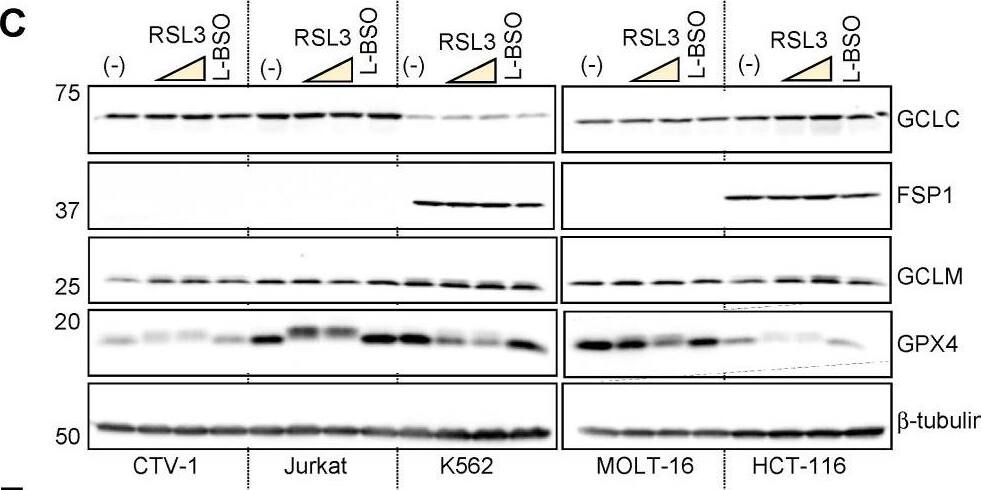
Applications for Human/Mouse/Rat Glutathione Peroxidase 4/GPX4 Antibody
Application
Recommended Usage
Western Blot
0.5 µg/mL
Sample: Mouse, human, and rat liver tissue
Sample: Mouse, human, and rat liver tissue
Formulation, Preparation, and Storage
Purification
Protein A or G purified from hybridoma culture supernatant
Reconstitution
Reconstitute at 0.5 mg/mL in sterile PBS. For liquid material, refer to CoA for concentration.
Formulation
Lyophilized from a 0.2 μm filtered solution in PBS with Trehalose. *Small pack size (SP) is supplied either lyophilized or as a 0.2 µm filtered solution in PBS.
Shipping
Lyophilized product is shipped at ambient temperature. Liquid small pack size (-SP) is shipped with polar packs. Upon receipt, store immediately at the temperature recommended below.
Stability & Storage
Use a manual defrost freezer and avoid repeated freeze-thaw cycles.
- 12 months from date of receipt, -20 to -70 °C as supplied.
- 1 month, 2 to 8 °C under sterile conditions after reconstitution.
- 6 months, -20 to -70 °C under sterile conditions after reconstitution.
Background: Glutathione Peroxidase 4/GPX4
Alternate Names
GPX4, PHGPx, snGPx
Gene Symbol
GPX4
UniProt
Additional Glutathione Peroxidase 4/GPX4 Products
Product Documents for Human/Mouse/Rat Glutathione Peroxidase 4/GPX4 Antibody
Product Specific Notices for Human/Mouse/Rat Glutathione Peroxidase 4/GPX4 Antibody
For research use only
Loading...
Loading...
Loading...
Loading...
Loading...