
Human/Mouse Insulin R/CD220 PE-conjugated Antibody
R&D Systems, part of Bio-Techne | Catalog # FAB1544P


Scientific images may be resized, cropped, or adjusted for brightness or contrast for presentation purposes. These updates are limited to presentation and do not affect the underlying scientific interpretation of the data. Where available, additional source data may be provided upon request.
Conjugate
Catalog #
Key Product Details
Species Reactivity
Validated:
Human, Mouse
Cited:
Human, Mouse
Applications
Validated:
Flow Cytometry
Cited:
Flow Cytometry, Immunocytochemistry
Label
Phycoerythrin (Excitation = 488 nm, Emission = 565-605 nm)
Antibody Source
Polyclonal Goat IgG
Product Specifications
Immunogen
Mouse myeloma cell line NS0-derived recombinant human Insulin R/CD220
His28-Lys944
Accession # NP_001073285
His28-Lys944
Accession # NP_001073285
Specificity
Detects human Insulin R/CD220 in direct ELISAs and Western blots. In direct ELISAs, approximately 20% cross-reactivity with recombinant mouse Insulin R is observed and less than 5% cross-reactivity with recombinant human INSRR is observed.
Clonality
Polyclonal
Host
Goat
Isotype
IgG
Scientific Data Images for Human/Mouse Insulin R/CD220 PE-conjugated Antibody
Detection of Insulin R/CD220 in Human Blood Monocytes by Flow Cytometry.
Human peripheral blood monocytes were stained with Goat Anti-Human/Mouse Insulin R/CD220 PE-conjugated Antigen Affinity-purified Polyclonal Antibody (Catalog # FAB1544P, filled histogram) or isotype control antibody (Catalog # IC108P, open histogram). View our protocol for Staining Membrane-associated Proteins.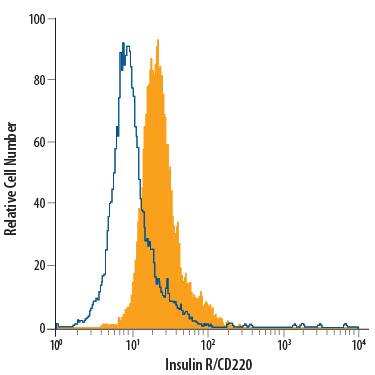
Detection of Insulin R/CD220 in Neuro‑2A Mouse Cell Line by Flow Cytometry.
Neuro-2A mouse neuroblastoma cell line was stained with Goat Anti-Human/Mouse Insulin R/CD220 PE-conjugated Antigen Affinity-purified Polyclonal Antibody (Catalog # FAB1544P, filled histogram) or isotype control antibody (Catalog # IC108P, open histogram). View our protocol for Staining Membrane-associated Proteins.Applications for Human/Mouse Insulin R/CD220 PE-conjugated Antibody
Application
Recommended Usage
Flow Cytometry
10 µL/106 cells
Sample: Human peripheral blood monocytes
Sample: Human peripheral blood monocytes
Reviewed Applications
Read 1 review rated 4 using FAB1544P in the following applications:
Spectra Viewer
Plan Your Experiments
Use our spectra viewer to interactively plan your experiments, assessing multiplexing options. View the excitation and emission spectra for our fluorescent dye range and other commonly used dyes.
Spectra Viewer
Formulation, Preparation, and Storage
Purification
Antigen Affinity-purified
Formulation
Supplied in a saline solution containing BSA and Sodium Azide.
Shipping
The product is shipped with polar packs. Upon receipt, store it immediately at the temperature recommended below.
Stability & Storage
Protect from light. Do not freeze.
- 12 months from date of receipt, 2 to 8 °C as supplied.
Background: Insulin R/CD220
The Insulin Receptor (INS R) and insulin-like growth factor-1 receptor (IGF-1 R) constitute a subfamily of receptor tyrosine kinases (1‑4). The two receptors share structural similarity as well as overlapping intracellular signaling events, and are believed to have evolved through gene duplication from a common ancestral gene. INS R cDNA encodes a type I transmembrane single chain preproprotein with a putative 27 amino acid residues (aa) signal peptide. The large INS R extracellular domain is organized into two successive homologous globular domains, which are separated by a Cysteine-rich domain, followed by three fibronectin type III domains. The intracellular region contains the kinase domain sandwiched between the juxtamembrane domain used for docking insulin-receptor substrates (IRS), and the carboxy-terminal tail that contains two phosphotyrosine-binding sites. After synthesis, the single chain INS R precursor is glycosylated, dimerized and transported to the Golgi apparatus where it is processed at a furin-cleavage site within the middle fibronectin type III domain to generate the mature disulfide-linked alpha2 beta2 tetrameric receptor. The alpha subunit is localized extracellularly and mediates ligand binding while the transmembrane beta subunit contains the cytoplasmic kinase domain and mediates intracellular signaling. As a result of alternative splicing, two INS R isoforms (A and B) that differ by the absence or presence, respectively, of a 12 aa residue sequence in the carboxyl terminus of the alpha subunit exist. Whereas the A isoform is predominantly expressed in fetal tissues and cancer cells, the B isoform is primarily expressed in adult differentiated cells. Both the A and B isoforms bind insulin with high-affinity, but the A isoform has considerably higher affinity for IGF‑I and IGF‑II. Ligand binding induces a conformational change of the receptor, resulting in ATP binding, autophosphorylation, and subsequent downstream signaling. INS R signaling is important in metabolic regulation, but may also contribute to cell growth, differentiation and apoptosis. Mutations in the INS R gene have been linked to insulin-resistant diabetes mellitus, noninsulin-dependent diabetes mellitus and leprechaunism, an extremely rare disorder characterized by abnormal resistance to insulin that results in a variety of distinguishing characteristics, including growth delays and abnormalities affecting the endocrine system. INS R is highly conserved between species, rat INS R shares 94% and 97% aa sequence homology with the human and mouse receptor, respectively.
References
- Nakae, J. et al. (2001) Endoc. Rev. 22:818.
- De Meyts, P. and J. Whittaker (2002) Nature Rev. Drug Disc. 1:769.
- Kim, J.J. and D. Accili (2002) Growth Hormone and IGF Res. 12:84.
- Sciacca, L. et al. (2003) Endocrinology 144:2650.
Long Name
Insulin Receptor
Alternate Names
CD220, INSR, InsulinR
Gene Symbol
INSR
UniProt
Additional Insulin R/CD220 Products
Product Documents for Human/Mouse Insulin R/CD220 PE-conjugated Antibody
Product Specific Notices for Human/Mouse Insulin R/CD220 PE-conjugated Antibody
For research use only
Loading...
Loading...
Loading...
Loading...
Loading...