
Human HepaCAM Antibody
R&D Systems, part of Bio-Techne | Catalog # MAB4108

Conjugate
Catalog #
Key Product Details
Validated by
Biological Validation
Species Reactivity
Validated:
Human
Cited:
Human, Mouse, Transgenic Mouse, Xenograft
Applications
Validated:
Western Blot
Cited:
Immunohistochemistry, Western Blot, Flow Cytometry, Immunocytochemistry, Immunoprecipitation, Bioassay, Cell Culture, Immunopanning
Label
Unconjugated
Antibody Source
Monoclonal Mouse IgG1 Clone # 419305
Product Specifications
Immunogen
Mouse myeloma cell line NS0-derived recombinant human HepaCAM
Val34-Tyr242
Accession # Q14CZ8
Val34-Tyr242
Accession # Q14CZ8
Specificity
Detects human HepaCAM in direct ELISAs and Western blots.
Clonality
Monoclonal
Host
Mouse
Isotype
IgG1
Scientific Data Images for Human HepaCAM Antibody
Detection of Human HepaCAM by Western Blot.
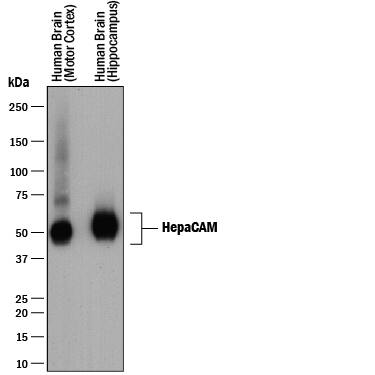
Western blot shows lysates of human brain (motor cortex) tissue and human brain (hippocampus) tissue. PVDF membrane was probed with 0.25 µg/mL of Mouse Anti-Human HepaCAM Monoclonal Antibody (Catalog # MAB4108) followed by HRP-conjugated Anti-Mouse IgG Secondary Antibody (Catalog # HAF018). A specific band was detected for HepaCAM at approximately 45-70 kDa (as indicated). This experiment was conducted under reducing conditions and using Immunoblot Buffer Group 1.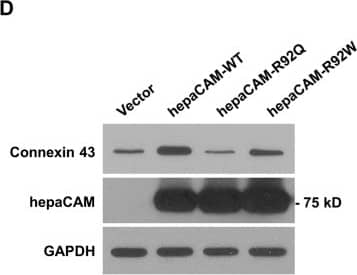
Detection of Human HepaCAM by Western Blot
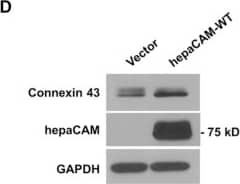
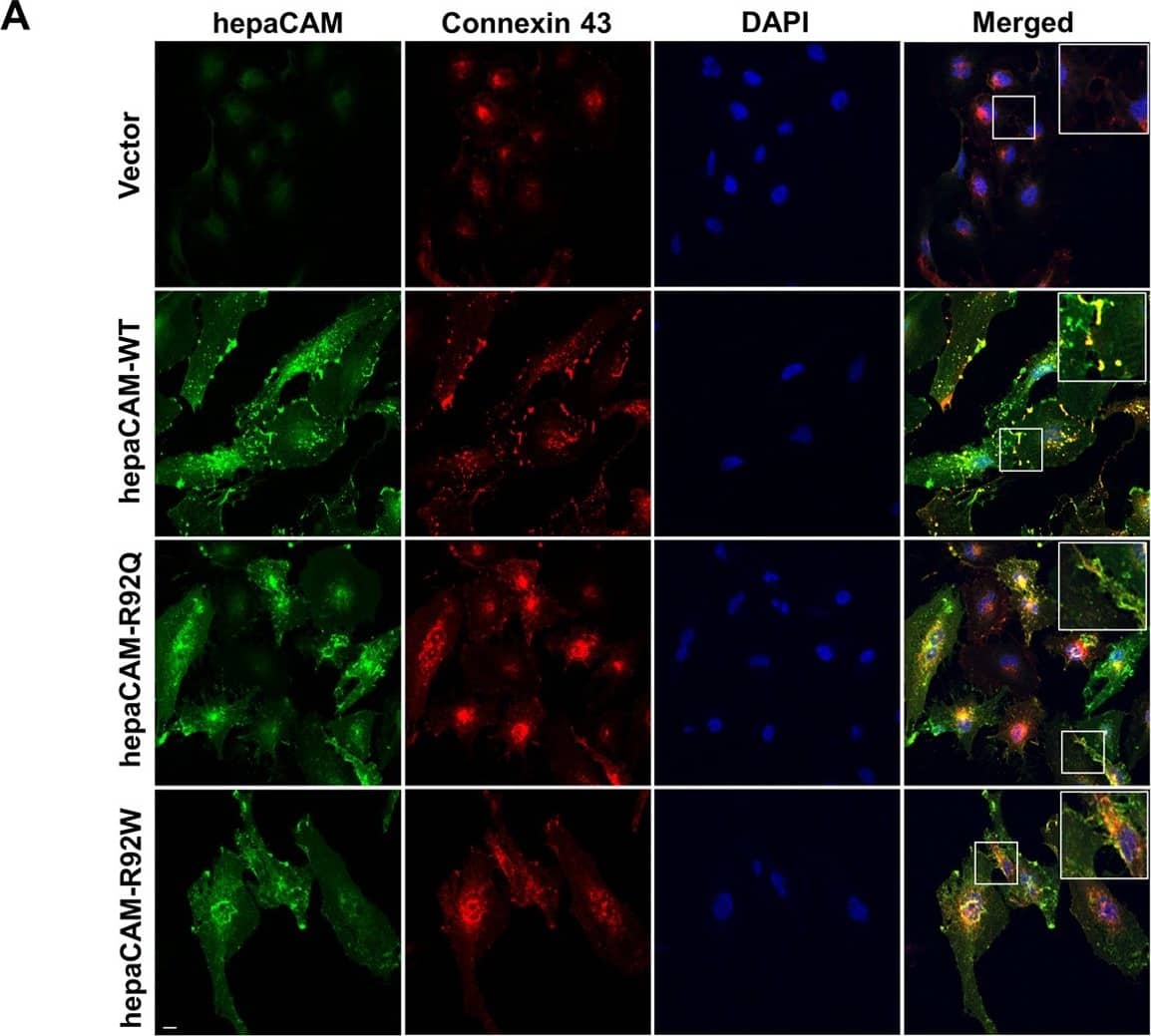
HepaCAM associates with connexin 43.(A) U373 MG cells were stably transfected with pcDNA3.1 vector, wild-type hepaCAM, hepaCAM-R92Q and hepaCAM-R92W. Immunofluorescent staining was performed with antibodies against the hepaCAM cytoplasmic domain (green) and connexin 43 (red). Co-localization of hepaCAM and connexin 43 is indicated by yellow fluorescence. Nuclei were stained with DAPI (blue). Insets show a higher magnification of sites of cell-cell contacts. Cells were visualized by confocal microscopy under a 60× objective. Scale bar: 10 μm. (B) Co-immunoprecipitatation of connexin 43 and hepaCAM. Cell lysates were prepared from U373 MG cells stably transfected with pcDNA3.1 vector and wild-type hepaCAM, and immunoprecipitated with antibody against the hepaCAM extracellular domain (IP hepaCAM). Immunoprecipitation with mouse IgG1 (IP IgG) was included as a negative control. Western blot analysis was performed on the immunoprecipitates and input (3%) using connexin 43 antibody. The efficiency of hepaCAM immunoprecipitation was evaluated with an HRP-conjugated FLAG antibody. The IgG heavy chain detected with an HRP-conjugated anti-mouse antibody is shown as a loading control. (C) Co-immunoprecipitation of wild-type and mutant hepaCAM with connexin 43. Cell lysates were immunoprecipitated with antibody against the hepaCAM extracellular domain (IP hepaCAM). Immunoprecipitation with mouse IgG1 (IP IgG) was included as a negative control. Western blot analysis was performed on the immunoprecipitates and input (2%) using connexin 43 antibody. (D) Expression of wild-type hepaCAM increases connexin 43 protein levels in U373 MG cells. 20 μg of cell lysates were subjected to Western blot analysis. GAPDH was used as a loading control. The result presented is a representative experiment of four independent experiments with similar results. The full view blots are shown in Supplementary Figure 1. (E) Quantification of connexin 43 protein levels in D and in three additional indepe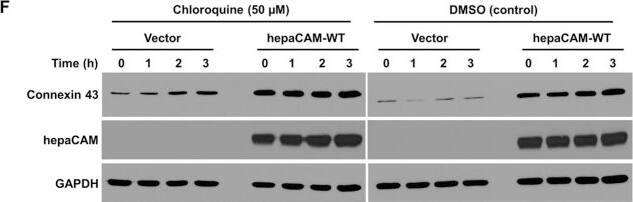
Detection of Human HepaCAM by Western Blot
HepaCAM regulates connexin 43 stability.(A) Evaluation of connexin 43 mRNA expression. Total RNA was analyzed by RT-PCR. GAPDH and no template controls (NTC) were included as housekeeping gene and negative controls, respectively. (B) Evaluation of connexin 43 protein stability by a cycloheximide (CHX) chase assay. Cells treated with CHX (50 μg/ml) for the times indicated were lysed and 30 μg of cell lysates were subjected to Western blot analysis. The result presented is a representative experiment of three independent experiments with similar results. (C) Quantification of all three CHX chase experiments using ImageJ. The densities of the connexin 43 bands were normalized to the densities of the respective GAPDH bands at each time-point. The level of connexin 43 remaining at each time-point was calculated as a percentage of the initial connexin 43 level (time 0 of CHX treatment). The data presented are the means ± SE (n = 3). (D) Expression of hepaCAM in HEK293T cells increases connexin 43 protein levels. HEK293T cells were transiently transfected with pcDNA3.1 vector or wild-type hepaCAM. Two days after transfection, cells were lysed and 60 μg of cell lysates were subjected to Western blot analysis using antibodies against connexin 43 and the hepaCAM extracellular domain. The result presented is a representative experiment of three independent experiments with similar results. (E) Quantification of all three experiments using ImageJ. The densities of the connexin 43 bands were normalized to the densities of the respective GAPDH bands for each sample, and the mean relative density over the three experiments was calculated. The data presented are the means ± SE (n = 3), ***p < 0.0001 as assessed by t-test. (F) HepaCAM slows down connexin 43 turnover by the lysosomal pathway. U373 MG cells stably transfected with pcDNA3.1 vector or wild-type hepaCAM were treated with chloroquine (50 μM) and 30 μg of cell lysates were subjected to Western blot analysis for connexin 43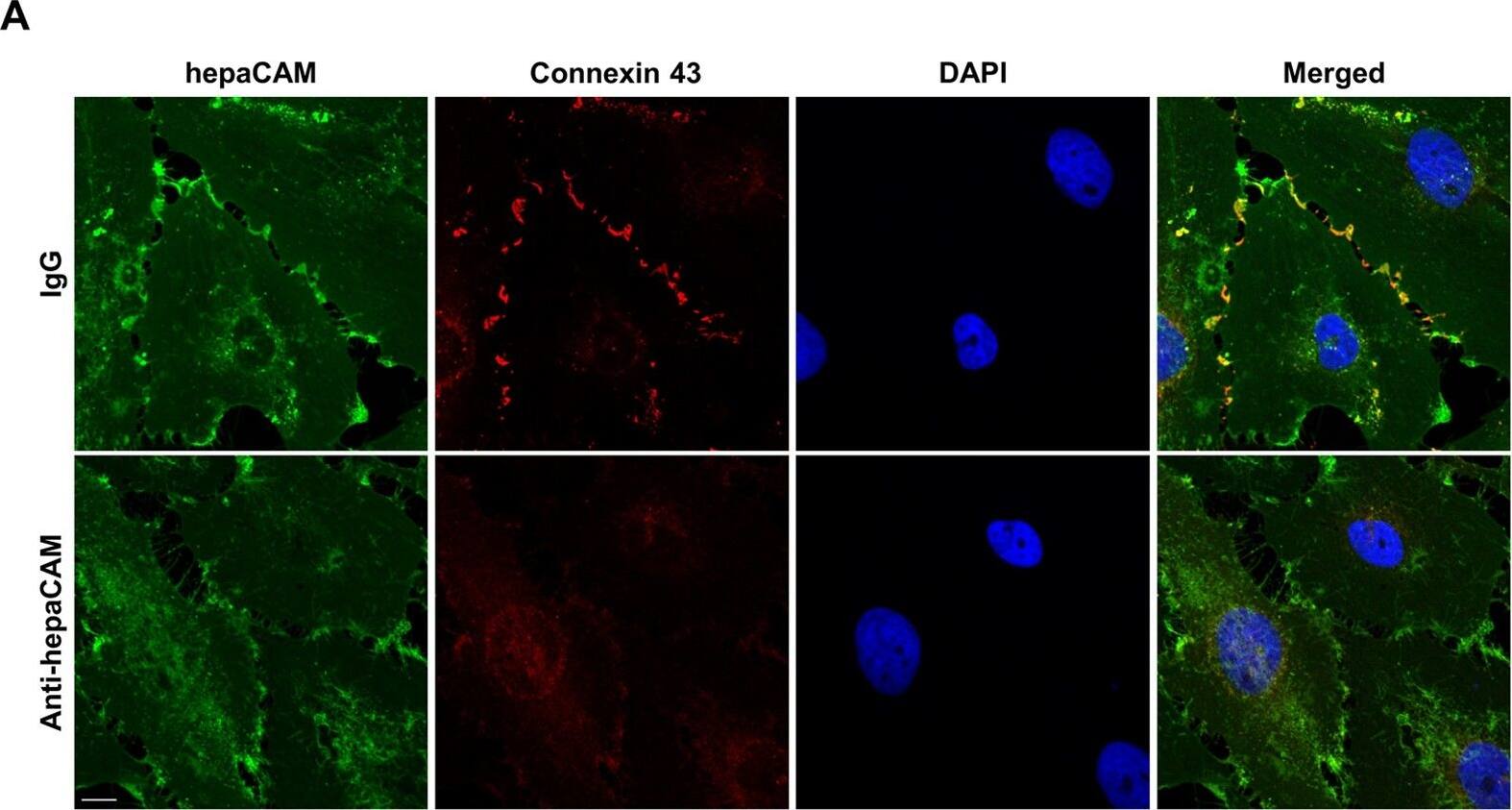
Applications for Human HepaCAM Antibody
Application
Recommended Usage
Western Blot
0.25 µg/mL
Sample: Human brain (motor cortex) tissue and human brain (hippocampus) tissue
Sample: Human brain (motor cortex) tissue and human brain (hippocampus) tissue
Reviewed Applications
Read 1 review rated 4 using MAB4108 in the following applications:
Formulation, Preparation, and Storage
Purification
Protein A or G purified from hybridoma culture supernatant
Reconstitution
Reconstitute at 0.5 mg/mL in sterile PBS. For liquid material, refer to CoA for concentration.
Formulation
Lyophilized from a 0.2 μm filtered solution in PBS with Trehalose. *Small pack size (SP) is supplied either lyophilized or as a 0.2 µm filtered solution in PBS.
Shipping
Lyophilized product is shipped at ambient temperature. Liquid small pack size (-SP) is shipped with polar packs. Upon receipt, store immediately at the temperature recommended below.
Stability & Storage
Use a manual defrost freezer and avoid repeated freeze-thaw cycles.
- 12 months from date of receipt, -20 to -70 °C as supplied.
- 1 month, 2 to 8 °C under sterile conditions after reconstitution.
- 6 months, -20 to -70 °C under sterile conditions after reconstitution.
Background: HepaCAM
HepaCAM (hepatocyte cell adhesion molecule) is a 50-75 kDa, type I transmembrane glycoprotein that belongs to the Ig-superfamily. It forms homodimers on the cell surface and promotes cell spreading and motility. Human HepaCAM is 382 aa in length. It contains a 206 aa extracellular domain (ECD) (aa 35‑240) and a 152 aa cytoplasmic region. The ECD has two C2 Ig-like domains. There is one potential truncated isoform that shows an alternate start site at Met200. Over aa 34‑242, human HepaCAM shares 99% and 98% aa sequence identity with mouse and dog HepaCAM, respectively.
Long Name
Hepatocyte Cell Adhesion Molecule
Alternate Names
cancer susceptibility, FLJ25530, glial cell adhesion molecule, GLIALCAM, hepaCAM, hepatic and glial cell adhesion molecule, hepatocyte cell adhesion molecule, Protein hepaCAM
Entrez Gene IDs
220296 (Human)
Gene Symbol
HEPACAM
UniProt
Additional HepaCAM Products
Product Documents for Human HepaCAM Antibody
Product Specific Notices for Human HepaCAM Antibody
For research use only
Loading...
Loading...
Loading...
Loading...
Loading...