
Human CCL19/MIP-3 beta Antibody
R&D Systems, part of Bio-Techne | Catalog # AF361

Scientific images may be resized, cropped, or adjusted for brightness or contrast for presentation purposes. These updates are limited to presentation and do not affect the underlying scientific interpretation of the data. Where available, additional source data may be provided upon request.
Conjugate
Catalog #
Key Product Details
Validated by
Biological Validation
Species Reactivity
Validated:
Human
Cited:
Human
Applications
Validated:
Western Blot, ELISA Capture (Matched Antibody Pair), Neutralization, Simple Western
Cited:
Immunohistochemistry, Immunocytochemistry, Blocking
Label
Unconjugated
Antibody Source
Polyclonal Goat IgG
Product Specifications
Immunogen
E. coli-derived recombinant human CCL19/MIP-3 beta (R&D Systems, Catalog # 361-MI)
Gly22-Ser98
Accession # Q99731
Gly22-Ser98
Accession # Q99731
Specificity
Detects human CCL19/MIP-3 beta in ELISAs and Western blots. In sandwich immunoassays, less than 0.05% cross-reactivity with recombinant mouse (rm) MIP‑3 beta, recombinant human (rh) GRO alpha, rhHCC-4, rhEotaxin, rmMIP-3 alpha, recombinant rat MIP-3 alpha, and rhMIP-3 alpha is observed.
Clonality
Polyclonal
Host
Goat
Isotype
IgG
Endotoxin Level
<0.10 EU per 1 μg of the antibody by the LAL method.
Scientific Data Images for Human CCL19/MIP-3 beta Antibody
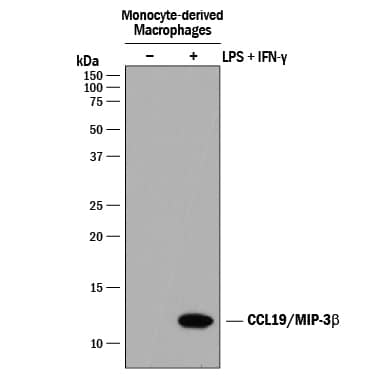
Detection of Human CCL19/MIP‑3 beta by Western Blot.
Western blot shows conditioned media from monocyte-derived macrophages untreated (-) or treated (+) with 1 µg/mL LPS and 40 ng/mL Recombinant Human IFN-gamma (Catalog # 285-IF) for 24 hours. PVDF membrane was probed with 1 µg/mL of Goat Anti-Human CCL19/MIP-3 beta Antigen Affinity-purified Polyclonal Antibody (Catalog # AF361) followed by HRP-conjugated Anti-Goat IgG Secondary Antibody (Catalog # HAF017). A specific band was detected for CCL19/MIP-3 beta at approximately 12 kDa (as indicated). This experiment was conducted under reducing conditions and using Immunoblot Buffer Group 1.
Chemotaxis Induced by CCL19/MIP‑3 beta and Neutrali-zation by Human CCL19/MIP‑3 beta Antibody.
Re-combinant Human CCL19/MIP-3 beta (Catalog # 361-MI) chemoattracts the BaF3 mouse pro-B cell line transfected with human CCR7 in a dose-dependent manner (orange line). The amount of cells that migrated through to the lower chemotaxis chamber was measured by Resazurin (Catalog # AR002). Chemotaxis elicited by Recombinant Human CCL19/MIP-3 beta (50 ng/mL) is neutralized (green line) by increasing concentrations of Human CCL19/MIP-3 beta Antigen Affinity-purified Polyclonal Antibody (Catalog # AF361). The ND50 is typically 2-10 µg/mL.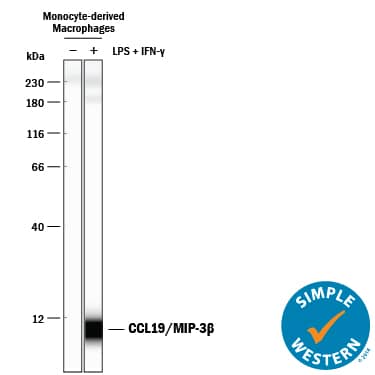
Detection of Human CCL19/MIP‑3 beta by Simple WesternTM.
Simple Western lane view shows conditioned media from monocyte-derived macrophages untreated (-) or treated (+) with 1 µg/mL LPS and 40 ng/mL Recombinant Human IFN-gamma (Catalog # 285-IF) for 24 hours. A specific band was detected for CCL19/MIP-3 beta at approximately 8 kDa (as indicated) using 50 µg/mL of Goat Anti-Human CCL19/MIP-3 beta Antigen Affinity-purified Polyclonal Antibody (Catalog # AF361) followed by 1:50 dilution of HRP-conjugated Anti-Goat IgG Secondary Antibody (Catalog # HAF109). This experiment was conducted under reducing conditions and using the 12-230 kDa separation system.Applications for Human CCL19/MIP-3 beta Antibody
Application
Recommended Usage
Simple Western
50 µg/mL
Sample: Conditioned media from monocyte-derived macrophages treated with Recombinant Human IFN‑ gamma
(Catalog # 285-IF)
Sample: Conditioned media from monocyte-derived macrophages treated with Recombinant Human IFN‑ gamma
(Catalog # 285-IF)
Western Blot
1 µg/mL
Sample: Recombinant Human CCL19/MIP-3 beta (Catalog # 361-MI)
Sample: Recombinant Human CCL19/MIP-3 beta (Catalog # 361-MI)
Neutralization
Measured by its ability to neutralize CCL19/MIP-3 beta-induced chemotaxis in the BaF3 mouse pro-B cell line transfected with human CCR7. The Neutralization Dose (ND50) is typically 2-10 µg/mL in the presence of 50 ng/mL Recombinant Human CCL19/MIP-3 beta.
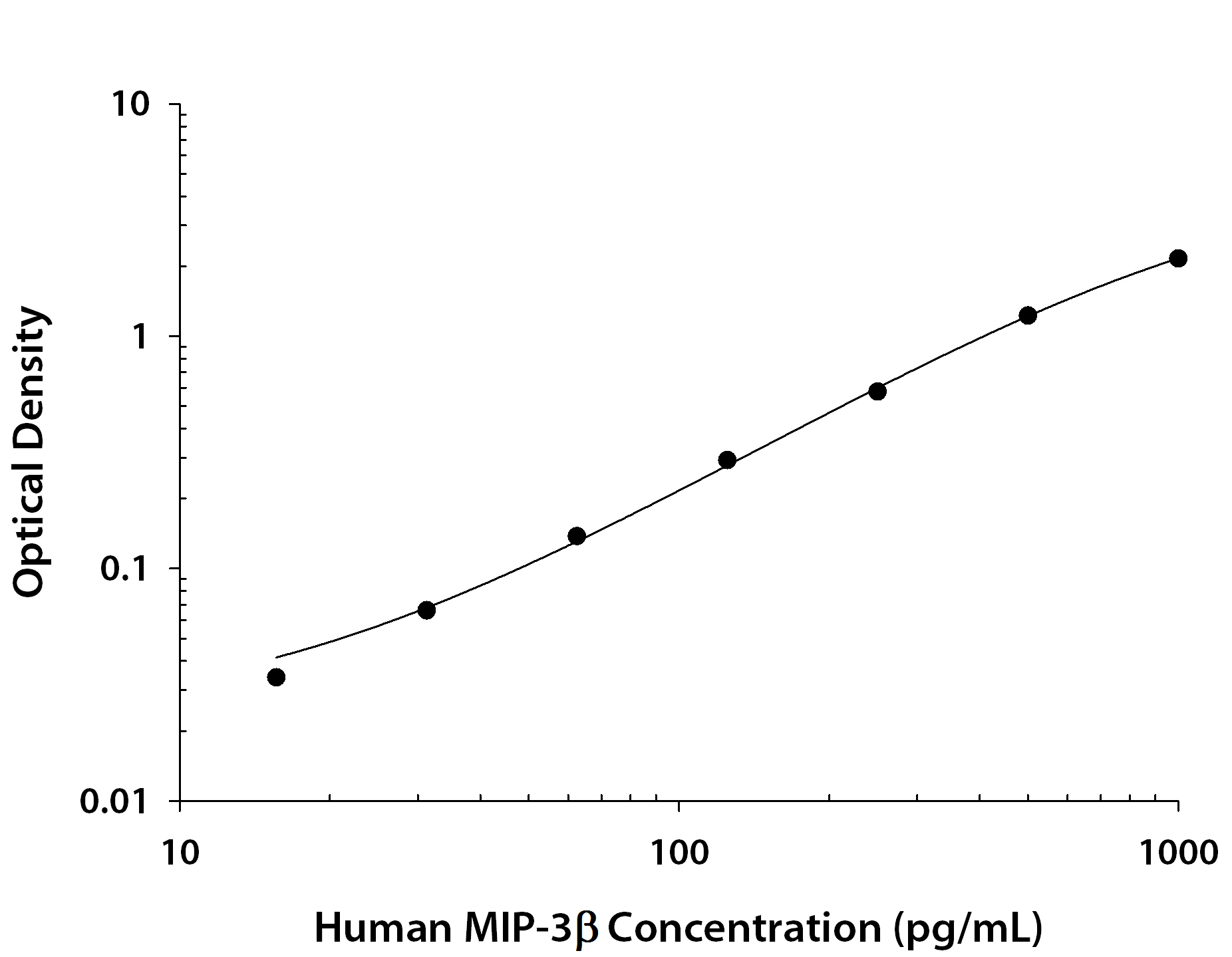
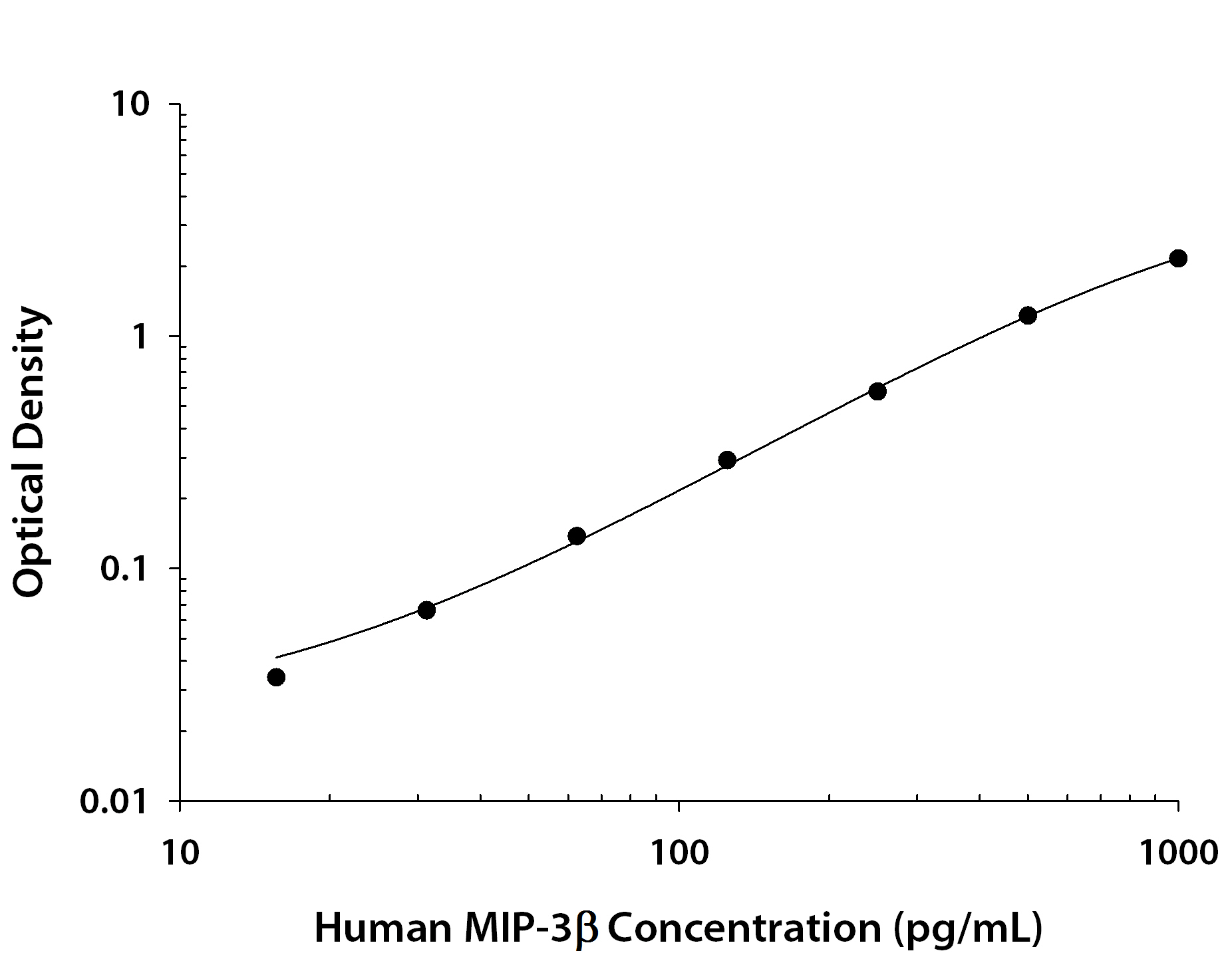
Human CCL19/MIP-3 beta Sandwich Immunoassay
Please Note: Optimal dilutions of this antibody should be experimentally determined.
Reviewed Applications
Read 1 review rated 2 using AF361 in the following applications:
Formulation, Preparation, and Storage
Purification
Antigen Affinity-purified
Reconstitution
Reconstitute at 0.2 mg/mL in sterile PBS. For liquid material, refer to CoA for concentration.
Formulation
Lyophilized from a 0.2 μm filtered solution in PBS with Trehalose. *Small pack size (SP) is supplied either lyophilized or as a 0.2 µm filtered solution in PBS.
Shipping
Lyophilized product is shipped at ambient temperature. Liquid small pack size (-SP) is shipped with polar packs. Upon receipt, store immediately at the temperature recommended below.
Stability & Storage
Use a manual defrost freezer and avoid repeated freeze-thaw cycles.
- 12 months from date of receipt, -20 to -70 °C as supplied.
- 1 month, 2 to 8 °C under sterile conditions after reconstitution.
- 6 months, -20 to -70 °C under sterile conditions after reconstitution.
Background: CCL19/MIP-3 beta
MIP-3 beta, also known as ELC (EBI1-Ligand Chemokine), is one of many novel beta chemokines identified through bioinformatics. MIP-3 beta cDNA encodes a 98 amino acid (aa) residue precursor protein with a predicted 21 aa residue signal peptide that is cleaved to form the 77 aa residue mature secreted protein. MIP-3 beta is distantly related to other beta chemokines (20-30% aa sequence identity) and the gene for MIP-3 beta has been mapped to chromosome 9p13 rather than chromosome 17 where the genes for many human beta chemokines are clustered. MIP-3 beta has been shown to be constitutively expressed in various lymphoid tissues (including thymus, lymph nodes, appendix and spleen). The expression of MIP-3 beta is down-regulated by the anti-inflammatory cytokine IL-10. MIP-3 beta has been shown to be a unique functional ligand for CCR7 (previously referred to as the Epstein-Barr virus-induced gene 1 (EBI1) orphan receptor), a chemokine receptor that is expressed in various lymphoid tissues and activated B and T lymphocytes. EBI1 is strongly up-regulated in B cells infected with Epstein-Barr virus and T cells infected with herpesvirus 6 or 7.
Alternate Names
ELC, MIP-3 beta, MIP3 beta
Gene Symbol
CCL19
UniProt
Additional CCL19/MIP-3 beta Products
Product Documents for Human CCL19/MIP-3 beta Antibody
Product Specific Notices for Human CCL19/MIP-3 beta Antibody
For research use only
Loading...
Loading...
Loading...
Loading...
Loading...