
Human/Mouse/Rat Activin A betaA subunit Antibody
R&D Systems, part of Bio-Techne | Catalog # MAB3381


Conjugate
Catalog #
Key Product Details
Species Reactivity
Validated:
Human, Mouse, Rat
Cited:
Human, Mouse, Rat, Porcine
Applications
Validated:
ELISA Capture (Matched Antibody Pair), Neutralization
Cited:
Immunohistochemistry, Western Blot, Neutralization, Immunocytochemistry, Bioassay, Blocking, ELISA Capture, ELISA Development, In vivo assay, Mass Cytometry
Label
Unconjugated
Antibody Source
Monoclonal Mouse IgG1 Clone # 69403
Product Specifications
Immunogen
Chinese hamster ovary cell line CHO-derived recombinant human Activin A
Specificity
Detects recombinant human Activin A in ELISAs. Also recognizes Activin A precursor. The amino acid sequences of mature betaA subunits from human, mouse and rat are identical. Therefore, this antibody will also detect the mature betaA subunit from mouse and rat.
Clonality
Monoclonal
Host
Mouse
Isotype
IgG1
Endotoxin Level
<0.10 EU per 1 μg of the antibody by the LAL method.
Scientific Data Images for Human/Mouse/Rat Activin A betaA subunit Antibody
Hemoglobin Expression Induced by Activin A and Neutralization by Human/ Mouse/Rat Activin A Antibody.
Recombinant Human/Mouse/ Rat Activin A (Catalog # 338-AC) increases hemoglobin expression in the K562 human chronic myelogenous leukemia cell line in a dose-dependent manner (orange line), as measured by the psuedoperoxidase assay. Hemoglobin Expression elicited by Recombinant Human/Mouse/Rat Activin A (7.5 ng/mL) is neutralized (green line) by increasing concentrations of Goat Anti-Human/Mouse/Rat Activin A betaA subunit Monoclonal Antibody (Catalog # MAB3381). The ND50 is typically 0.02-0.06 µg/mL.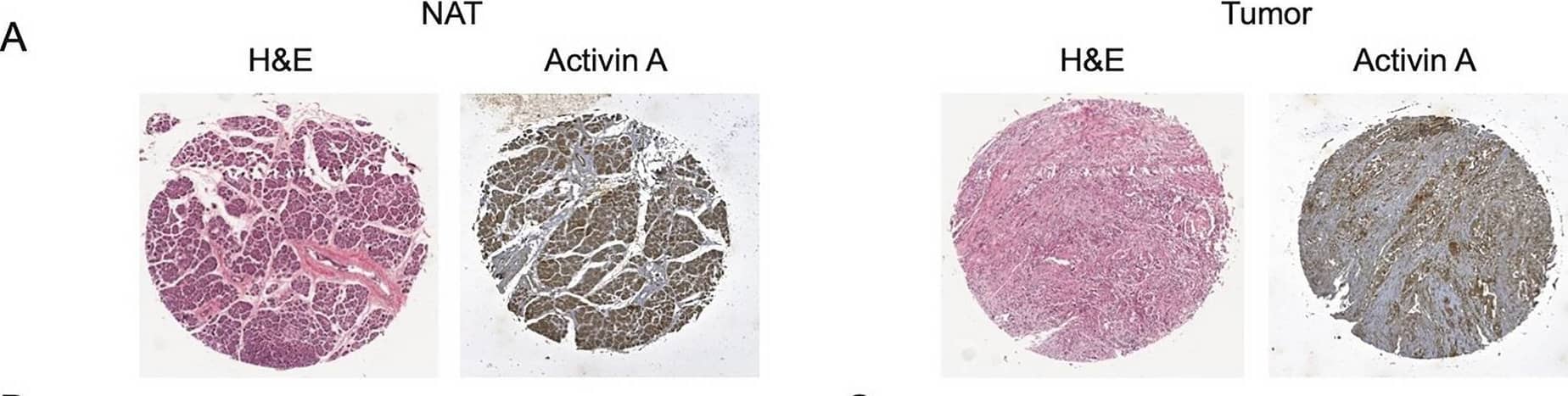
Detection of Activin A betaA subunit by Immunohistochemistry
Activin A levels are significantly higher in tumor tissue and correlate to worse prognosis in PDAC. (A) Representative cores of pancreatic tumors from a human pancreatic tissue microarray stained with H&E to assess the percentage of epithelial versus stromal cells in each core. Adjacent sections were immunostained for activin A expression. (B) Quantification of the percentage of epithelial cells (left panel) or stromal cells (right panel) in normal tissue (white bar) versus tumor tissue (black bar). Statistical analysis is unpaired t-test. (C) Quantification of activin A in TMA (n = 63). An average of the percentage of epithelial and stromal fraction was calculated and scored in each TMA. Comparing epithelial (left panel) and stromal fraction (right panel) in normal tissue (white bar) versus tumor tissue (black bar). Statistical analysis 2-way ANOVA; mean ± SEM, ***(p < 0.001). (D) Kaplan–Meier plots of patient overall survival versus expression of activin A in either epithelial cells (left panel) or stromal cells (right panel). Statistical analysis Log-rank (Mantel-Cox) test, ** (p < 0.01), ***(p < 0.001). Image collected and cropped by CiteAb from the following open publication (https://pubmed.ncbi.nlm.nih.gov/33846512), licensed under a CC-BY license. Not internally tested by R&D Systems.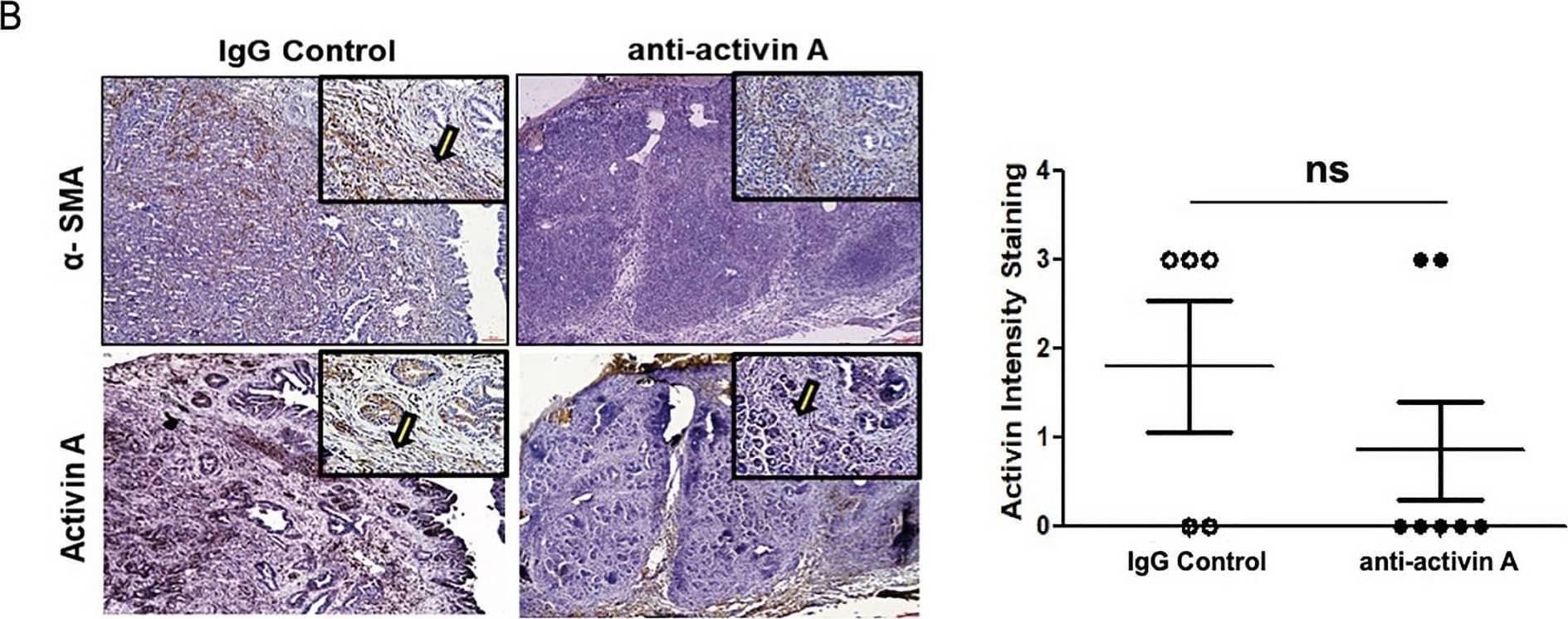
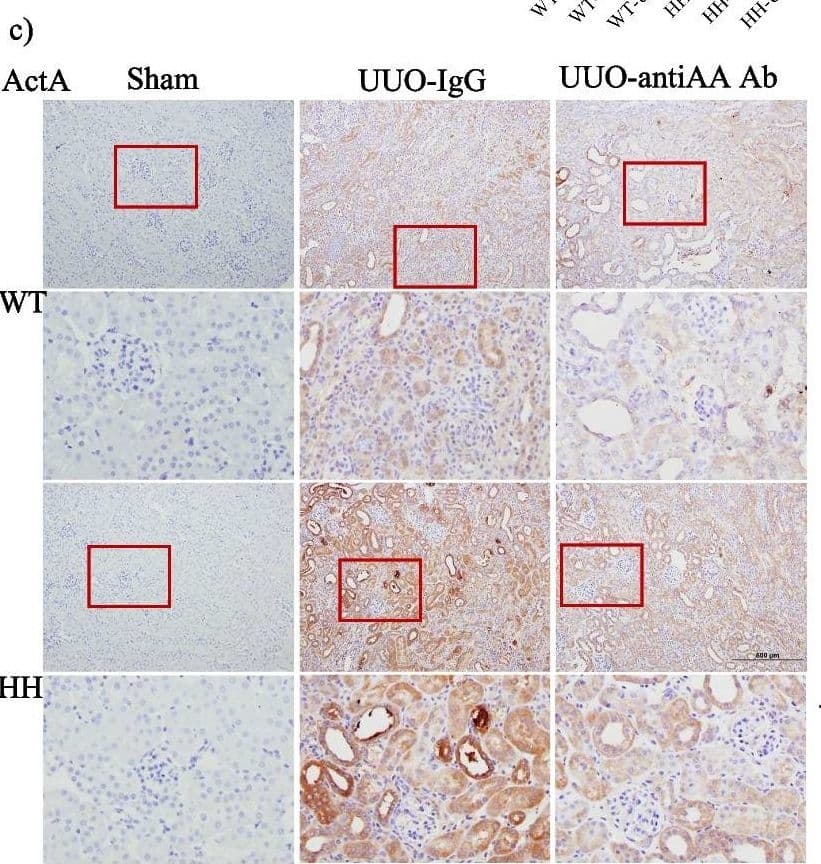
Detection of Activin A betaA subunit by Immunohistochemistry
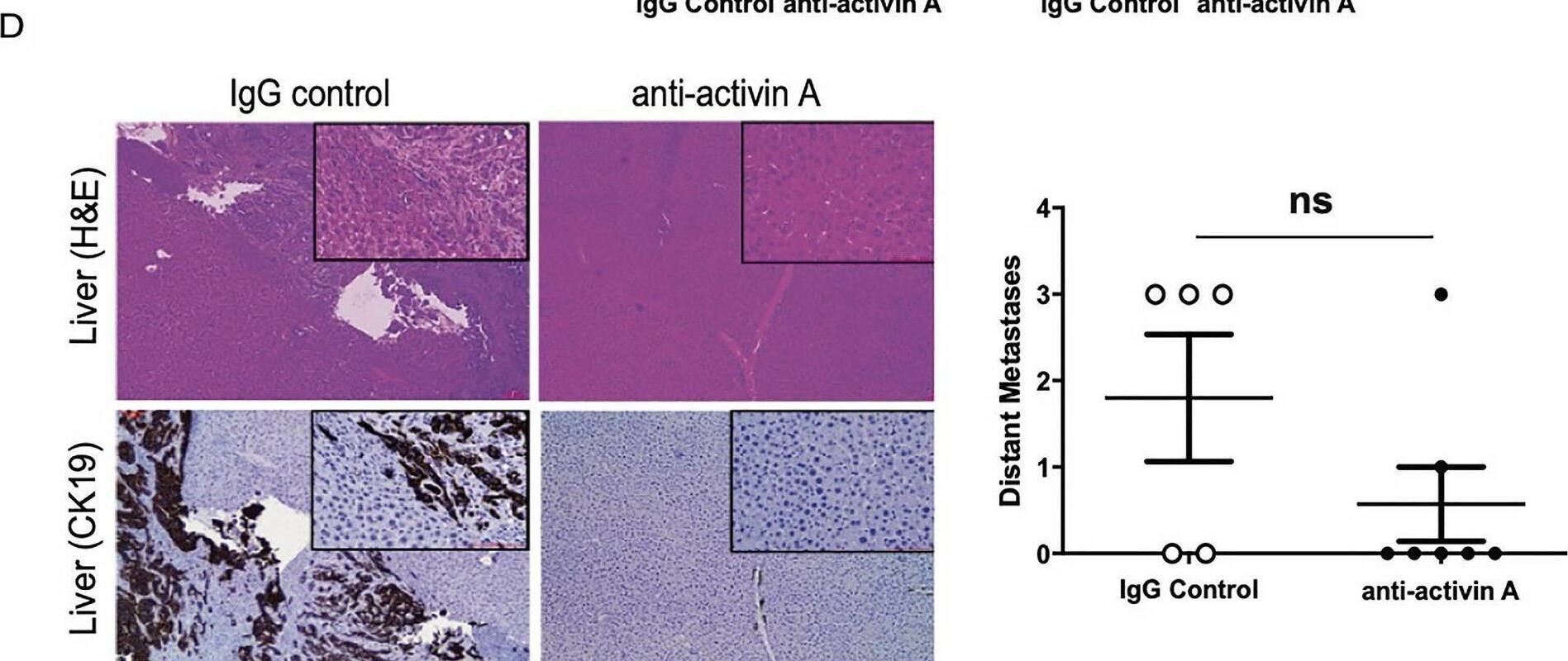
Inhibition of activin A in KPC mice significantly reduces metastasis. (A) Time course of anti-activin A neutralizing antibody injected in mice weekly (2 mg/kg). Control animals were injected with the same concentration of IgG isotype. Remaining animals were collected at the end of week 13 of treatment. (B) Representative image (×4 magnification) of H&E staining of pancreas from control treated (IgG) and anti-activin A treated KPC mice IHC-stained for either alpha-SMA (to indicate stromal cells) or activin A. Representative stromal cells marked by arrows. (C) Representative image (×4 magnification) of H&E staining of pancreas used for quantification of CN (yellow arrow) cystic lesions. Quantification of lesions is documented in both IgG control and anti-activin A antibody treated mice. (D) Left panel: Representative images (×10 and ×40 magnification) of liver tissue from control treated versus anti-activin A treated KPC mice stained with H&E (upper panel) or ductal marker protein CK19 (Lower panel). Right panel: Quantification of distant metastatic formation in the liver tissue of control (n = 5) and treated (n = 7) mice. Statistical analysis unpaired Student t-test (ns: not significant). Image collected and cropped by CiteAb from the following open publication (https://pubmed.ncbi.nlm.nih.gov/33846512), licensed under a CC-BY license. Not internally tested by R&D Systems.


Applications for Human/Mouse/Rat Activin A betaA subunit Antibody
Application
Recommended Usage
Neutralization
Measured by its ability to neutralize Activin A-induced hemoglobin expression in the K562 human chronic myelogenous leukemia cell line. The Neutralization Dose (ND50) is typically 0.02-0.06 µg/mL in the presence of 7.5 ng/mL Recombinant Human/Mouse/Rat Activin A.
Human/Mouse/Rat Activin A Sandwich Immunoassay
Please Note: Optimal dilutions of this antibody should be experimentally determined.
Reviewed Applications
Read 2 reviews rated 5 using MAB3381 in the following applications:
Formulation, Preparation, and Storage
Purification
Protein A or G purified from hybridoma culture supernatant
Reconstitution
Reconstitute at 0.5 mg/mL in sterile PBS. For liquid material, refer to CoA for concentration.
Formulation
Lyophilized from a 0.2 μm filtered solution in PBS with Trehalose. *Small pack size (SP) is supplied either lyophilized or as a 0.2 µm filtered solution in PBS.
Shipping
Lyophilized product is shipped at ambient temperature. Liquid small pack size (-SP) is shipped with polar packs. Upon receipt, store immediately at the temperature recommended below.
Stability & Storage
Use a manual defrost freezer and avoid repeated freeze-thaw cycles.
- 12 months from date of receipt, -20 to -70 °C as supplied.
- 1 month, 2 to 8 °C under sterile conditions after reconstitution.
- 6 months, -20 to -70 °C under sterile conditions after reconstitution.
Background: Activin A betaA subunit
References
- Kumanov, P. et al. (2005) Reprod. Biomed. Online 10:786.
- Maeshima, A. et al. (2008) Endocr. J. 55:1.
- Rodgarkia-Dara, C. et al. (2006) Mutat. Res. 613:123.
- Werner, S. and C. Alzheimer (2006) Cytokine Growth Factor Rev. 17:157.
- Xu, P. and A.K. Hall (2006) Dev. Biol. 299:303.
- Shav-Tal, Y. and D. Zipori (2002) Stem Cells 20:493.
- Chen, Y.G. et al. (2006) Exp. Biol. Med. 231:534.
- Gray, A.M. and A.J. Mason (1990) Science 247:1328.
- Mason, A.J. et al. (1996) Mol. Endocrinol. 10:1055.
- Thompson, T.B. et al. (2004) Mol. Cell. Endocrinol. 225:9.
- Harrison, C.A. et al. (2005) Trends Endocrinol. Metab. 16:73.
- Onichtchouk, D. et al. (1999) Nature 401:480.
- Gray, P.C. et al. (2002) Mol. Cell. Endocrinol. 188:254.
- Kelber, J.A. et al. (2008) J. Biol. Chem. 283:4490.
- Phillips, D.J. et al. (1997) J. Endocrinol. 155:65.
- Schneyer, A. et al. (2003) Endocrinology 144:1671.
Gene Symbol
INHBA
Additional Activin A betaA subunit Products
Product Documents for Human/Mouse/Rat Activin A betaA subunit Antibody
Product Specific Notices for Human/Mouse/Rat Activin A betaA subunit Antibody
For research use only
Loading...
Loading...
Loading...
Loading...