
Recombinant Human FGF-8b Heat Stable Protein, CF New
R&D Systems, part of Bio-Techne | Catalog # BT-FGF8BHS

Key Product Details
Source
E. coli
Conjugate
Unconjugated
Applications
Bioactivity
Product Specifications
Source
E. coli-derived human FGF-8 protein
Proprietary, engineered based on P55075
Proprietary, engineered based on P55075
Purity
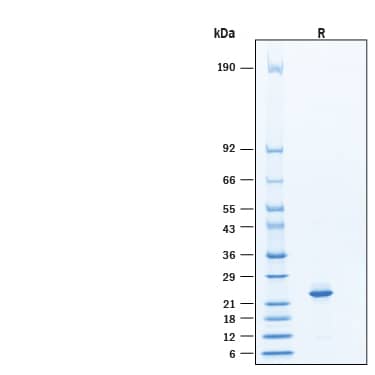
>95%, by SDS-PAGE visualized with Silver Staining and quantitative densitometry by Coomassie® Blue Staining.
Endotoxin Level
<0.10 EU per 1 μg of the protein by the LAL method.
SDS-PAGE
22-27 kDa, under reducing conditions.
Activity
Measured by its ability to activate SRE-SEAP reporter in HEK293 human embryonic kidney cells. The ED50 for this effect is 0.800-8.00 ng/mL.
Scientific Data Images for Recombinant Human FGF-8b Heat Stable Protein, CF
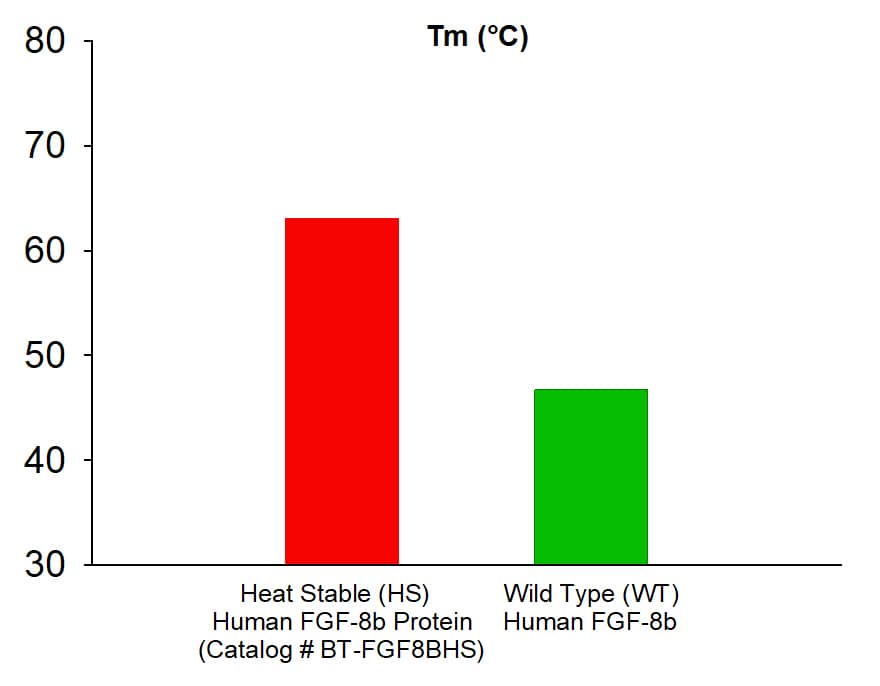
Melting Temperature Comparison of Heat Stable (HS) and Wild-Type (WT) Recombinant Human FGF-8b.
Recombinant Human FGF-8b Heat Stable Protein (Catalog # BT-FGF8BHS) exhibits a higher melting temperature (Tm) than wild-type human FGF-8b. Thermal stability was assessed by Differential Scanning Fluorimetry (DSF).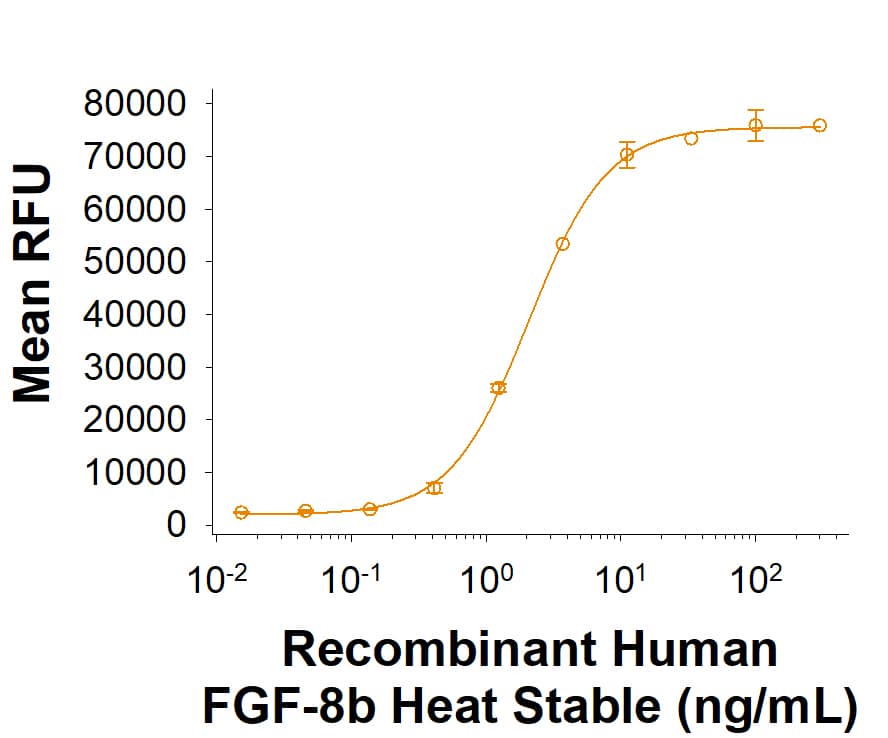
Recombinant Human FGF‑8b Heat Stable Protein Bioactivity.
The bioactivity of Recombinant Human FGF‑8b Heat‑Stable Protein (Catalog # BT-FGF8BHS) is measured by its ability to activate SEAP reporter activity in HEK293 human embryonic kidney cells stably transfected with a secreted alkaline phosphatase (SEAP) reporter gene.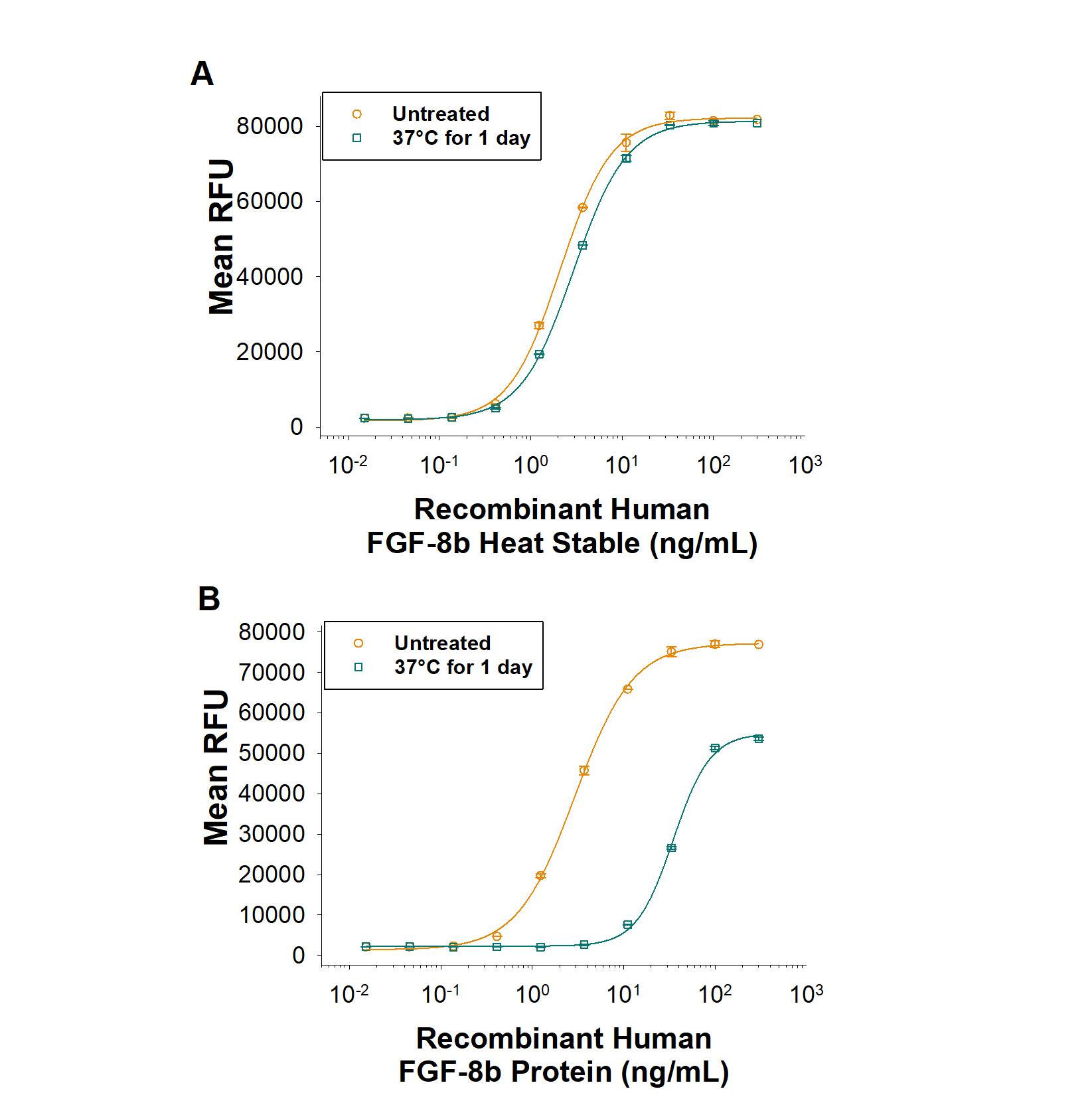
Recombinant Human FGF‑8b Heat Stable Protein Bioactivity.
Recombinant human FGF‑8b activates SEAP reporter activity in HEK293 human embryonic kidney cells stably transfected with a secreted alkaline phosphatase (SEAP) reporter gene. Recombinant human FGF‑8b (A) heat‑stable (Catalog # BT‑FGF8BHS) or (B) wild‑type (423‑F8) proteins were either untreated or incubated at 37 °C for 1 day in cell culture medium prior to assay. Heat‑stable (HS) FGF‑8b retained comparable bioactivity following incubation relative to the untreated control, indicating enhanced thermal stability. In contrast, wild‑type (WT) FGF‑8b exhibited a significant loss of activity after heat‑stress incubation, indicating poorer thermal stability of the WT protein.Formulation, Preparation and Storage
BT-FGF8BHS
| Formulation | Lyophilized from a 0.2 μm filtered solution in MOPS, Na2SO4 and Brij-35 with Trehalose. |
| Reconstitution | Reconstitute at 100 μg/mL in water. |
| Shipping | The product is shipped at ambient temperature. Upon receipt, store it immediately at the temperature recommended below. |
| Stability & Storage | Use a manual defrost freezer and avoid repeated freeze-thaw cycles.
|
Background: FGF-8
FGF-8 is a member of the fibroblast growth factor family that was originally discovered as a growth factor essential for the androgen-dependent growth of mouse mammary carcinoma cells (1-3). Alternate splicing of mouse FGF-8 mRNA generates eight secreted isoforms, designated a-h, but only FGF-8a, b, e and f exist in humans (4). FGF-8 contains a 22 amino acid (aa) signal sequence, an N‑terminal domain that varies according to the isoform (30 aa for FGF-8b; 20 aa for the shortest, FGF-8a), a 125 aa FGF domain and a 37 aa proline‑rich C‑terminal sequence. The FGF domain of FGF-8 shares the most aa identity with FGF17 (75%) and FGF-18 (67%), and the three form an FGF subfamily (2). Mouse FGF-8b shares 100% aa identity with human FGF-8b. FGF-8 is widely expressed during embryogenesis, and mediates epithelial-mesenchymal transitions. It plays an organizing and inducing role during gastrulation, and regulates patterning of the midbrain/hindbrain, eye, ear, limbs and heart in the embryo (2, 5 - 8). The isoforms may play different roles in development. FGF-8b shows the strongest receptor affinity and oncogenic transforming capacity although FGF-8a and FGF-8e are also transforming and have been found in human prostate, breast or ovarian tumors (1, 5, 9-12). FGF-8 shows limited expression in the normal adult, but low levels are found in the reproductive and genitourinary tract, peripheral leukocytes and bone marrow hematopoietic cells (3, 9, 13). Our proprietary Heat Stable FGF-8b (HS) is engineered for superior thermostability compared to the wild-type protein. Additionally, FGF-8b HS retains full bioactivity under heat-challenge conditions in a functional reporter assay.
References
- Mattila, M.M. and P.L. Harkonen (2007) Cytokine Growth Factor Rev. 18:257.
- Reuss, B. and O. von Bohlen und Halbach (2003) Cell Tiss. Res. 313:139.
- Tanaka, A. et al. (1992) Proc. Natl. Acad. Sci. USA 89:8928.
- Gemel, J. et al. (1996) Genomics 35:253.
- Olsen, S.K. et al. (2006) Genes Dev. 20:185.
- Crossley, P.H. et al. (1996) Cell, 84:127.
- Heikinheimo, M. et al. (1994) Mech. Dev. 48:129.
- Sun, X. et al. (1999) Genes Dev. 13:1834.
- Ghosh, A.K. et al. (1996) Cell Growth Differ. 7:1425.
- Mattila, M.M. et al. (2001) Oncogene 20:2791.
- Valve, E. et al. (2000) Int. J. Cancer 88:718.
- Valve, E.M. et al. (2001) Lab. Invest. 81:815.
- Nezu, M. et al. (2005) Biochem. Biophys. Res. Commun. 335:843.
Long Name
Fibroblast Growth Factor 8
Alternate Names
AIGF, FGF8, HBGF-8
Gene Symbol
FGF8
Additional FGF-8 Products
Product Documents for Recombinant Human FGF-8b Heat Stable Protein, CF
Product Specific Notices for Recombinant Human FGF-8b Heat Stable Protein, CF
For research use only
Loading...
Loading...
Loading...
Loading...