
Recombinant Human Erythropoietin Biotinylated Protein, CF New
R&D Systems, part of Bio-Techne | Catalog # BT11264

Key Product Details
Source
CHO
Accession #
Structure / Form
Biotinylated via amines
Conjugate
Biotin
Applications
Bioactivity
Product Specifications
Source
Chinese Hamster Ovary cell line, CHO-derived human Erythropoietin/EPO protein
Ala28-Arg193
Ala28-Arg193
Purity
>95%, by SDS-PAGE visualized with Silver Staining and quantitative densitometry by Coomassie® Blue Staining.
Endotoxin Level
<0.10 EU per 1 μg of the protein by the LAL method.
Predicted Molecular Mass
21 kDa
SDS-PAGE
33-44 kDa, under reducing conditions.
Activity
Measured by its binding ability in a functional ELISA.
Biotinylated Recombinant Human Erythropoietin/EPO binds to Recombinant Human Erythropoietin R Fc Chimera Protein (Catalog # 963-ER) with an ED50 of 4.00-40.0 ng/mL.
Biotinylated Recombinant Human Erythropoietin/EPO binds to Recombinant Human Erythropoietin R Fc Chimera Protein (Catalog # 963-ER) with an ED50 of 4.00-40.0 ng/mL.
Scientific Data Images for Recombinant Human Erythropoietin Biotinylated Protein, CF
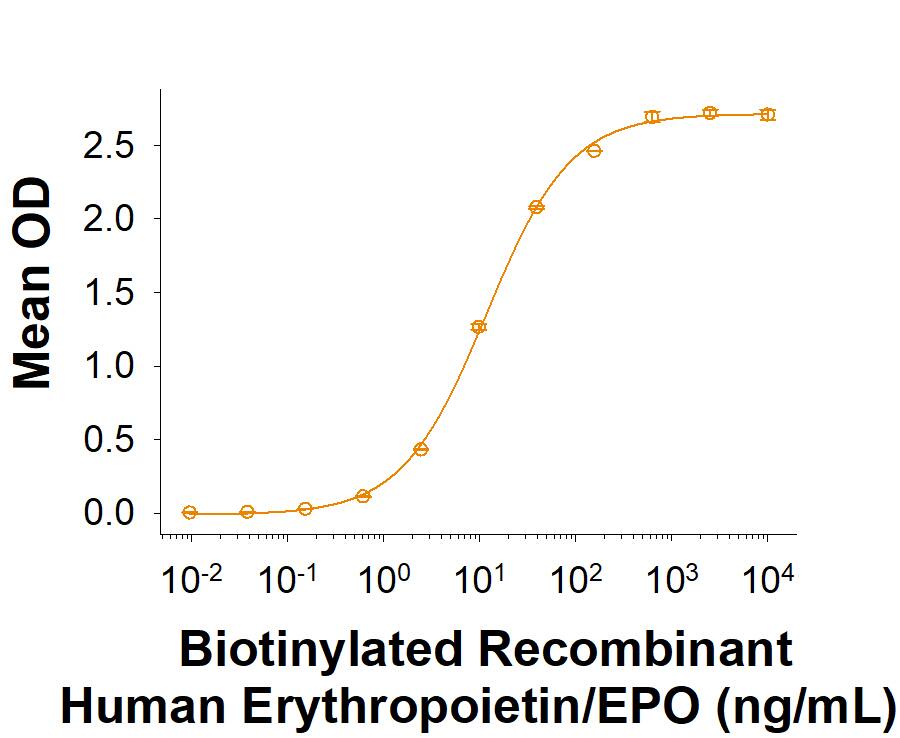
Biotinylated Recombinant Human Erythropoietin/EPO Protein Binding Activity.
Measured by its binding ability in a functional ELISA. Biotinylated Recombinant Human Erythropoietin/EPO Protein (Catalog # BT11264) binds to Recombinant Human Erythropoietin R Fc Chimera Protein (963-ER) with an ED50 of 4.00-40.0 ng/mL.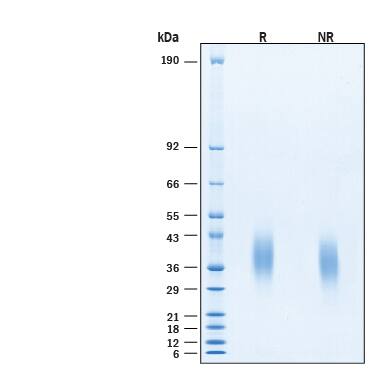
Biotinylated Recombinant Human Erythropoietin/EPO Protein SDS-PAGE.
2 μg/lane of Biotinylated Recombinant Human Erythropoietin/EPO Protein (Catalog # BT11264) was resolved with SDS-PAGE under reducing (R) and non-reducing (NR) conditions and visualized by Coomassie® Blue staining, showing bands at 33-44 kDa under reducing conditions.Formulation, Preparation and Storage
BT11264
| Formulation | Lyophilized from a 0.2 μm filtered solution in PBS with Trehalose. |
| Reconstitution | Reconstitute at 250 μg/mL in water. |
| Shipping | The product is shipped at ambient temperature. Upon receipt, store it immediately at the temperature recommended below. |
| Stability & Storage | Use a manual defrost freezer and avoid repeated freeze-thaw cycles.
|
Background: Erythropoietin/EPO
Erythropoietin (EPO) is a 34 kDa glycoprotein hormone in the type I cytokine family and is related to thrombopoietin (1). Its three N-glycosylation sites, four alpha helices, and N- to C-terminal disulfide bond are conserved across species (2, 3). Glycosylation of the EPO protein is required for biological activities in vivo (4). The mature human EPO protein shares 75% - 84% amino acid sequence identity with bovine, canine, equine, feline, mouse, ovine, porcine, and rat EPO. EPO is primarily produced in the kidney by a population of fibroblast-like cortical interstitial cells adjacent to the proximal tubules (5). It is also produced in much lower, but functionally significant amounts by fetal hepatocytes and in adult liver and brain (6-8). EPO promotes erythrocyte formation by preventing the apoptosis of early erythroid precursors which express the erythropoietin receptor (EPO R) (8, 9). EPO R has also been described in brain, retina, heart, skeletal muscle, kidney, endothelial cells, and a variety of tumor cells (7, 8, 10, 11). Ligand induced dimerization of EPO R triggers JAK2-mediated signaling pathways followed by receptor/ligand endocytosis and degradation (1, 12). Rapid regulation of circulating EPO allows tight control of erythrocyte production and hemoglobin concentrations. Anemia or other causes of low tissue oxygen tension induce erythropoietin production by stabilizing the hypoxia-induceable transcription factors HIF-1 alpha and HIF-2 alpha (1, 6). EPO additionally plays a tissue-protective role in ischemia by blocking apoptosis and inducing angiogenesis (7, 8, 13).
References
- Koury, M.J. (2005) Exp. Hematol. 33:1263.
- Jacobs, K. et al. (1985) Nature 313:806.
- Wen, D. et al. (1993) Blood 82:1507.
- Tsuda E., et al. (1990) Eur. J. Biochem. 188:405.
- Lacombe, C. et al. (1988) J. Clin. Invest. 81:620.
- Eckardt, K.U. and A. Kurtz (2005) Eur. J. Clin. Invest. 35 Suppl. 3:13.
- Sharples, E.J. et al. (2006) Curr. Opin. Pharmacol. 6:184.
- Rossert, J. and K. Eckardt (2005) Nephrol. Dial. Transplant 20:1025.
- Koury, M.J. and M.C. Bondurant (1990) Science 248:378.
- Acs, G. et al. (2001) Cancer Res. 61:3561.
- Hardee, M.E. et al. (2006) Clin. Cancer Res. 12:332.
- Verdier, F. et al. (2000) J. Biol. Chem. 275:18375.
- Kertesz, N. et al. (2004) Dev. Biol. 276:101.
Alternate Names
ECYT5, EPO, MVCD2
Gene Symbol
EPO
UniProt
Additional Erythropoietin/EPO Products
Product Documents for Recombinant Human Erythropoietin Biotinylated Protein, CF
Product Specific Notices for Recombinant Human Erythropoietin Biotinylated Protein, CF
For research use only
Loading...
Loading...
Loading...
Loading...