
Recombinant Human ErbB2/Her2 Fc Biotinylated Protein, CF
R&D Systems, part of Bio-Techne | Catalog # BT1129
Fc Chimera

Key Product Details
- R&D Systems NS0-derived Recombinant Human ErbB2/Her2 Fc Biotinylated Protein (BT1129)
- Quality control testing to verify active proteins with lot specific assays by in-house scientists
- All R&D Systems proteins are covered with a 100% guarantee
Source
NS0
Structure / Form
Disulfide-linked homodimer, Biotinylated via amines
Conjugate
Biotin
Applications
Bioactivity
Product Specifications
Source
Mouse myeloma cell line, NS0-derived human ErbB2/Her2 protein
| Human ErbB2 (Thr23-Thr652) Accession # NP_004439 |
IEGRMD | Human IgG1 (Pro100-Lys330) |
6-His tag |
| N-terminus | C-terminus | ||
Purity
>90%, by SDS-PAGE visualized with Silver Staining and quantitative densitometry by Coomassie® Blue Staining.
Endotoxin Level
<0.10 EU per 1 μg of the protein by the LAL method.
N-terminal Sequence Analysis
Thr23
Predicted Molecular Mass
97 kDa
SDS-PAGE
105-130 kDa, under reducing conditions.
Activity
Measured by its binding ability in a functional ELISA.
Biotinylated Recombinant Human ErbB2/Her2 Fc Chimera (Catalog # BT1129) binds to Human ErbB2/Her2 (Research Grade Trastuzumab Biosimilar) Antibody (Catalog # MAB9589) with an ED50 of 0.500-6.00 ng/mL.
Biotinylated Recombinant Human ErbB2/Her2 Fc Chimera (Catalog # BT1129) binds to Human ErbB2/Her2 (Research Grade Trastuzumab Biosimilar) Antibody (Catalog # MAB9589) with an ED50 of 0.500-6.00 ng/mL.
Scientific Data Images for Recombinant Human ErbB2/Her2 Fc Biotinylated Protein, CF
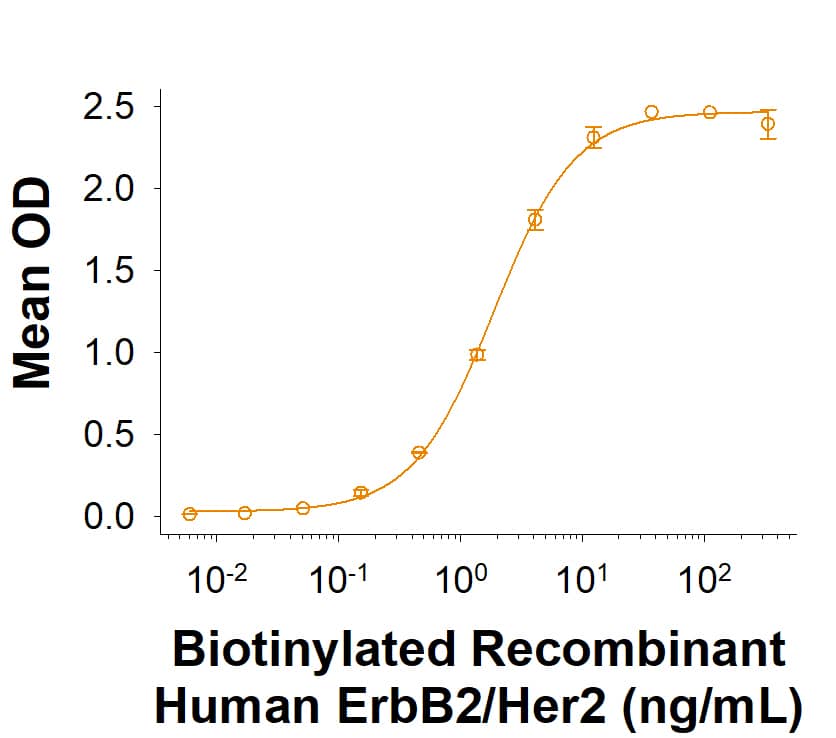
Biotinylated Recombinant Human ErbB2/Her2 Fc Chimera Protein Binding Activity.
In a functional ELISA, Biotinylated Recombinant Human ErbB2/Her2 Fc Chimera Protein (Catalog # BT1129) binds to Human ErbB2/Her2 (Research Grade Trastuzumab Biosimilar) Antibody (MAB9589) with an ED50 of 0.500-6.00 ng/mL.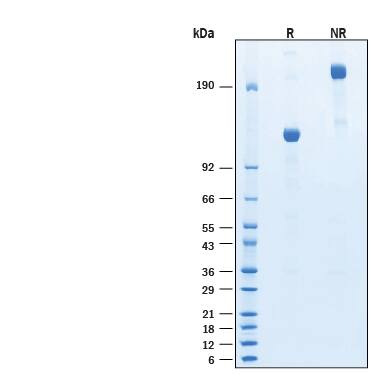
Biotinylated Recombinant Human ErbB2/Her2 Fc Chimera Protein SDS-PAGE.
2 μg/lane of Biotinylated Recombinant Human ErbB2/Her2 Fc Chimera Protein (Catalog # BT1129) was resolved with SDS-PAGE under reducing (R) and non-reducing (NR) conditions and visualized by Coomassie® Blue staining, showing bands at 105-130 kDa and 210-260 kDa, respectively.Formulation, Preparation and Storage
BT1129
| Formulation | Lyophilized from a 0.2 μm filtered solution in PBS with Trehalose. |
| Reconstitution | Reconstitute at 500 μg/mL in water. |
| Shipping | The product is shipped at ambient temperature. Upon receipt, store it immediately at the temperature recommended below. |
| Stability & Storage | Use a manual defrost freezer and avoid repeated freeze-thaw cycles.
|
Background: ErbB2/Her2
ErbB2, also called Neu and Her2 (human epidermal growth factor receptor 2), is a type I membrane glycoprotein that is a member of the ErbB family of tyrosine kinase receptors. ErbB family members serve as receptors for the epidermal growth factor (EGF) family of growth factors. ErbB2 is widely expressed in epithelial cells and has also been found to be over-expressed in a large number of breast carcinomas. Among ErbB family members, ErbB2 is unique in that it has no identified ligands. Rather, ErbB2 heterodimerizes with the other members of the ErbB family (ErbB1 (EGFR), ErbB3, ErbB4) to form higher affinity signaling complexes. Because ErbB3 contains a defective kinase domain, the kinase domain of ErbB2 is responsible for initiating the tyrosine phosphorylation signal through the heterodimeric receptor. It has been found that a discrete three amino acid signal in the ErbB3 cytoplasmic domain is critical for transactivation of ErbB2. Interestingly, this same three amino acid signal has also been found in ErbB1 and ErbB4. Phosphoinositide 3-kinase has been shown to play a role in ErbB2 signal transduction. The cytoplasmic domain of ErbB2 has been shown to associate with beta-catenin and plakoglobin. Human ErbB2 consists of 1255 amino acids (aa) with a 21 aa signal sequence, a 631 aa extracellular domain, a 23 aa transmembrane region, and a 580 aa cytoplasmic domain. ErbB2 can be shed from the cell surface by proteolytic cleavage by an unidentified protease. ErbB2 appears to play roles in development, cancer, communication at the neuromuscular junction and regulation of cell growth and differentiation (1-10).
References
- Coussens, L. et. al. (1985) Science 230:1132.
- Yamamoto, T. et. al. (1986) Nature 319:230.
- Kanai, Y. et. al. (1995) Biochem. Biophys. Res. Commun. 208:1067.
- Codony-Servat, J. et. al. (1999) Cancer Res. 59:1196.
- Carraway, K.L. 3rd et. al. (1994) J. Biol. Chem. 269:14303.
- Emkey, R. and C.R. Kahn (1997) J. Biol. Chem. 272:31172.
- Schaefer, G. et. al. (1999) J. Biol. Chem. 274:859.
- Schlessinger, J. (2000) Cell 103:211.
- Hellyer, N.J. et. al. (2001) J. Biol. Chem. 276:42153.
- Daly, R.J. (1999) Growth Factors 16:255.
Long Name
Receptor Tyrosine Protein Kinase ErbB2
Alternate Names
CD340, HER2, Neu Oncogene, NGL, TKR1
Gene Symbol
ERBB2
Additional ErbB2/Her2 Products
Product Documents for Recombinant Human ErbB2/Her2 Fc Biotinylated Protein, CF
Product Specific Notices for Recombinant Human ErbB2/Her2 Fc Biotinylated Protein, CF
For research use only
Loading...
Loading...
Loading...
Loading...