
Rat CD44 PE-conjugated Antibody
R&D Systems, part of Bio-Techne | Catalog # FAB6577P

Discontinued Product
FAB6577P has been discontinued.
View all CD44 products.
Key Product Details
Species Reactivity
Rat
Applications
Flow Cytometry
Label
Phycoerythrin (Excitation = 488 nm, Emission = 565-605 nm)
Antibody Source
Monoclonal Mouse IgG2B Clone # 740017
Product Specifications
Immunogen
Mouse myeloma cell line NS0-derived recombinant rat CD44
Gln22-Thr223 (predicted)
Accession # P26051
Gln22-Thr223 (predicted)
Accession # P26051
Specificity
Detects rat CD44 in direct ELISAs. In direct ELISAs, no cross-reactivity with recombinant
human, mouse, or porcine CD44 is observed.
Clonality
Monoclonal
Host
Mouse
Isotype
IgG2B
Scientific Data Images for Rat CD44 PE-conjugated Antibody
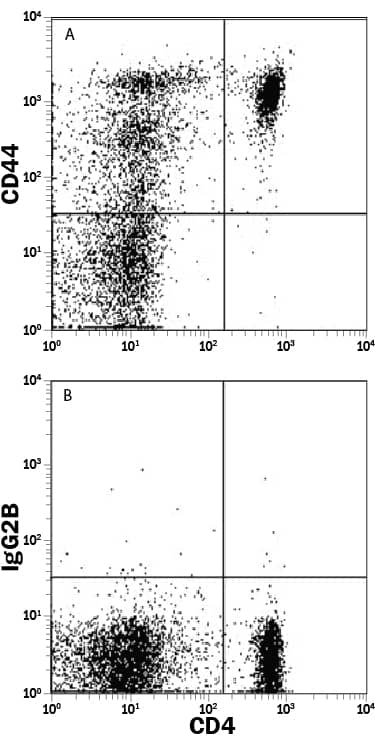
Detection of CD44 in Rat Splenocytes by Flow Cytometry.
Rat splenocytes were stained with Anti-Rat CD4 APC-conjugated Monoclonal Antibody and either (A) Mouse Anti-Rat CD44 PE-conjugated Monoclonal Antibody (Catalog # FAB6577P) or (B) Mouse IgG2BPhycoerythrin Isotype Control (Catalog # IC0041P). View our protocol for Staining Membrane-associated Proteins.Applications for Rat CD44 PE-conjugated Antibody
Application
Recommended Usage
Flow Cytometry
10 µL/106 cells
Sample: Rat splenocytes
Sample: Rat splenocytes
Spectra Viewer
Plan Your Experiments
Use our spectra viewer to interactively plan your experiments, assessing multiplexing options. View the excitation and emission spectra for our fluorescent dye range and other commonly used dyes.
Spectra Viewer
Formulation, Preparation, and Storage
Purification
Protein A or G purified from hybridoma culture supernatant
Formulation
Supplied in a saline solution containing BSA and Sodium Azide.
Shipping
The product is shipped with polar packs. Upon receipt, store it immediately at the temperature recommended below.
Stability & Storage
Store the unopened product at 2 - 8° C. Do not use past expiration date. Protect from light.
Background: CD44
CD44 is a ubiquitously expressed protein that is a major receptor for hyaluronan and exerts control over cell growth and migration (1-5). Mouse CD44 has a 22 amino acid (aa) signal sequence, an extracellular domain (ECD) that contains a 100 aa hyaluronan-binding disulfide-stabilized link region plus a 48-463 aa stem region, a 21 aa transmembrane domain, and a 72 aa cytoplasmic domain. Within the stem, ten variably spliced exons (v1-10, exons 6-15) produce multiple protein isoforms (1‑5). The standard or hematopoietic form, CD44H, does not include the variable segments (1‑5). Cancer aggressiveness and T cell activation have been correlated with expression of specific isoforms (2, 4). With variable N- and O-glycosylation and splicing within the stalk, CD44 can range from 80 to 200 kDa (1, 2). Within the N‑terminal invariant portion of the ECD (aa 23-222), rat CD44 shares 91% and 75% aa sequence identity with corresponding mouse and human CD44, respectively. The many reported functions of CD44 fall within three categories (1, 2). First, CD44 binds hyaluronan and other ligands within the extracellular matrix and can function as a “platform” for growth factors and metalloproteinases. Second, CD44 is a co-receptor that modifies activity of receptors including MET and the ErbB family of tyrosine kinases. Third, the CD44 intracellular domain links the plasma membrane to the actin cytoskeleton via the ERM proteins, ezrin, radixin and moesin. CD44 can be synthesized in a soluble form (4) or may be cleaved at multiple sites by either membrane-type matrix metalloproteinases, or ADAM proteases to produce soluble ectodomains (6, 7). The cellular portion may then undergo gamma secretase-dependent intramembrane cleavage to form an A beta‑like transmembrane portion and a cytoplasmic signaling portion that affects gene expression (8, 9). These cleavage events are thought to promote metastasis by enhancing tumor cell motility and growth (1, 2, 6).
References
- Pure, E. and R.K. Assoian (2009) Cell. Signal. 21:651.
- Ponta, H. et al. (2003) Nat. Rev. Mol. Cell Biol. 4:33.
- Screaton, G.R. et al. (1992) Proc. Natl. Acad. Sci. USA 89:12160.
- Lynch, K.W. (2004) Nat. Rev. Immunol. 4:931.
- Yu, Q. and B.P. Toole (1996) J. Biol. Chem. 271:20603.
- Nagano, O. and H. Saya (2004) Cancer Sci. 95:930.
- Nakamura, H. et al. (2004) Cancer Res. 64:876.
- Murakami, D. et al. (2003) Oncogene 22:1511.
- Lammich, S. et al. (2002) J. Biol. Chem. 277:44754.
Alternate Names
CD44, ECMR-III, HCAM, HCELL, LHR, MDU2, MDU3, MIC4, MUTCH-I, Pgp1
Gene Symbol
CD44
UniProt
Additional CD44 Products
Product Documents for Rat CD44 PE-conjugated Antibody
Product Specific Notices for Rat CD44 PE-conjugated Antibody
For research use only
Loading...
Loading...
Loading...
Loading...
Loading...