
p21/CIP1/CDKN1A Antibody (WA-1)
Novus Biologicals, part of Bio-Techne | Catalog # NBP2-29463

![Immunohistochemistry-Paraffin: p21/CIP1/CDKN1A Antibody (WA-1) [NBP2-29463]](https://resources.bio-techne.com/images/products/p21-CIP1-CDKN1A-Antibody-WA-1-Immunohistochemistry-Paraffin-NBP2-29463-img0001.jpg "Immunohistochemistry-Paraffin: p21/CIP1/CDKN1A Antibody (WA-1) [NBP2-29463]")
Scientific images may be resized, cropped, or adjusted for brightness or contrast for presentation purposes. These updates are limited to presentation and do not affect the underlying scientific interpretation of the data. Where available, additional source data may be provided upon request.
Conjugate
Catalog #
Forumulation
Catalog #
Key Product Details
Species Reactivity
Validated:
Human, Mouse, Chimpanzee, Monkey
Cited:
Human, Mouse, Rat
Applications
Validated:
Immunohistochemistry, Immunohistochemistry-Paraffin, Western Blot, Flow Cytometry, Immunocytochemistry/ Immunofluorescence
Cited:
Immunohistochemistry, Immunohistochemistry-Paraffin, Western Blot, IF/IHC
Label
Unconjugated
Antibody Source
Monoclonal Mouse IgG1 kappa Clone # WA-1
Concentration
0.2 mg/ml
Product Specifications
Immunogen
Human recombinant p21/CIP1/CDKN1A protein (Uniprot: P38936 )
Localization
Nuclear
Specificity
This monoclonal antibody recognizes a 21kDa protein, identified as the p21WAF1 tumor suppressor protein. This monoclonal antibody is highly specific to p21 and shows no cross-reaction with other closely related mitotic inhibitors. p21WAF1 is a specific inhibitor of cdks and a tumor suppressor involved in the pathogenesis of a variety of malignancies. The expression of this gene acts as an inhibitor of the cell cycle during G1 phase and is tightly controlled by the tumor suppressor protein p53. Its expression is induced by the wild type, but not mutant, p53 suppressor protein. Normal cells generally display a rather intense nuclear p21 expression. Loss of p21 expression has been reported in many carcinomas (gastric carcinoma, non-small cell lung carcinoma, thyroid carcinoma). In ELISA, monoclonal antibody WA-1 is useful either as a solid phase or for detection of p21 protein.
Clonality
Monoclonal
Host
Mouse
Isotype
IgG1 kappa
Theoretical MW
21 kDa.
Disclaimer note: The observed molecular weight of the protein may vary from the listed predicted molecular weight due to post translational modifications, post translation cleavages, relative charges, and other experimental factors.
Disclaimer note: The observed molecular weight of the protein may vary from the listed predicted molecular weight due to post translational modifications, post translation cleavages, relative charges, and other experimental factors.
Description
200ug/ml of antibody purified from Bioreactor Concentrate by Protein A or G. Prepared in 10 mM PBS with 0.05% BSA & 0.05% azide.
Antibody with azide - store at 2 to 8C.
Antibody with azide - store at 2 to 8C.
Scientific Data Images for p21/CIP1/CDKN1A Antibody (WA-1)
Immunohistochemistry-Paraffin: p21/CIP1/CDKN1A Antibody (WA-1) [NBP2-29463]
Immunohistochemistry-Paraffin: p21/CIP1/CDKN1A Antibody (WA-1) [NBP2-29463] - Formalin-fixed, paraffin-embedded human bladder carcinoma stained with p21 Monoclonal Antibody (WA-1).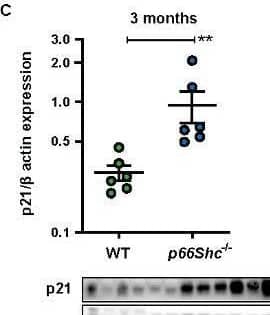
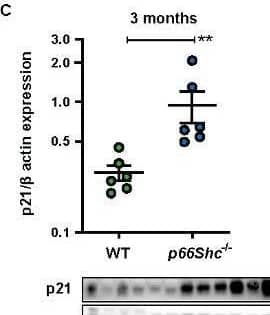
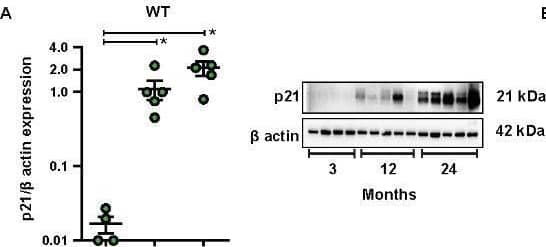
Western Blot: p21/CIP1/CDKN1A Antibody (WA-1) [NBP2-29463] -
p66Shc-/- induces premature cell cycle arrest during aging. (A-B) p21 protein expression in lung homogenate at different ages in WT and p66Shc-/- mice. n=4-5. (C-E) p21 protein expression in lung homogenates from WT and p66Shc-/- mice of corresponding ages. n=6. (F-H) Lamin B1 protein expression in lung homogenates from WT and p66Shc-/- mice of corresponding ages. The expression of p21 and lamin B1 is depicted as a ratio relative to beta-actin expression. (I) Senescence associated beta-galactosidase (SA beta-gal) activity in fresh cryo-sections from lungs of WT and p66Shc-/- mice at 3, 12, and 24 months of age (n= 3-4 mice per group). Thirty parenchymal fields were randomly selected for each lung to quantify the number of beta- galactosidase positive cells. (J-L) mRNA expression of (J) IL6, (K) IL-1 beta beta, and (L) TNF alpha in lung homogenates of p66Shc-/- and WT during aging. n=3 mice per group. Data were log-transformed for analysis. (A-B) Tests were performed as general linear hypothesis tests and P-values were adjusted for multiple testing using the "single-step" method. (C-H)P-values are from Student’s. t-tests. (I-L) Multiple tests were performed as general linear hypothesis tests and P-values were adjusted for multiple testing using the "single-step" method. Main effects of the two predictors were tested by F-tests in corresponding linear models without interaction terms. n=3-6 mice per group. The sample size for each group is indicated in the Supplementary Table 2. *p <0.05, **p≤0.01, ***p ≤0.001. Image collected and cropped by CiteAb from the following open publication (https://pubmed.ncbi.nlm.nih.gov/37548932), licensed under a CC-BY license. Not internally tested by Novus Biologicals.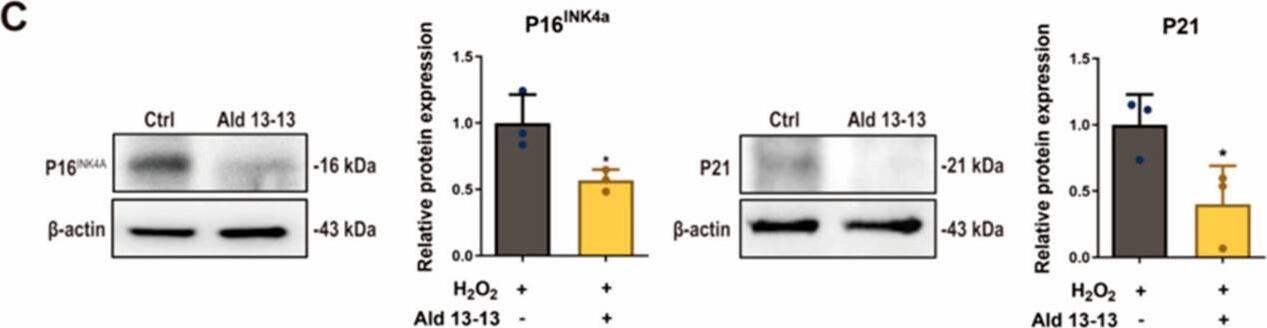
Western Blot: p21/CIP1/CDKN1A Antibody (WA-1) [NBP2-29463] -
Aldehyde 13-13 acts to reduce cellular senescence: (A) OR2H2 expression comparison between non-senescent (Non-S) and senescent (S) cells via qPCR; (B) Immunocytochemical depiction of Ki-67 (green) in senescent cells exposed to aldehyde 13-13 (40 uM). DAPI is shown in red; (C) Immunoblot assessment of P16 and P21 expression in senescent cells treated with aldehyde 13-13; (D) Examination of morphology and expression of senescence-associated beta-galactosidase (SA beta-Gal) in VK2/E6E7 cells. Tests were performed in three or four replicates. Ctrl, control; Ald 13-13, aldehyde 13-13. Data are presented as mean +/- SD. Two-tailed unpaired t-test was applied for multiple or two-group comparisons. *, p < 0.05; **, p < 0.01; ***, p < 0.001. Image collected and cropped by CiteAb from the following open publication (https://pubmed.ncbi.nlm.nih.gov/37765029), licensed under a CC-BY license. Not internally tested by Novus Biologicals.Applications for p21/CIP1/CDKN1A Antibody (WA-1)
Application
Recommended Usage
Flow Cytometry
1-2 ug/million cells
Immunocytochemistry/ Immunofluorescence
1-2 ug/ml
Immunohistochemistry
0.5-1ug/ml
Immunohistochemistry-Paraffin
1-2 ug/ml
Application Notes
Immunohistochemistry (Formalin-fixed): 1-2ug/ml for 30 minutes at RT. Staining of formalin-fixed tissues requires heating tissue sections in 10mM Tris with 1mM EDTA, pH 9.0, for 45 min at 95C followed by cooling at RT for 20 minutes.
Optimal dilution for a specific application should be determined.
Use in Western blot reported in scientific literature (PMID 28137862).
Optimal dilution for a specific application should be determined.
Use in Western blot reported in scientific literature (PMID 28137862).
Formulation, Preparation, and Storage
Purification
Protein A or G purified
Formulation
10 mM PBS with 0.05% BSA
Preservative
0.05% Sodium Azide
Concentration
0.2 mg/ml
Shipping
The product is shipped with polar packs. Upon receipt, store it immediately at the temperature recommended below.
Stability & Storage
Store at 4C.
Background: p21/CIP1/CDKN1A
It is interesting to note that p21 expression is induced by wild type, but not mutant p53. The HJ21/WA-1 antibody clone has been used to demonstrate this phenomenon by western blot (Blaydes, 2001). The inability of mutant p53 to induce p21 essentially means that normal functions of p21 are compromised when p53 gene mutations are present. Since p53 gene mutations are present in up to 50% of human cancers, the loss of p21 function in cancer is significant.
In its normal functioning state, p21 binds to cyclin/CDK complexes. When it binds to these complexes, it inhibits their kinase activity which, in turn, stops cell cycle progression and hence p21 gains its reputation as a mitotic cell cycle inhibitor. In this regard, the antibody showed that decreased Cdk2-cyclin E1 activity corresponded with a decrease in cyclin E1 and increase in p21 protein levels (White, 2005).
Long Name
p21 Cyclin Dependent Kinase 4 Inhibitor 1A
Alternate Names
CDKN1A, CIP1
Gene Symbol
CDKN1A
UniProt
Additional p21/CIP1/CDKN1A Products
Product Documents for p21/CIP1/CDKN1A Antibody (WA-1)
Product Specific Notices for p21/CIP1/CDKN1A Antibody (WA-1)
This product is for research use only and is not approved for use in humans or in clinical diagnosis. Primary Antibodies are guaranteed for 1 year from date of receipt.
Loading...
Loading...
Loading...
Loading...
Loading...
Loading...