
Mouse SLPI Antibody
R&D Systems, part of Bio-Techne | Catalog # AF1735

Conjugate
Catalog #
Key Product Details
Species Reactivity
Validated:
Mouse
Cited:
Mouse, Bacteria - Borrelia burgdorferi (Lyme disease spirochete)
Applications
Validated:
Western Blot
Cited:
Western Blot, Flow Cytometry, Immunocytochemistry
Label
Unconjugated
Antibody Source
Polyclonal Goat IgG
Product Specifications
Immunogen
Mouse myeloma cell line NS0-derived mouse SLPI
Specificity
Detects mouse SLPI in direct ELISAs and Western blots. In these formats, less than 5% cross-reactivity with recombinant human SLPI is observed.
Clonality
Polyclonal
Host
Goat
Isotype
IgG
Scientific Data Images for Mouse SLPI Antibody
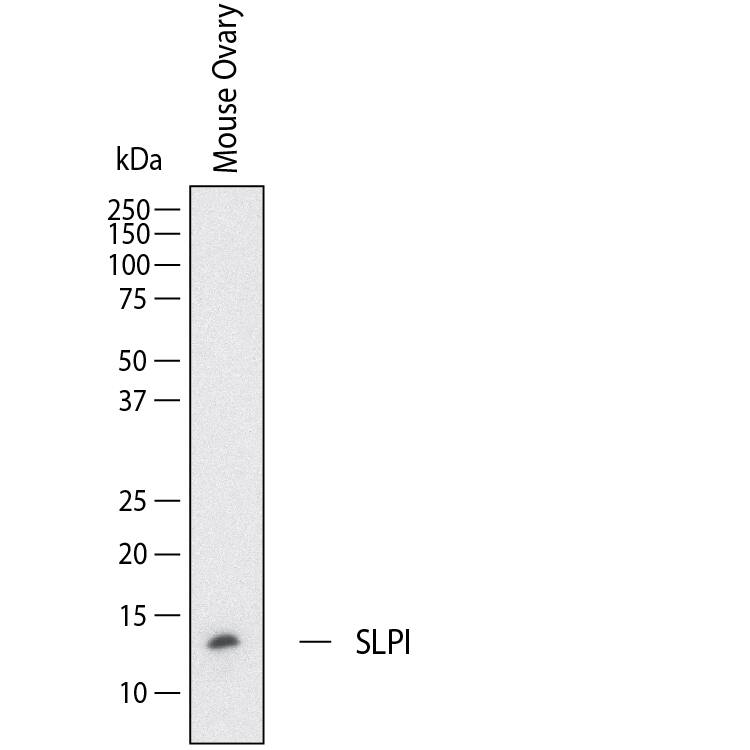
Detection of Mouse SLPI by Western Blot.
Western Blot shows lysates of mouse ovary. PVDF membrane was probed with 2 µg/ml of Goat Anti-Mouse SLPI Antigen Affinity-purified Polyclonal Antibody (Catalog # AF1735) followed by HRP-conjugated Anti-Goat IgG Secondary Antibody (Catalog # HAF017). A specific band was detected for SLPI at approximately 12 kDa (as indicated). This experiment was conducted under reducing conditions and using Western Blot Buffer Group 1.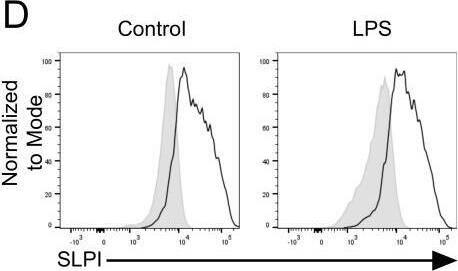
Detection of SLPI by Flow Cytometry
The impact of SLPI on local response to LPS injection. (A) Total PEC number isolated from WT and Slpi-/- mice injected with PBS or LPS for 24h. (B) Peritoneal macrophage percentage and total number as in (A). (C) Representative gating for resident macrophages in WT and Slpi-/- mice injected with PBS or LPS for 24h.(D) SLPI expression in resident peritoneal macrophages isolated from WT (black line) and Slpi-/- mice (shaded histogram) injected with PBS or LPS for 24h.(E) Fold change of geometrical MFI was compared between WT and Slpi-/- macrophages as in (D). (F) MMP-9 in supernatants of WT and Slpi-/- total PEC or peritoneal adherent cells (macrophages) isolated from PBS or LPS injected mice and stimulated with LPS (100ng/ml) or HKLM (107 cells) for 24h.WT vs Slpi-/- **p<0.01 by multiple unpaired t-test. (A, B, E) Data represent 5 to 8 mice per experimental group pooled from three independent experiments. Error bars show means ± SEM. (F) Data represent 3 to 5 mice per experimental group pooled from two independent experiments. Error bars show means ± SEM. Image collected and cropped by CiteAb from the following open publication (https://pubmed.ncbi.nlm.nih.gov/40496854), licensed under a CC-BY license. Not internally tested by R&D Systems.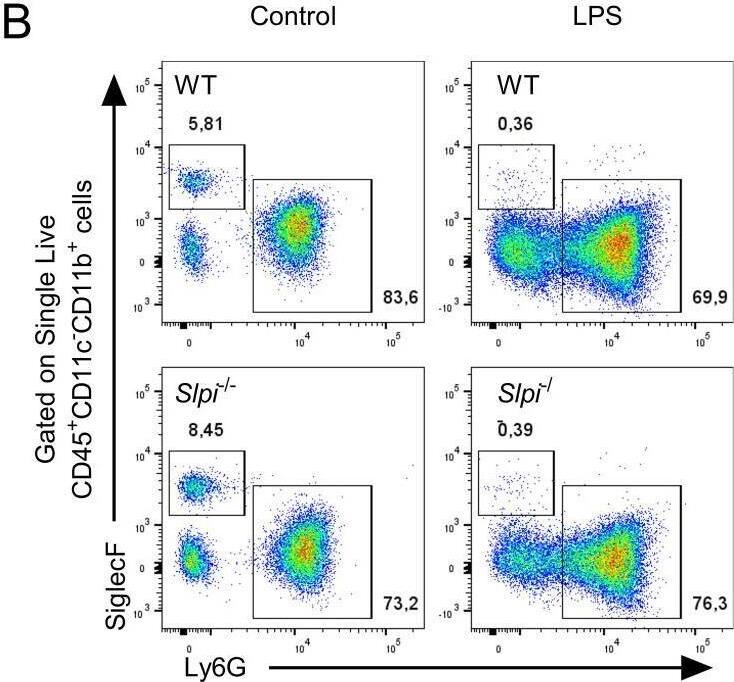
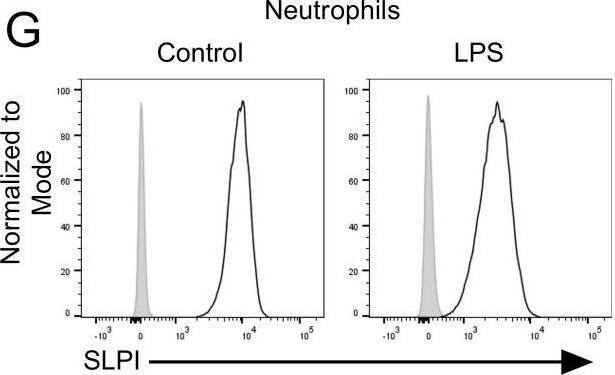
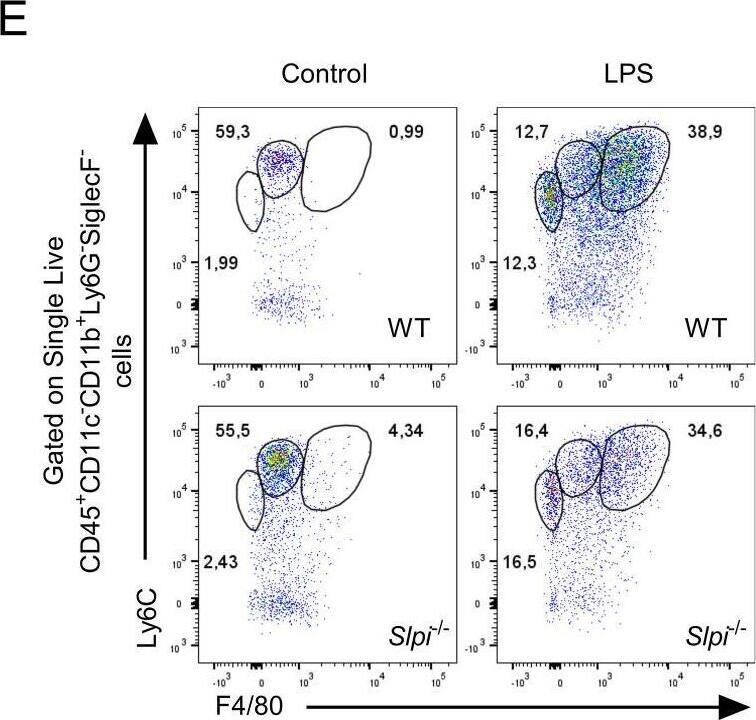
Detection of SLPI by Flow Cytometry
LPS induces changes in expression pattern of SLPI in selected immune cell populations in vivo. (A) Total blood CD45+ leukocyte number isolated from WT and Slpi-/- mice injected with PBS or LPS for 24h. (B) Representative gating for neutrophils (CD11b+Ly6G+SiglecF-), eosinophils (CD11b+Ly6G-SiglecF+) and monocytes (CD11b+Ly6C+Ly6G-) as in (A). (C) Percentage of neutrophils, eosinophils and monocytes isolated as in (A). (D) Percentage of Ly6Chi, MHC II+F4/80+ and Ly6Clow monocytes isolated as in (A). (E) Representative gating of Ly6Chi (CD11b+Ly6Chigh), MHC II+F4/80+ and Ly6Clow monocytes isolated as in (A). (F, G) SLPI expression in blood neutrophils isolated from WT (black line) and Slpi-/- mice (shaded histogram) injected with PBS or LPS for 24h.Data represented as mean ± SEM of fold change in geometrical MFI values (WT vs Slpi-/-). (H) SLPI expression in blood monocytes represented as a fold change in geometrical MFI values (WT vs Slpi-/-). (I) Representative histograms of SLPI expression in blood monocytes isolated from WT (black line) and Slpi-/- mice (shaded histogram) injected with PBS or LPS for 24h. (A, C, D, F, H) Data represent 7 to 8 mice per experimental group pooled from three independent experiments Error bars show means ± SEM. (A, C, D, F) Control vs LPS or WT vs Slpi-/- * p<0.05, **p<0.01, ***p<0.001, ****p<0.0001 by one-way ANOVA, Tukey post hoc test. (H) WT Ly6Chi monocytes vs WT Ly6Clow monocytes ****p<0.0001 by one-way ANOVA, Tukey post hoc test. Image collected and cropped by CiteAb from the following open publication (https://pubmed.ncbi.nlm.nih.gov/40496854), licensed under a CC-BY license. Not internally tested by R&D Systems.Applications for Mouse SLPI Antibody
Application
Recommended Usage
Western Blot
2 µg/mL
Sample: Mouse ovary
Sample: Mouse ovary
Formulation, Preparation, and Storage
Purification
Antigen Affinity-purified
Reconstitution
Reconstitute at 0.2 mg/mL in sterile PBS. For liquid material, refer to CoA for concentration.
Formulation
Lyophilized from a 0.2 μm filtered solution in PBS with Trehalose. See Certificate of Analysis for details.
*Small pack size (-SP) is supplied either lyophilized or as a 0.2 µm filtered solution in PBS.
*Small pack size (-SP) is supplied either lyophilized or as a 0.2 µm filtered solution in PBS.
Shipping
Lyophilized product is shipped at ambient temperature. Liquid small pack size (-SP) is shipped with polar packs. Upon receipt, store immediately at the temperature recommended below.
Stability & Storage
Use a manual defrost freezer and avoid repeated freeze-thaw cycles.
- 12 months from date of receipt, -20 to -70 °C as supplied.
- 1 month, 2 to 8 °C under sterile conditions after reconstitution.
- 6 months, -20 to -70 °C under sterile conditions after reconstitution.
Background: SLPI
References
-
Zhang, D. et al. (2002) J. Biol. Chem. 277:29999.
- Taggart, C.C. et al. (2002) J. Biol. Chem. 277:33648.
Long Name
Secretory Leukocyte Protease Inhibitor
Alternate Names
ALK1, ALPProtease inhibitor WAP4, antileukoproteinase, BLPISeminal proteinase inhibitor, HUSI, HUSI-I, Mucus proteinase inhibitor, secretory leukocyte peptidase inhibitor, Secretory leukocyte protease inhibitor, secretory leukocyte protease inhibitor (antileukoproteinase), WAP four-disulfide core domain protein 4, WAP4HUSI-1, WFDC4MPI
Gene Symbol
SLPI
Additional SLPI Products
Product Documents for Mouse SLPI Antibody
Product Specific Notices for Mouse SLPI Antibody
For research use only
Loading...
Loading...
Loading...
Loading...
Loading...