
Mouse SCF/c-kit Ligand Antibody
R&D Systems, part of Bio-Techne | Catalog # AB-455-NA


Scientific images may be resized, cropped, or adjusted for brightness or contrast for presentation purposes. These updates are limited to presentation and do not affect the underlying scientific interpretation of the data. Where available, additional source data may be provided upon request.
Key Product Details
Species Reactivity
Validated:
Mouse
Cited:
Mouse
Applications
Validated:
Western Blot, Neutralization
Cited:
Immunohistochemistry, Immunohistochemistry-Paraffin, Neutralization
Label
Unconjugated
Antibody Source
Polyclonal Goat IgG
Product Specifications
Immunogen
E. coli-derived recombinant mouse SCF/c‑kit Ligand
Lys26-Ala189
Accession # Q78ED8
Lys26-Ala189
Accession # Q78ED8
Specificity
Detects mouse SCF/c‑kit Ligand in direct ELISAs and Western blots. In direct ELISAs, approximately 70% cross-reactivity with recombinant rat SCF/c-kit Ligand is observed, and approximately 25% cross-reactivity with recombinant human SCF/c‑kit Ligand and recombinant feline SCF/c‑kit Ligand is observed.
Clonality
Polyclonal
Host
Goat
Isotype
IgG
Endotoxin Level
<0.10 EU per 1 μg of the antibody by the LAL method.
Scientific Data Images for Mouse SCF/c-kit Ligand Antibody
Cell Proliferation Induced by SCF/c-kit Ligand and Neutralization by Mouse SCF/c-kit Ligand Antibody.
Recombinant Mouse SCF/ c-kit Ligand (Catalog # 455-MC) stimulates proliferation in the TF-1 human erythro-leukemic cell line in a dose-dependent manner (orange line). Proliferation elicited by Recombinant Mouse SCF/c-kit Ligand (25 ng/mL) is neutralized (green line) by increasing concentrations of Goat Anti-Mouse SCF/ c-kit Ligand Polyclonal Antibody (Catalog # AB-455-NA). The ND50 is typically 4-20 µg/mL.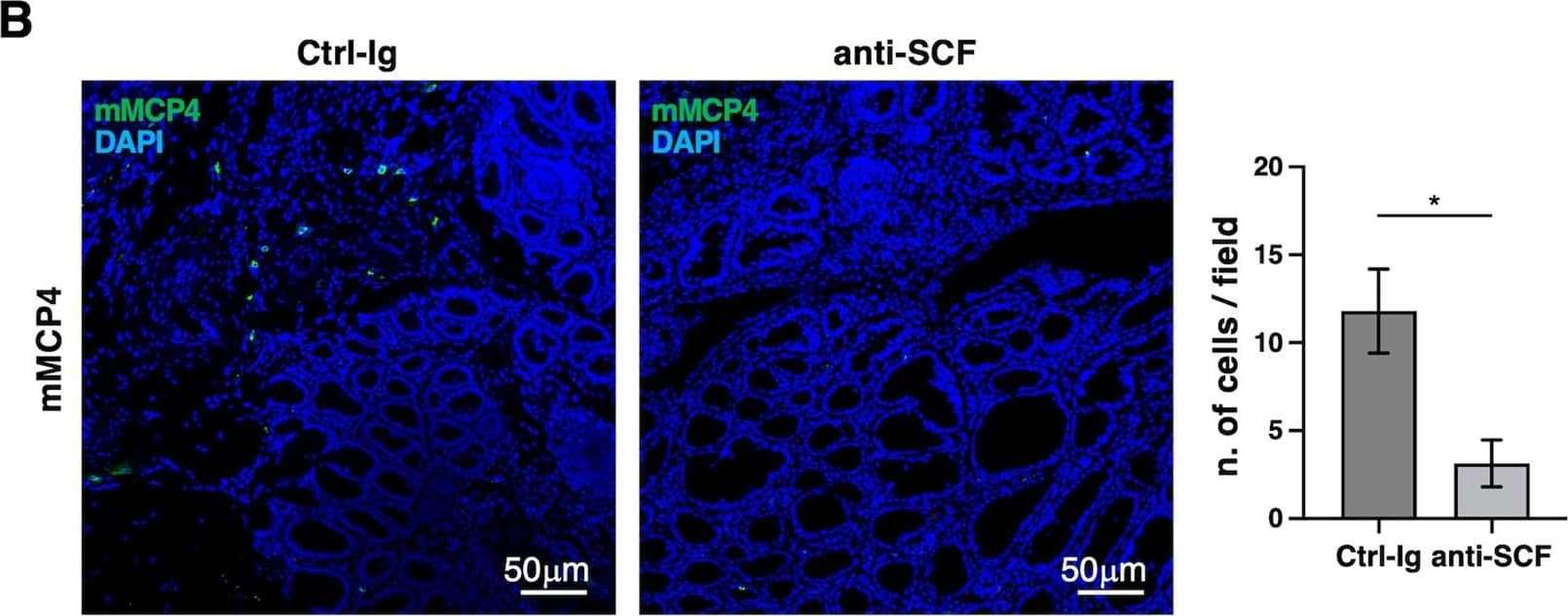
Detection of Mouse SCF/c-kit Ligand by Immunohistochemistry
SCF controls connective tissue-like MC accumulation in tumor lesions. A Schematic representation of anti-SCF neutralizing Ab administration in vivo. AOM/DSS-treated mice were i.p. injected three times with anti-SCF or control Ab (100 μg/mouse) starting from the fourth DSS cycle. Treated and control mice were sacrificed at 13 weeks from AOM administration. B Colon paraffin-embedded sections from AOM/DSS mice treated with Ctrl-Ig or anti-SCF neutralizing antibodies as described in (A) were stained with anti-MCP4 Ab followed by Alexa Fluor 488 secondary Abs (green). Nuclei were counterstained with DAPI (blue) and images were acquired with a Zeiss LSM980 confocal microscopy using a 20× objective. The frequencies of MCs positive for mMCP4 protease were analyzed in 20 fields randomly acquired from tumor lesions and shown as mean ± SD cells/field. Paired Student’s t test: *p < 0.05. Number of adenomas and colon lengths are shown in (C). Paired Student’s t test: *p < 0.05. Graphs are representative of two independent experiments with a total of 5 mice/group. Image collected and cropped by CiteAb from the following open publication (https://pubmed.ncbi.nlm.nih.gov/37730723), licensed under a CC-BY license. Not internally tested by R&D Systems.Applications for Mouse SCF/c-kit Ligand Antibody
Application
Recommended Usage
Western Blot
1 µg/mL
Sample: Recombinant Mouse SCF/c-kit Ligand (Catalog # 455-MC)
Sample: Recombinant Mouse SCF/c-kit Ligand (Catalog # 455-MC)
Neutralization
Measured by its ability to neutralize SCF/c‑kit Ligand-induced proliferation in the TF‑1 human erythroleukemic cell line. Kitamura, T. et al. (1989) J. Cell Physiol. 140:323. The Neutralization Dose (ND50) is typically 4-20 µg/mL in the presence of 25 ng/mL Recombinant Mouse SCF/c‑kit Ligand.
Formulation, Preparation, and Storage
Purification
Protein A or G purified
Reconstitution
Reconstitute at 1 mg/mL in sterile PBS.
Formulation
Lyophilized from a 0.2 μm filtered solution in PBS with Trehalose.
Shipping
The product is shipped at ambient temperature. Upon receipt, store it immediately at the temperature recommended below.
Stability & Storage
Use a manual defrost freezer and avoid repeated freeze-thaw cycles.
- 12 months from date of receipt, -20 to -70 °C as supplied.
- 1 month, 2 to 8 °C under sterile conditions after reconstitution.
- 6 months, -20 to -70 °C under sterile conditions after reconstitution.
Background: SCF/c-kit Ligand
Stem cell factor (SCF), also known as c-kit ligand (KL), mast cell growth factor (MGF), and steel factor (SLF), is a widely expressed 28-40 kDa type I transmembrane glycoprotein (1). It promotes the survival, differentiation, and mobilization of multiple cell types including myeloid, erythroid, megakaryocytic, lymphoid, germ cell, and melanocyte progenitors (1-7). SCF is a primary growth and activation factor for mast cells and eosinophils (8). Mature mouse SCF consists of a 189 amino acid (aa) extracellular domain (ECD), a 23 aa transmembrane segment, and a 36 aa cytoplasmic tail (9). The ECD shows both N-linked and O-linked glycosylation (10). Proteolytic cleavage at two alternate sites in the extracellular juxtamembrane region releases a 25 kDa soluble molecule which is comparable to the only form produced by Steel-dickie mutant mice (11, 12). An alternately spliced isoform of mouse SCF lacks 28 aa that encompasses the primary proteolytic recognition site (13). Within the ECD of the short isoform (corresponding to this recombinant protein), mouse SCF shares 93% aa sequence identity with rat SCF and 72-75% with canine, feline, and human SCF. Rat SCF is active on mouse and human cells, but human SCF is only weakly active on mouse cells (14). Non-covalent dimers of transmembrane or soluble SCF interact with the receptor tyrosine kinase SCF R/c-kit to trigger receptor dimerization and signaling (15). SCF assists in the recovery of cardiac function following myocardial infarction by increasing the number of cardiomyocytes and vascular channels (16).
References
- Ashman, L.K. (1999) Int. J. Biochem. Cell Biol. 31:1037.
- Sette, C. et al. (2000) Int. J. Dev. Biol. 44:599.
- Yoshida, H. et al. (2001) J. Invest. Dermatol. Symp. Proc. 6:1.
- Erlandsson, A. et al. (2004) Exp. Cell Res. 301:201.
- Kapur, R. et al. (2002) Blood 100:1287.
- Wang, C.-H. et al. (2007) Arterioscler. Thromb. Vasc. Biol. 27:540.
- Bashamboo, A. et al. (2006) J. Cell Sci. 119:3039.
- Reber, L. et al. (2006) Eur. J. Pharmacol. 533:327.
- Huang, E. et al. (1990) Cell 63:225.
- Arakawa, T. et al. (1991) J. Biol. Chem. 266:18942.
- Majumdar, M.K. et al. (1994) J. Biol. Chem. 269:1237.
- Brannan, C.I. et al. (1991) Proc. Natl. Acad. Sci. USA 88:4671.
- Flanagan, J.G. et al. (1991) Cell 64:1025.
- Martin, F.H. et al. (1990) Cell 63:203.
- Lemmon, M.A. et al. (1997) J. Biol. Chem. 272:6311.
- Kanellakis, P. et al. (2006) Cardiovasc. Res. 70:117.
Long Name
Stem Cell Factor
Alternate Names
c-kit Ligand, DCUA, DFNA69, FPH2, FPHH, KITLG, KL-1, MGF, SHEP7, SLF
Gene Symbol
KITLG
UniProt
Additional SCF/c-kit Ligand Products
Product Documents for Mouse SCF/c-kit Ligand Antibody
Product Specific Notices for Mouse SCF/c-kit Ligand Antibody
For research use only
Loading...
Loading...
Loading...
Loading...
Loading...