
Mouse PlGF-2 Antibody
R&D Systems, part of Bio-Techne | Catalog # AF465

Scientific images may be resized, cropped, or adjusted for brightness or contrast for presentation purposes. These updates are limited to presentation and do not affect the underlying scientific interpretation of the data. Where available, additional source data may be provided upon request.
Conjugate
Catalog #
Key Product Details
Species Reactivity
Validated:
Mouse
Cited:
Mouse, Rat
Applications
Validated:
Western Blot
Cited:
Immunohistochemistry, Western Blot
Label
Unconjugated
Antibody Source
Polyclonal Goat IgG
Product Specifications
Immunogen
S. frugiperda insect ovarian cell line Sf 21-derived recombinant mouse PlGF-2 (R&D Systems, Catalog # 465-PL)
Ala24-Pro158
Accession # Q544A5
Ala24-Pro158
Accession # Q544A5
Specificity
Detects mouse PlGF-2 in direct ELISAs and Western blots. In these formats, less than 5% cross‑reactivity with recombinant human PlGF is observed.
Clonality
Polyclonal
Host
Goat
Isotype
IgG
Scientific Data Images for Mouse PlGF-2 Antibody
Detection of PlGF-2 by Western Blot
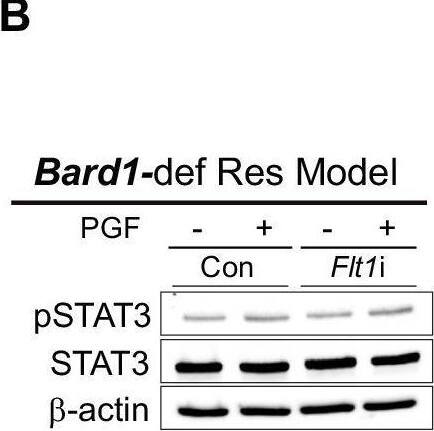
Quantitation of phosphorylated STAT3 (pSTAT3) levels in Brca1-def and Bard1-def breast tumor cells and tumor tissue sections.(A, B) Immunoblot analysis was performed using antibodies against pSTAT3, STAT3 and beta-actin (loading control) using lysates from Flt1-expressing (Con) and -deficient (Flt1i), talazoparib-resistant (“Res”) Brca1 and Bard1-def tumor cells, treated with 50 ng/mL of mouse PGF protein that were used in Fig. 5A, B. (C) Representative images of IHC for pSTAT3 staining in tumor sections from the mice described in Fig. 1 comparing talazoparib-sensitive (“Sen”) tumors to talazoparib-resistant (“Res”) tumors. Scale bars, 20 µm. (D) Immunostained sections from (C) were quantified using automated QuPath software to identify positively stained cells. For the Brca1-def model, n = 4 tumors for both Sen and Res. For the Bard1-def model, n = 5 Sen tumors, and n = 4 Res tumors. Data were presented as mean values ± SEM. P values were determined by a two-tailed, unpaired, Mann–Whitney test. ns; not significant. Image collected and cropped by CiteAb from the following open publication (https://pubmed.ncbi.nlm.nih.gov/38956205), licensed under a CC-BY license. Not internally tested by R&D Systems.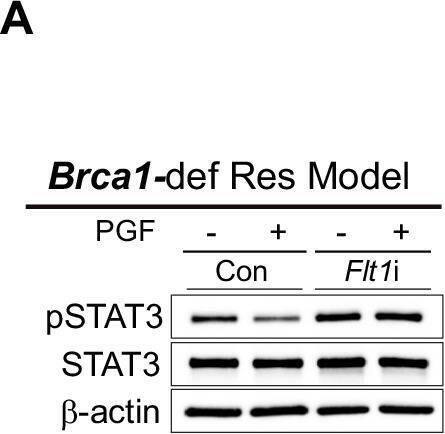
Detection of PlGF-2 by Western Blot
Quantitation of phosphorylated STAT3 (pSTAT3) levels in Brca1-def and Bard1-def breast tumor cells and tumor tissue sections.(A, B) Immunoblot analysis was performed using antibodies against pSTAT3, STAT3 and beta-actin (loading control) using lysates from Flt1-expressing (Con) and -deficient (Flt1i), talazoparib-resistant (“Res”) Brca1 and Bard1-def tumor cells, treated with 50 ng/mL of mouse PGF protein that were used in Fig. 5A, B. (C) Representative images of IHC for pSTAT3 staining in tumor sections from the mice described in Fig. 1 comparing talazoparib-sensitive (“Sen”) tumors to talazoparib-resistant (“Res”) tumors. Scale bars, 20 µm. (D) Immunostained sections from (C) were quantified using automated QuPath software to identify positively stained cells. For the Brca1-def model, n = 4 tumors for both Sen and Res. For the Bard1-def model, n = 5 Sen tumors, and n = 4 Res tumors. Data were presented as mean values ± SEM. P values were determined by a two-tailed, unpaired, Mann–Whitney test. ns; not significant. Image collected and cropped by CiteAb from the following open publication (https://pubmed.ncbi.nlm.nih.gov/38956205), licensed under a CC-BY license. Not internally tested by R&D Systems.
Mouse PlGF-2 ELISA Standard Curve
Recombinant Mouse PlGF-2 (Catalog # 465-PL) was serially diluted and captured by Rat Anti-Mouse PlGF-2 Monoclonal Antibody (Catalog # MAB4651) coated on a Clear Polystyrene Microplate (Catalog # DY990). Goat Anti-Mouse PlGF-2 Antigen Affinity-purified Polyclonal Antibody (Catalog # AF465) was biotinylated and incubated with the protein captured on the plate. Detection of the standard curve was achieved by incubating Streptavidin-HRP (Catalog # DY998)Applications for Mouse PlGF-2 Antibody
Application
Recommended Usage
Western Blot
0.1 µg/mL
Sample: Recombinant Mouse PlGF-2 (Catalog # 465-PL)
Sample: Recombinant Mouse PlGF-2 (Catalog # 465-PL)
Formulation, Preparation, and Storage
Purification
Antigen Affinity-purified
Reconstitution
Reconstitute at 0.2 mg/mL in sterile PBS. For liquid material, refer to CoA for concentration.
Formulation
Lyophilized from a 0.2 μm filtered solution in PBS with Trehalose. *Small pack size (SP) is supplied either lyophilized or as a 0.2 µm filtered solution in PBS.
Shipping
Lyophilized product is shipped at ambient temperature. Liquid small pack size (-SP) is shipped with polar packs. Upon receipt, store immediately at the temperature recommended below.
Stability & Storage
Use a manual defrost freezer and avoid repeated freeze-thaw cycles.
- 12 months from date of receipt, -20 to -70 °C as supplied.
- 1 month, 2 to 8 °C under sterile conditions after reconstitution.
- 6 months, -20 to -70 °C under sterile conditions after reconstitution.
Background: PlGF-2
Placenta growth factor (PlGF) is a member of the vascular endothelial growth factor (VEGF) family of growth factors. PlGF and VEGF share primary structural as well as limited amino acid sequence homology with the A and B chains of PDGF. All eight cysteine residues involved in intra- and inter-chain disulfides are conserved among these growth factors. As a result of alternative splicing, three PlGF RNAs encoding monomeric human PlGF-1, PlGF-2 and PlGF-3 isoform precursors containing 149, 179 and 219 amino acid residues, respectively, have been described. In normal mouse tissues, only one mouse PlGF mRNA encoding the equivalent of human PlGF-2 has been identified. Mouse PlGF-2 encodes a 158 amino acid residue precursor protein. Mouse PlGF-2 shares 65% amino acid identity with human PlGF-2. The gene for PlGF has been mapped to mouse chromosome 12 and human chromosome 14. PlGF binds with high-affinity to Flt-1, but not to Flk-1/KDR.
References
- DiPalma, T. et al. (1996) Mamm. Genome 7:6.
- Cao, Y. et al. (1997) Biochem. Biophys. Res. Commun. 235:493.
- Ferrara, N. et al. (1997) Endocrin. Rev. 18:4.
Long Name
Placenta Growth Factor 2
Alternate Names
PlGF2
Gene Symbol
PGF
UniProt
Additional PlGF-2 Products
Product Documents for Mouse PlGF-2 Antibody
Product Specific Notices for Mouse PlGF-2 Antibody
For research use only
Loading...
Loading...
Loading...
Loading...
Loading...