
Mouse OSMR beta Antibody
R&D Systems, part of Bio-Techne | Catalog # AF662

Conjugate
Catalog #
Key Product Details
Species Reactivity
Validated:
Mouse
Cited:
Human, Mouse, Rat, Transgenic Mouse
Applications
Validated:
Immunohistochemistry, Western Blot
Cited:
Immunohistochemistry, Immunohistochemistry-Paraffin, Western Blot, Flow Cytometry, Immunocytochemistry, ELISA Development
Label
Unconjugated
Antibody Source
Polyclonal Goat IgG
Product Specifications
Immunogen
Mouse myeloma cell line NS0-derived recombinant mouse OSM R beta
Glu24-Leu738
Accession # O70458
Glu24-Leu738
Accession # O70458
Specificity
Detects mouse OSM R beta in direct ELISAs and Western blots.
Clonality
Polyclonal
Host
Goat
Isotype
IgG
Scientific Data Images for Mouse OSMR beta Antibody
Detection of Mouse OSMR beta by Western Blot
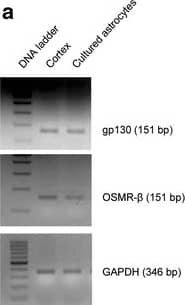
OSM down-regulates GLT-1 and GLAST expression in primary mouse cortical astrocytes. a Total mRNA purified from wild-type (C57BL/6J) mouse neonatal (P2) brain cortex as well as from cultured cortical astrocytes established from P2 brains was analyzed for expression of OSMR-beta and gp130 mRNA by reverse transcriptase PCR; GAPDH primers were used as loading control. b Cortical astrocyte cultures were treated without or with OSM (10 ng/mL) for 2, 4, 8, 12, and 24 h and analyzed for GLT-1 and GLAST mRNA levels (gene expression normalized to HPRT1) by real-time PCR. Data are normalized to untreated controls and presented as mean ± SEM; n = 3, **p < 0.01, ***p < 0.001; one-way ANOVA using Bonferroni correction. c Cortical astrocytic cultures were treated without or with OSM (10 ng/mL) for 3, 5, and 24 h and were analyzed for GLAST proteins by Western blot. Relative densitometric analysis of GLAST proteins is shown in the lower panel. Data are presented as percentage of each respective ratio between optical density value of GLAST band intensity and optical density value of the matched alpha-tubulin (which served as the loading control) band intensity; n = 3, **p < 0.01, ***p < 0.001; one-way ANOVA Image collected and cropped by CiteAb from the following open publication (https://pubmed.ncbi.nlm.nih.gov/27287400), licensed under a CC-BY license. Not internally tested by R&D Systems.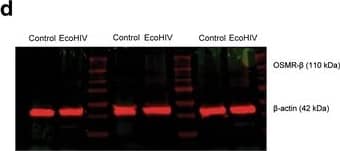
Detection of Mouse OSMR beta by Western Blot
EcoHIV induces OSM release and gp130 mRNA, but not OSMR-beta mRNA or protein, in cultured primary mouse microglia. a Shows real-time PCR analysis of HIV LTR mRNA in control and EcoHIV-infected (35,000 pg of p24, for 24 h) primary microglia. ****p < 0.0001, n = 3. b Shows ELISA analysis of secreted OSM proteins in culture supernatants collected from control and EcoHIV-infected primary microglia. *p < 0.05, n = 6. c Shows real-time PCR analysis of gp130 and OSMR-beta mRNA in control and EcoHIV-infected primary microglia. *p < 0.05, n = 3. d Shows Western blot analysis for OSMR-beta proteins in control and EcoHIV-infected primary microglial cell lysates obtained from three independent experiments. beta-Actin served as the loading control Image collected and cropped by CiteAb from the following open publication (https://pubmed.ncbi.nlm.nih.gov/27287400), licensed under a CC-BY license. Not internally tested by R&D Systems.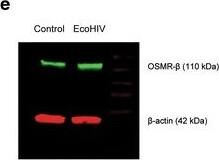
Detection of Mouse OSMR beta by Western Blot
EcoHIV neither induces OSM secretion, nor the expression of gp130 or GLAST mRNA, but stimulates the expression of GLT-1 and OSMR-beta in primary cortical astrocytes. a Shows real-time PCR analyses of HIV LTR mRNA in control and EcoHIV-infected (35,000 pg of p24, for 24 h) cortical astrocyte cultures. ****p < 0.0001, n = 3. b Shows ELISA analysis of secreted OSM proteins in culture supernatants collected from control and EcoHIV-infected primary astrocyte cultures. n = 6. c, d Shows real-time PCR analyses of GLAST and GLT-1 (c) and gp130 and OSMR-beta (d) mRNA in control and EcoHIV-infected cortical astrocyte cultures. *p < 0.05, **p < 0.01, n = 3. e Shows Western blot analyses for OSMR-beta proteins in control and EcoHIV-infected cortical astrocyte culture lysates. The left panel shows representative blot of three independent experiments. The right panel shows densitometric analysis of OSMR-beta proteins. Data are presented as percentage of each respective ratio between optical density value of OSMR-beta band (110 kDa) intensity and optical density value of the matched beta-actin (42 kDa; loading control) band intensity. *p = 0.027, n = 3; two-tailed Student’s t test Image collected and cropped by CiteAb from the following open publication (https://pubmed.ncbi.nlm.nih.gov/27287400), licensed under a CC-BY license. Not internally tested by R&D Systems.Applications for Mouse OSMR beta Antibody
Application
Recommended Usage
Immunohistochemistry
5-15 µg/mL
Sample: Immersion fixed frozen sections of mouse embryo (E13.5-15.5)
Sample: Immersion fixed frozen sections of mouse embryo (E13.5-15.5)
Western Blot
0.1 µg/mL
Sample: Recombinant Mouse OSM R beta Fc Chimera (Catalog # 662-OR)
Sample: Recombinant Mouse OSM R beta Fc Chimera (Catalog # 662-OR)
Formulation, Preparation, and Storage
Purification
Antigen Affinity-purified
Reconstitution
Reconstitute at 0.2 mg/mL in sterile PBS. For liquid material, refer to CoA for concentration.
Formulation
Lyophilized from a 0.2 μm filtered solution in PBS with Trehalose. *Small pack size (SP) is supplied either lyophilized or as a 0.2 µm filtered solution in PBS.
Shipping
Lyophilized product is shipped at ambient temperature. Liquid small pack size (-SP) is shipped with polar packs. Upon receipt, store immediately at the temperature recommended below.
Stability & Storage
Use a manual defrost freezer and avoid repeated freeze-thaw cycles.
- 12 months from date of receipt, -20 to -70 °C as supplied.
- 1 month, 2 to 8 °C under sterile conditions after reconstitution.
- 6 months, -20 to -70 °C under sterile conditions after reconstitution.
Background: OSMR beta
Oncostatin M (OSM) is a member of the IL-6 family of cytokines that share the gp130 as a common signal transducing receptor subunit. Human OSM signals through two types of human OSM receptor complexes: the type I complex comprising the leukemia inhibitory factor receptor beta (LIF R beta) and gp130, the type II complex made up of OSM receptor beta (OSM R beta) and gp130. In contrast, mouse OSM signals only through the mouse OSM R beta and gp130 complex. Mouse OSM R beta cDNA encodes a 971 amino acid (aa) residue type I transmembrane protein which contains a 23 aa residue signal peptide, an extracellular domain of 714 aa, a transmembrane domain of 20 aa and a 214 aa cytoplasmic domain. Mouse OSM R beta alone binds mOSM with low-affinity, but forms a high-affinity binding complex in the presence of gp130. Mouse OSM R beta is 55% identical at the amino acid sequence level to human OSM R beta.
References
- Lindberg, R.A. et al. (1998) Mol. Cell. Biol. 18:3357.
- Tanaka, M. et al. (1999) Blood 93:804.
Long Name
Oncostatin M Receptor beta
Alternate Names
OSM R beta, OSMR, OSMRB
Gene Symbol
OSMR
UniProt
Additional OSMR beta Products
Product Documents for Mouse OSMR beta Antibody
Product Specific Notices for Mouse OSMR beta Antibody
For research use only
Loading...
Loading...
Loading...
Loading...
Loading...