
Mouse MMR/CD206 PE-conjugated Antibody
R&D Systems, part of Bio-Techne | Catalog # FAB2535P

Conjugate
Catalog #
Key Product Details
Species Reactivity
Validated:
Mouse
Cited:
Mouse, Rat
Applications
Validated:
Flow Cytometry
Cited:
Flow Cytometry
Label
Phycoerythrin (Excitation = 488 nm, Emission = 565-605 nm)
Antibody Source
Polyclonal Goat IgG
Product Specifications
Immunogen
Mouse myeloma cell line NS0-derived recombinant mouse MMR/CD206
Leu19-Ala1388
Accession # Q2HZ94
Leu19-Ala1388
Accession # Q2HZ94
Specificity
Detects mouse MMR/CD206 in direct ELISAs and Western blots. In direct ELISAs and Western blots, approximately 45% cross-reactivity with recombinant human MMR is observed.
Clonality
Polyclonal
Host
Goat
Isotype
IgG
Scientific Data Images for Mouse MMR/CD206 PE-conjugated Antibody
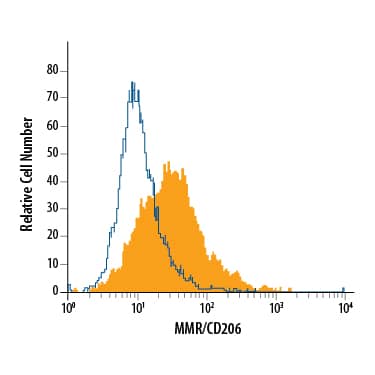
Detection of MMR/CD206 in J774A.1 Mouse Cell Line by Flow Cytometry.
J774A.1 mouse reticulum cell sarcoma macrophage cell line was stained with Goat Anti-Mouse MMR/CD206 PE-conjugated Antigen Affinity-purified Polyclonal Antibody (Catalog # FAB2535P, filled histogram) or isotype control antibody (Catalog # IC108P, open histogram). View our protocol for Staining Membrane-associated Proteins.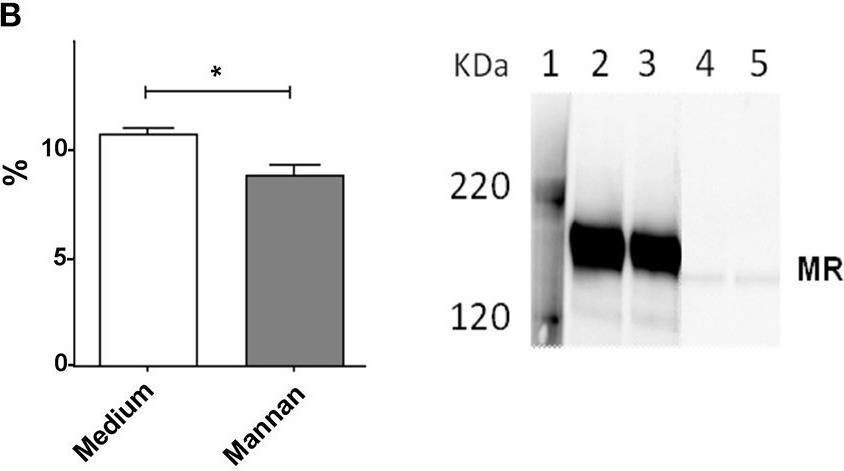
Detection of MMR/CD206 by Western Blot
Addition of mannan decreases expression of MR on BMDCs. (A) Cell surface expression of MR measured by flow cytometry in BMDCs treated with medium (dashed line) or mannan (100 μg/mL, solid line) for 30 min prior to staining with PE-labeled anti-MR antibody. The percentages of MR positive cells (%) are depicted in the histogram. (B) Immune blotting: BMDCs were added with medium (lane 2 and 4) or mannan (100 μg/mL, lane 3 and 5), and after 1 h supernatants (lane 4 and 5) and lysed cells (lane 2 and 3) were analyzed for the content of MR by Western blotting. (C) FITC positive cells in BMDC pretreated with medium (dotted line) or mannan (black solid line) and then added with FITC-dextran were measured by flow cytometry. The mean fluorescence intensities (MFI) are depicted in the histogram. Data indicate mean ± SD of duplicates (*P < 0.05 and **P < 0.01). Image collected and cropped by CiteAb from the following open publication (https://pubmed.ncbi.nlm.nih.gov/31803184), licensed under a CC-BY license. Not internally tested by R&D Systems.Applications for Mouse MMR/CD206 PE-conjugated Antibody
Application
Recommended Usage
Flow Cytometry
10 µL/106 cells
Sample: J774A.1 mouse reticulum cell sarcoma macrophage cell line
Sample: J774A.1 mouse reticulum cell sarcoma macrophage cell line
Spectra Viewer
Plan Your Experiments
Use our spectra viewer to interactively plan your experiments, assessing multiplexing options. View the excitation and emission spectra for our fluorescent dye range and other commonly used dyes.
Spectra Viewer
Formulation, Preparation, and Storage
Purification
Antigen Affinity-purified
Formulation
Supplied in a saline solution containing BSA and Sodium Azide.
Shipping
The product is shipped with polar packs. Upon receipt, store it immediately at the temperature recommended below.
Stability & Storage
Protect from light. Do not freeze.
- 12 months from date of receipt, 2 to 8 °C as supplied.
Background: MMR/CD206
The mouse Macrophage Mannose Receptor (MMR), also known as CD206 and MRC1 (mannose receptor C, type 1), is a 175 kDa scavenger receptor that is expressed on tissue macrophages, myeloid dendritic cells, and liver and lymphatic endothelial cells (1). It belongs to a family of receptors sharing similar protein structure that also includes DEC205, phospholipase A2 receptor, and Endo180 (2, 3). The mouse MMR protein is synthesized as a 1456 amino acid (aa) precursor that contains a 19 aa signal sequence, a 1369 aa extracellular region, a 21 aa transmembrane segment and a 47 aa cytoplasmic domain (4). Its extracellular region is composed of an N-terminal cysteine-rich domain, followed by a single fibronectin type II repeat, and eight C-type lectin carbohydrate recognition domains (CRD) (3‑5). Mouse to human, the extracellular region is 82% aa identical. The cysteine-rich domain mediates recognition of sulfated N-acetylgalactosamine, which occurs on some extracellular matrix proteins and is the terminal sugar of the unusual oligosaccharides present on pituitary hormones such as lutropin and thyrotropin (6). Several of the CRDs participate in the Ca2+-dependent recognition of carbohydrates showing a preference for branched sugars with terminal mannose, fucose or N‑acetylglucosamine (7). The cytoplasmic domain of MMR includes a tyrosine-based motif for internalization in clathrin-coated vesicles. Once internalized, ligands are released following acidification of phagosomes or endosomes, and the receptor recycles to the cell surface (3, 8). MMR mediates phagocytosis upon binding to target structures that occur on a variety of pathogenic microorganisms including Gram-negative and Gram-positive bacteria, yeasts, parasites, and mycobacteria. MMR also functions to maintain homeostasis through the endocytosis of potentially harmful glycoproteins associated with inflammation (2, 3).
References
- East, L. and C. Isake (2002) Biochim. Biophys. Acta 1572:364.
- Chieppa, M. et al. (2003) J. Immunol. 171:4552.
- Figdor, C. et al. (2002) Nat. Rev. Immunol. 2:77.
- Harris, N. et al. (1992) Blood 80:2363.
- Taylor, M. et al. (1990) J. Biol. Chem. 265:12156.
- Leteux, C. et al. (2000) J. Exp. Med. 191:1117.
- Martinez-Pomares, L. et al. (2001) Immunobiology 204:527.
- Feinberg, H. et al. (2000) J. Biol. Chem. 275:21539.
Long Name
Macrophage Mannose Receptor
Alternate Names
CD206, CLEC13D, MRC1
Gene Symbol
MRC1
UniProt
Additional MMR/CD206 Products
Product Documents for Mouse MMR/CD206 PE-conjugated Antibody
Product Specific Notices for Mouse MMR/CD206 PE-conjugated Antibody
For research use only
Loading...
Loading...
Loading...
Loading...
Loading...