
Mouse GLI-2 Antibody
R&D Systems, part of Bio-Techne | Catalog # AF3635

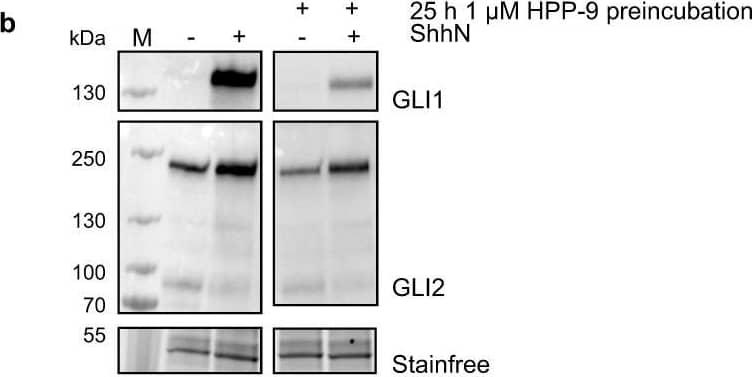

Scientific images may be resized, cropped, or adjusted for brightness or contrast for presentation purposes. These updates are limited to presentation and do not affect the underlying scientific interpretation of the data. Where available, additional source data may be provided upon request.
Conjugate
Catalog #
Key Product Details
Species Reactivity
Validated:
Mouse
Cited:
Human, Mouse, Drosophila, Frog - Xenopus (African Clawed Frog), Transgenic Mouse
Applications
Validated:
Immunohistochemistry, Western Blot
Cited:
Immunohistochemistry, Immunohistochemistry-Paraffin, Western Blot, Immunocytochemistry/Immunofluorescence, Immunocytochemistry, Immunoprecipitation, Chromatin Immunoprecipitation, IF/ICC
Label
Unconjugated
Antibody Source
Polyclonal Goat IgG
Product Specifications
Immunogen
E. coli-derived recombinant mouse GLI-2
Met1-Glu416
Accession # NP_001074594
Met1-Glu416
Accession # NP_001074594
Specificity
Detects mouse GLI-2 in direct ELISAs and Western blots.
Clonality
Polyclonal
Host
Goat
Isotype
IgG
Scientific Data Images for Mouse GLI-2 Antibody
GLI‑2 in Mouse Embryo.
GLI-2 was detected in immersion fixed frozen sections of mouse embryo (15 d.p.c.) using Goat Anti-Mouse GLI-2 Antigen Affinity-purified Polyclonal Antibody (Catalog # AF3635) at 15 µg/mL overnight at 4 °C. Tissue was stained using the Anti-Goat HRP-DAB Cell & Tissue Staining Kit (brown; Catalog # CTS008) and counterstained with hematoxylin (blue). Lower panel shows a lack of labeling when primary antibodies are omitted and tissue is stained only with secondary antibody followed by incubation with detection reagents. Specific staining was localized to developing muscle. View our protocol for Chromogenic IHC Staining of Frozen Tissue Sections.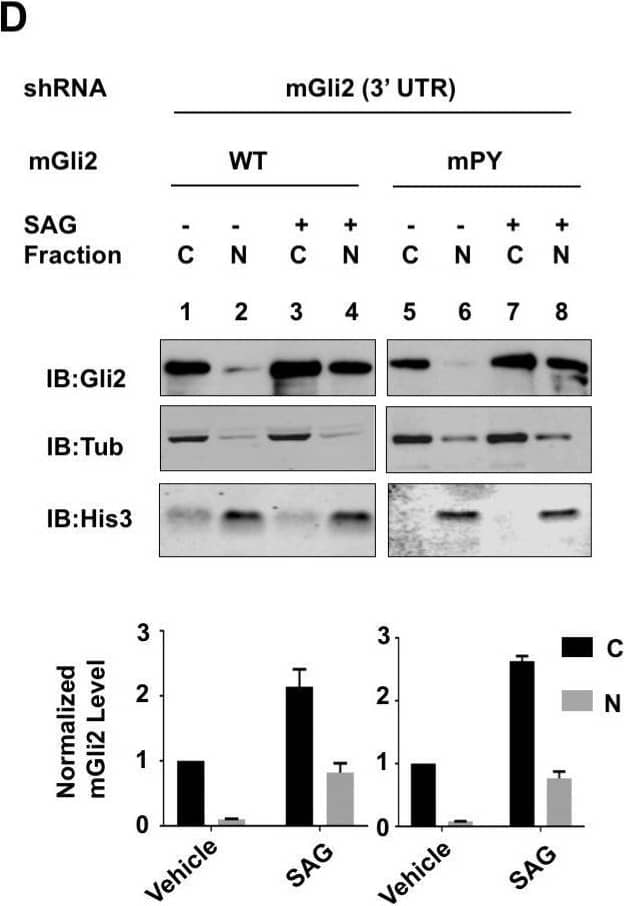
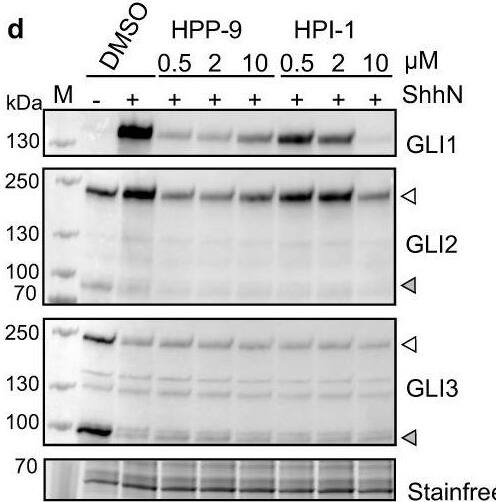
Detection of GLI-2 by Western Blot
The PY-type nuclear localization signal (PY-NLS) is required for Gli activation.(A) Western blot of cell lysates from the indicated cell lines indicated that Myc-Gli2WT and Myc-Gli2mPY were expressed at comparable levels that were slightly higher than that of endogenous Gli2. (B–C) Normalized mRNA levels of endogenous Gli1 (B) or Patch1 (C) measured by quantitative reverse transcription PCR (RT-qPCR) in control (green fluorescent protein [GFP] short hairpin RNA [shRNA]) or Gli2-depeleted NIH3T3 cells with or without lentiviral infection of the indicated Gli2 constructs. (D) Fractionation of Myc-Gli2WT and Myc-Gli2mPY from the indicated cell lines treated with or without SAG. Quantification of protein level is shown in the bottom panel. (E–F) Immunostaining (E) and quantification (F) of ciliary-localized Myc-Gli2WT or Myc-Gli2mPY in NIH3T3mGli2-shRNA cells treated with or without sonic hedgehog (Shh). N = 50 cells were examined for each Gli construct. Data are means ± SD from 2 independent experiments. **P < 0.01. (G) Gli-luciferase assay was performed in NIH3T3 cells transfected with the indicated constructs. Data are means ± SD from 2 independent experiments. *P < 0.05, NS: not significant. The underlying data for this figure can be found in S1 Data. Image collected and cropped by CiteAb from the following open publication (https://pubmed.ncbi.nlm.nih.gov/28777795), licensed under a CC-BY license. Not internally tested by R&D Systems.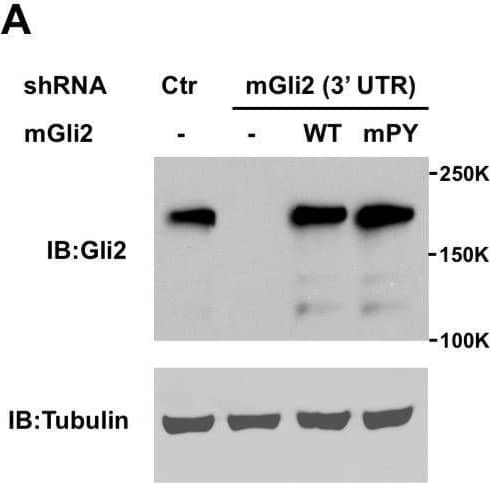
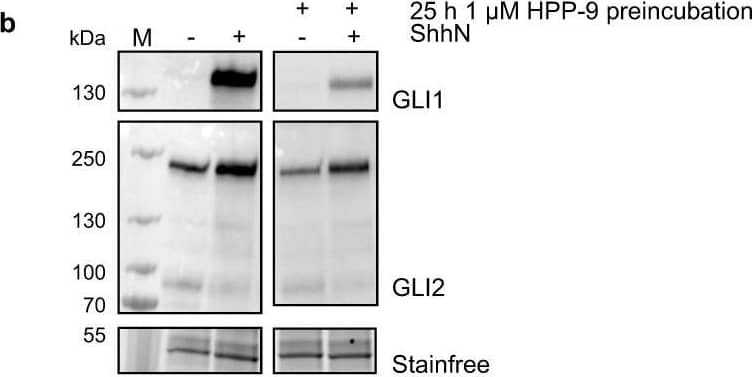
Detection of GLI-2 by Western Blot
The PY-type nuclear localization signal (PY-NLS) is required for Gli activation.(A) Western blot of cell lysates from the indicated cell lines indicated that Myc-Gli2WT and Myc-Gli2mPY were expressed at comparable levels that were slightly higher than that of endogenous Gli2. (B–C) Normalized mRNA levels of endogenous Gli1 (B) or Patch1 (C) measured by quantitative reverse transcription PCR (RT-qPCR) in control (green fluorescent protein [GFP] short hairpin RNA [shRNA]) or Gli2-depeleted NIH3T3 cells with or without lentiviral infection of the indicated Gli2 constructs. (D) Fractionation of Myc-Gli2WT and Myc-Gli2mPY from the indicated cell lines treated with or without SAG. Quantification of protein level is shown in the bottom panel. (E–F) Immunostaining (E) and quantification (F) of ciliary-localized Myc-Gli2WT or Myc-Gli2mPY in NIH3T3mGli2-shRNA cells treated with or without sonic hedgehog (Shh). N = 50 cells were examined for each Gli construct. Data are means ± SD from 2 independent experiments. **P < 0.01. (G) Gli-luciferase assay was performed in NIH3T3 cells transfected with the indicated constructs. Data are means ± SD from 2 independent experiments. *P < 0.05, NS: not significant. The underlying data for this figure can be found in S1 Data. Image collected and cropped by CiteAb from the following open publication (https://pubmed.ncbi.nlm.nih.gov/28777795), licensed under a CC-BY license. Not internally tested by R&D Systems.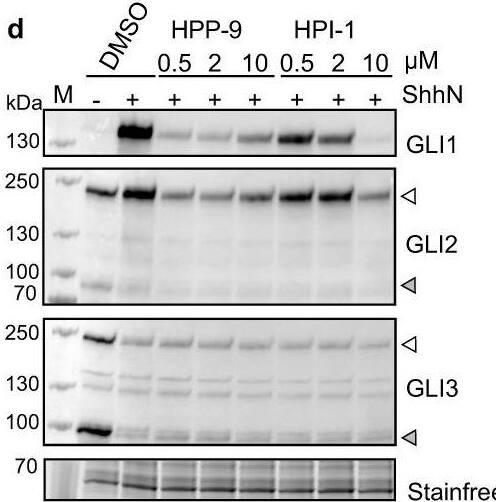
Applications for Mouse GLI-2 Antibody
Application
Recommended Usage
Immunohistochemistry
5-15 µg/mL
Sample: Immersion fixed frozen sections of mouse embryo (15 d.p.c.)
Sample: Immersion fixed frozen sections of mouse embryo (15 d.p.c.)
Western Blot
0.1 µg/mL
Sample: Recombinant Mouse GLI-2
Sample: Recombinant Mouse GLI-2
Reviewed Applications
Read 5 reviews rated 3.4 using AF3635 in the following applications:
Formulation, Preparation, and Storage
Purification
Antigen Affinity-purified
Reconstitution
Reconstitute at 0.2 mg/mL in sterile PBS. For liquid material, refer to CoA for concentration.
Formulation
Lyophilized from a 0.2 μm filtered solution in PBS with Trehalose. *Small pack size (SP) is supplied either lyophilized or as a 0.2 µm filtered solution in PBS.
Shipping
Lyophilized product is shipped at ambient temperature. Liquid small pack size (-SP) is shipped with polar packs. Upon receipt, store immediately at the temperature recommended below.
Stability & Storage
Use a manual defrost freezer and avoid repeated freeze-thaw cycles.
- 12 months from date of receipt, -20 to -70 °C as supplied.
- 1 month, 2 to 8 °C under sterile conditions after reconstitution.
- 6 months, -20 to -70 °C under sterile conditions after reconstitution.
Background: GLI-2
Long Name
GLI-Kruppel family member GLI2
Alternate Names
GLI2, THP2
Gene Symbol
GLI2
UniProt
Additional GLI-2 Products
Product Documents for Mouse GLI-2 Antibody
Product Specific Notices for Mouse GLI-2 Antibody
For research use only
Loading...
Loading...
Loading...
Loading...
Loading...