
Mouse DLL4 Antibody
R&D Systems, part of Bio-Techne | Catalog # AF1389

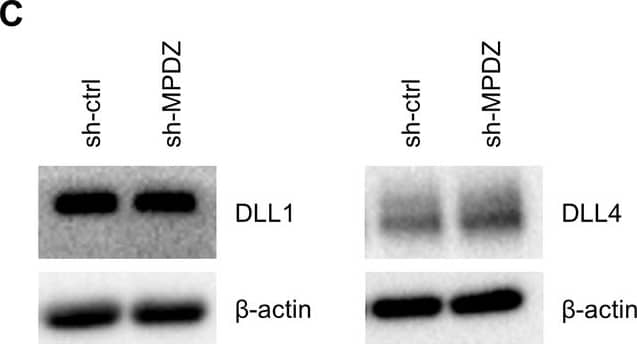

Scientific images may be resized, cropped, or adjusted for brightness or contrast for presentation purposes. These updates are limited to presentation and do not affect the underlying scientific interpretation of the data. Where available, additional source data may be provided upon request.
Conjugate
Catalog #
Key Product Details
Species Reactivity
Validated:
Mouse
Cited:
Human, Mouse, Rat, Chicken, Transgenic Mouse
Applications
Validated:
Immunohistochemistry, Western Blot, Immunocytochemistry
Cited:
Immunohistochemistry, Immunohistochemistry-Paraffin, Immunohistochemistry-Frozen, Western Blot, Immunocytochemistry, IHC-F
Label
Unconjugated
Antibody Source
Polyclonal Goat IgG
Product Specifications
Immunogen
Mouse myeloma cell line NS0-derived recombinant mouse DLL4
Ser28-Pro525
Accession # BAB18580
Ser28-Pro525
Accession # BAB18580
Specificity
Detects mouse DLL4 in direct ELISAs and Western blots. In direct ELISAs, approximately 50% cross‑reactivity with recombinant human DLL4 is observed.
Clonality
Polyclonal
Host
Goat
Isotype
IgG
Scientific Data Images for Mouse DLL4 Antibody
Detection of Mouse DLL4 by Western Blot.
Western blot shows lysates of bEnd.3 mouse endothelioma cell line. PVDF membrane was probed with 2 µg/mL of Goat Anti-Mouse DLL4 Antigen Affinity-purified Polyclonal Antibody (Catalog # AF1389) followed by HRP-conjugated Anti-Goat IgG Secondary Antibody (Catalog # HAF017). A specific band was detected for DLL4 at approximately 90 kDa (as indicated). This experiment was conducted under reducing conditions and using Immunoblot Buffer Group 1.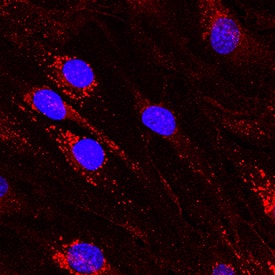
DLL4 in bEnd.3 Mouse Cell Line.
DLL4 was detected in immersion fixed bEnd.3 mouse endothelioma cell line using Goat Anti-Mouse DLL4 Antigen Affinity-purified Polyclonal Antibody (Catalog # AF1389) at 10 µg/mL for 3 hours at room temperature. Cells were stained using the NorthernLights™ 557-conjugated Anti-Goat IgG Secondary Antibody (red; Catalog # NL001) and counterstained with DAPI (blue). Specific staining was localized to cytoplasm. View our protocol for Fluorescent ICC Staining of Cells on Coverslips.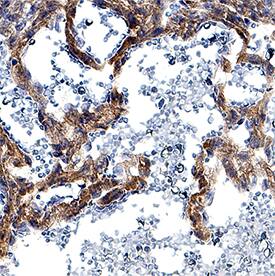
DLL4 in Mouse Embryo.
DLL4 was detected in immersion fixed paraffin-embedded sections of mouse embryo (13 d.p.c.) using Goat Anti-Mouse DLL4 Antigen Affinity-purified Polyclonal Antibody (Catalog # AF1389) at 5 µg/mL for 1 hour at room temperature followed by incubation with the Anti-Goat IgG VisUCyte™ HRP Polymer Antibody (Catalog # VC004). Tissue was stained using DAB (brown) and counterstained with hematoxylin (blue). Specific staining was localized to developing vasculature. View our protocol for IHC Staining with VisUCyte HRP Polymer Detection Reagents.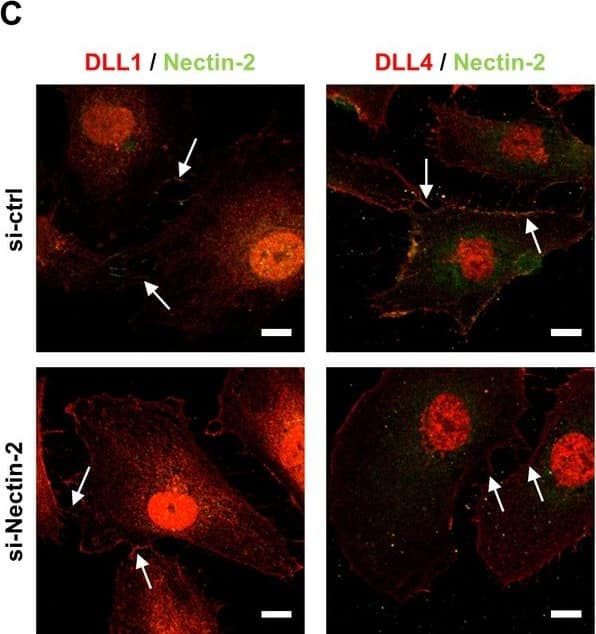
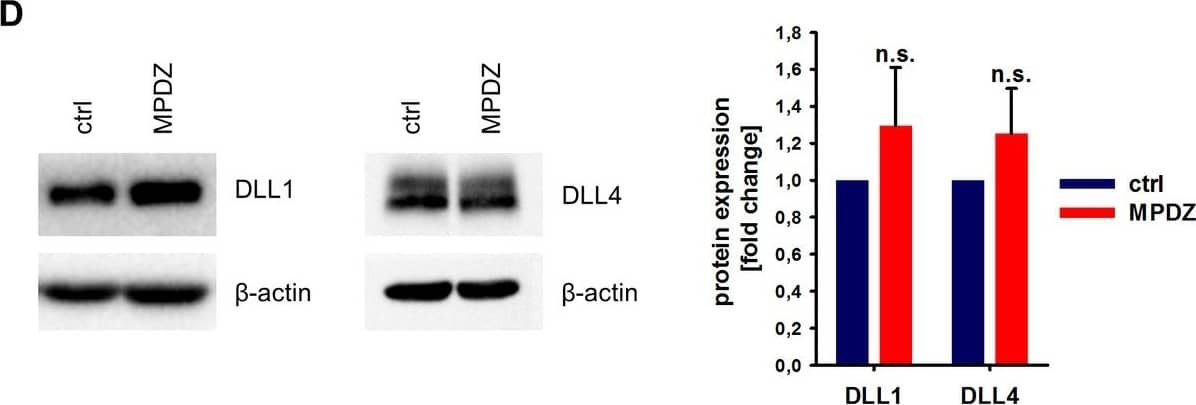
Applications for Mouse DLL4 Antibody
Application
Recommended Usage
Immunocytochemistry
5-15 µg/mL
Sample: Immersion fixed bEnd.3 mouse endothelioma cell line
Sample: Immersion fixed bEnd.3 mouse endothelioma cell line
Immunohistochemistry
5-15 µg/mL
Sample: Immersion fixed paraffin-embedded sections of mouse embryo (13 d.p.c.)
Sample: Immersion fixed paraffin-embedded sections of mouse embryo (13 d.p.c.)
Western Blot
2 µg/mL
Sample: bEnd.3 mouse endothelioma cell line
Sample: bEnd.3 mouse endothelioma cell line
Reviewed Applications
Read 1 review rated 3 using AF1389 in the following applications:
Formulation, Preparation, and Storage
Purification
Antigen Affinity-purified
Reconstitution
Reconstitute at 0.2 mg/mL in sterile PBS. For liquid material, refer to CoA for concentration.
Formulation
Lyophilized from a 0.2 μm filtered solution in PBS with Trehalose. *Small pack size (SP) is supplied either lyophilized or as a 0.2 µm filtered solution in PBS.
Shipping
Lyophilized product is shipped at ambient temperature. Liquid small pack size (-SP) is shipped with polar packs. Upon receipt, store immediately at the temperature recommended below.
Stability & Storage
Use a manual defrost freezer and avoid repeated freeze-thaw cycles.
- 12 months from date of receipt, -20 to -70 °C as supplied.
- 1 month, 2 to 8 °C under sterile conditions after reconstitution.
- 6 months, -20 to -70 °C under sterile conditions after reconstitution.
Background: DLL4
Delta-Like protein 4 (DLL4) is a type I membrane protein belonging to the Delta/Serrate/Lag2 (DSL) family of Notch ligands (1). Notch signaling is an evolutionarily conserved pathway that controls cell fate and is required in multiple developmental processes including vascular development, hematopoiesis, somatogenesis, myogenesis, and neurogenesis (2-4). Dysregulation in the Notch pathway is associated with various human diseases. In mammals, four Notch homologs (Notch 1 to 4) and five ligands (DLL 1, 3 and 4, Jagged 1 and 2) have been identified. Notch ligands are transmembrane proteins with a DSL motif necessary for Notch binding, tandem EGF repeats, a transmembrane region and a short intracellular domain (ICD). Notch ligands are categorized into two subfamilies based on the presence of an extracellular cysteine-rich domain and insertions that interrupt some EGF repeats in the Jagged but not the Delta ligand family. Interactions of Notch receptors with their ligands results in reciprocal Regulated Intramembrane Proteolysis (RIP) (4). RIP is a mechanism for transmembrane signal transduction that involves the sequential processing by A Disintegrin Metalloprotease (ADAM) and then by Presenilin/ gamma-Ssecretase, resulting in shedding of the extracellular domains and the generation of the soluble ICD signaling fragments, respectively. The Notch ICD translocates to the nucleus and interacts with transcriptional coactivators, resulting in the transcription of target genes. The ICDs of the Notch ligands have also been shown to translocate to the nucleus where they may have a signaling function (5, 6). DLL4 is expressed highly and selectively within the arterial endothelium and has been shown to function as a ligand for Notch 1 and Notch 4. Human and mouse DLL4 share 86% amino acid sequence identity (1).
References
- Shutter, J.R. et al. (2000) Genes Dev. 14:1313.
- Iso, Tatsuya et al. (2002) Arterioscler. Thromb. Vasc. Biol. 23:543.
- Walker, L. et al. (2001) Stem Cells 19:543.
- Baron, M. (2002) Semin. Cell Dev. Biol. 14:113.
- Ikeuchi, T. and S.S. Sisodia (2003) J. Biol. Chem. 278:7751.
- Bland, C.E. et al. (2003) J. Biol. Chem. 278:13607.
Long Name
Delta-like 4
Alternate Names
delta 4, Delta 4 precursor, delta ligand 4, delta4, delta-like 4 (Drosophila), delta-like 4 homolog, delta-like 4 homolog (Drosophila), delta-like 4 protein, delta-like protein 4, Drosophila Delta homolog 4, hdelta2, MGC126344, notch ligand delta-2, notch ligand DLL4
Gene Symbol
DLL4
UniProt
Additional DLL4 Products
Product Documents for Mouse DLL4 Antibody
Product Specific Notices for Mouse DLL4 Antibody
For research use only
Loading...
Loading...
Loading...
Loading...
Loading...