
Mouse Dectin-1/CLEC7A Antibody
R&D Systems, part of Bio-Techne | Catalog # MAB1756

Conjugate
Catalog #
Key Product Details
Species Reactivity
Validated:
Mouse
Cited:
Mouse
Applications
Validated:
Western Blot
Cited:
Western Blot
Label
Unconjugated
Antibody Source
Monoclonal Rat IgG2B Clone # 218838
Product Specifications
Immunogen
Mouse myeloma cell line NS0-derived recombinant mouse Dectin-1
Phe69-Leu244
Accession # Q6QLQ4
Phe69-Leu244
Accession # Q6QLQ4
Specificity
Detects mouse Dectin-1 in direct ELISAs and Western blots. In direct ELISAs, this antibody does not cross-react with recombinant human (rh) Dectin‑1, rmDectin-2 alpha, or rhDLEC.
Clonality
Monoclonal
Host
Rat
Isotype
IgG2B
Scientific Data Images for Mouse Dectin-1/CLEC7A Antibody
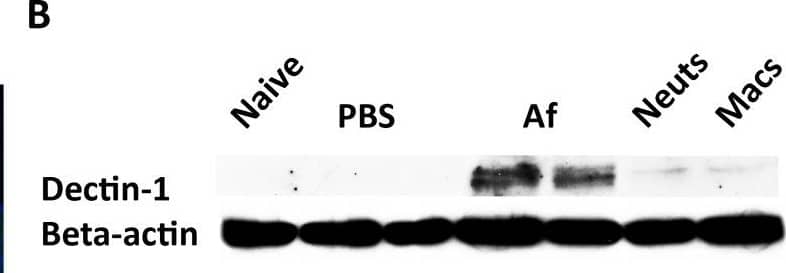
Detection of Dectin-1/CLEC7A by Western Blot
beta-glucan expression and Dectin-1 signaling in A. fumigatus keratitis. Fungal beta-glucan expression and Dectin-1 protein activation in the cornea during Aspergillus infection were assessed by IHC and western blot analysis, respectively. A. 5µm central cornea sections at 6 and 24h post-infection were PASH stained to visualize swollen conidia (6h) and hyphae (24h), while beta-glucan expression was detected using a mouse anti-fungal beta-glucan antibody. B. Western blot analysis using anti-Dectin-1 antibody or C. anti-pSyk antibody was performed on cornea protein lysates from naïve, 10h PBS injected (trauma control), and 10hr A. fumigatus infected corneas. Data are representative of two independent experiments, with three corneas per time point. [Endo- endothelium Epi- epithelium, Neuts- casein-elicited peritoneal neutrophils. MACs- thioglycolate-elicited peritoneal, macrophages.] Image collected and cropped by CiteAb from the following open publication (https://pubmed.ncbi.nlm.nih.gov/20617171), licensed under a CC-BY license. Not internally tested by R&D Systems.Applications for Mouse Dectin-1/CLEC7A Antibody
Application
Recommended Usage
Western Blot
1 µg/mL
Sample: Recombinant Mouse Dectin-1/CLEC7A (Catalog # 1756-DC)
Sample: Recombinant Mouse Dectin-1/CLEC7A (Catalog # 1756-DC)
Reviewed Applications
Read 2 reviews rated 2.5 using MAB1756 in the following applications:
Formulation, Preparation, and Storage
Purification
Protein A or G purified from hybridoma culture supernatant
Reconstitution
Reconstitute at 0.5 mg/mL in sterile PBS. For liquid material, refer to CoA for concentration.
Formulation
Lyophilized from a 0.2 μm filtered solution in PBS with Trehalose. *Small pack size (SP) is supplied either lyophilized or as a 0.2 µm filtered solution in PBS.
Shipping
Lyophilized product is shipped at ambient temperature. Liquid small pack size (-SP) is shipped with polar packs. Upon receipt, store immediately at the temperature recommended below.
Stability & Storage
Use a manual defrost freezer and avoid repeated freeze-thaw cycles.
- 12 months from date of receipt, -20 to -70 °C as supplied.
- 1 month, 2 to 8 °C under sterile conditions after reconstitution.
- 6 months, -20 to -70 °C under sterile conditions after reconstitution.
Background: Dectin-1/CLEC7A
Dectin-1, also known as CLEC7A and the beta-glucan receptor, is a 43 kDa type II transmembrane C-type lectin that functions in the innate immune response to fungal pathogens. Although Dectin-1 resembles other CLEC molecules structurally, it binds ligands in a calcium-independent manner (1, 2). Mature mouse Dectin-1 is a 244 amino acid (aa) glycoprotein that consists of a short ITAM-containing cytoplasmic tail, a transmembrane segment, and a stalk and carbohydrate recognition domain (CRD) in the extracellular domain (3). The CRD of mouse Dectin-1 shares 61%, 60%, and 87% aa sequence identity with that of bovine, human, and rat Dectin‑1, respectively. It shares 25% - 34% aa sequence identity with the CRD of other subgroup members CLEC-1, CLEC-2, CLEC9A, CLEC12B, LOX-1, and MICL. Mouse Dectin-1 is alternately spliced, generating a variant that lacks the stalk region (4). Mouse Dectin-1 is expressed on monocytes, macrophages, and neutrophils, and on some populations of dendritic cells and T cells (5). It is upregulated on macrophages by GM-CSF, IL-4, or IL-13 and downregulated by dexamethasone, IL-10, or LPS (6). The CRD selectively binds beta-glucan polymers, a major component of yeast and mycobacterial cell walls (7). Yeast beta-glucan is accessible to Dectin-1 only at sites of cell budding, and Dectin-1 does not recognize the filamentous form of yeast (8). Dectin-1 mediates the phagocytosis of zymosan particles and intact yeast (8 ‑ 10). It co-localizes with TLR2 in the presence of zymosan, and the two receptors cooperate in ligand recognition and the propagation of proinflammatory signaling (9, 11 ‑ 13). Dectin-1 interaction with the tetraspanin CD37 increases its stability on the cell membrane and inhibits ligand-induced signaling (14). Genetic knockout of Dectin-1 in mice increases their susceptibility to pathogenic infection (15, 16).
References
- Kanazawa, N. (2007) J. Dermatol. Sci. 45:77.
- Brown, G.D. (2006) Nat. Rev. Immunol. 6:33.
- Ariizumi, K. et al. (2000) J. Biol. Chem. 275:20157.
- Heinsbroek, S.E.M. et al. (2006) J. Immunol. 176:5513.
- Taylor, P.R. et al. (2002) J. Immunol. 169:3876.
- Willment, J.A. et al. (2003) J. Immunol. 171:4569.
- Palma, A.S. et al. (2006) J. Biol. Chem. 281:5771.
- Gantner, B.N. et al. (2005) EMBO J. 24:1277.
- Gantner, B.N. et al. (2003) J. Exp. Med. 197:1107.
- Kennedy, A.D. et al. (2007) Eur. J. Immunol. 37:467.
- Brown, G.D. et al. (2003) J. Exp. Med. 197:1119.
- Yadav, M. and J.S. Schorey (2006) Blood 108:3168.
- Suram, S. et al. (2006) J. Biol. Chem. 281:5506.
- Meyer-Wentrup, F. et al. (2007) J. Immunol. 178:154.
- Saijo, S. et al. (2007) Nat. Immunol. 8:39.
- Taylor, P.R. et al. (2007) Nat. Immunol. 8:31.
Alternate Names
CD369, CLEC7A, CLECSF12, Dectin1
Gene Symbol
CLEC7A
UniProt
Additional Dectin-1/CLEC7A Products
Product Documents for Mouse Dectin-1/CLEC7A Antibody
Product Specific Notices for Mouse Dectin-1/CLEC7A Antibody
For research use only
Loading...
Loading...
Loading...
Loading...
Loading...