
Mouse CTLA-4 Fluorescein-conjugated Antibody
R&D Systems, part of Bio-Techne | Catalog # FAB434F

Discontinued Product
FAB434F has been discontinued.
View all CTLA-4 products.
Key Product Details
Species Reactivity
Validated:
Mouse
Cited:
Mouse
Applications
Validated:
Flow Cytometry
Cited:
Flow Cytometry
Label
Fluorescein (Excitation = 488 nm, Emission = 515-545 nm)
Antibody Source
Monoclonal Rat IgG2A Clone # 63828
Product Specifications
Immunogen
Mouse myeloma cell line NS0-derived recombinant mouse CTLA-4
Ala36-Phe161
Accession # XP_001479180
Ala36-Phe161
Accession # XP_001479180
Specificity
Detects mouse CTLA-4 in direct ELISAs and Western blots. In direct ELISAs, this antibody does not cross-react with recombinant mouse (rm) CD28, recombinant human CTLA-4, rmICOS, or rmPD-1.
Clonality
Monoclonal
Host
Rat
Isotype
IgG2A
Scientific Data Images for Mouse CTLA-4 Fluorescein-conjugated Antibody
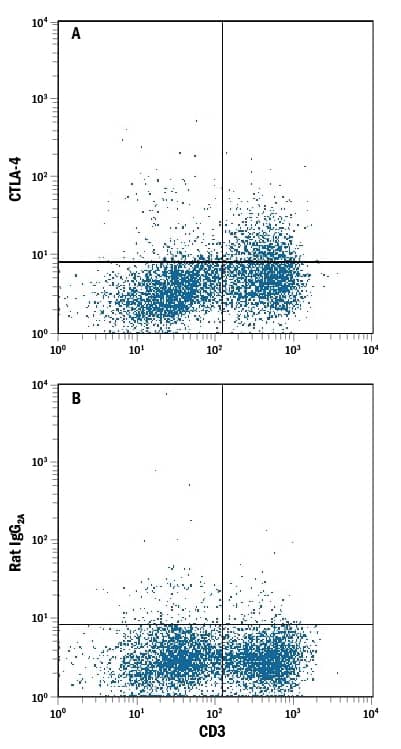
Detection of CTLA‑4 in Mouse Splenocytes by Flow Cytometry.
Mouse splenocytes treated with Concanavalin A for 48 hours were stained with Rat Anti-Mouse CD3 APC-conjugated Monoclonal Antibody (Catalog # FAB4841A) and either (A) Rat Anti-Mouse CTLA-4 Fluorescein-conjugated Monoclonal Antibody (Catalog # FAB434F) or (B) Rat IgG2AFluorescein Isotype Control (Catalog # IC006F). View our protocol for Staining Membrane-associated Proteins.Applications for Mouse CTLA-4 Fluorescein-conjugated Antibody
Application
Recommended Usage
Flow Cytometry
10 µL/106 cells
Sample: Mouse splenocytes treated with Concanavalin A
Sample: Mouse splenocytes treated with Concanavalin A
Formulation, Preparation, and Storage
Purification
Protein A or G purified from hybridoma culture supernatant
Formulation
Supplied in a saline solution containing BSA and Sodium Azide.
Shipping
The product is shipped with polar packs. Upon receipt, store it immediately at the temperature recommended below.
Stability & Storage
Protect from light. Do not freeze.
- 12 months from date of receipt, 2 to 8 °C as supplied.
Background: CTLA-4
CTLA-4 and CD28, together with their ligands B7-1 and B7-2, constitute one of the dominant costimulatory pathways that regulate T and B cell responses. CTLA-4 and CD28 are structurally homologous molecules that are members of the immunoglobulin (Ig) gene superfamily. Both CTLA-4 and CD28 are composed of a single Ig V‑like extracellular domain, a transmembrane domain and an intracellular domain. CTLA-4 and CD28 are both expressed on the cell surface as disulfide-linked homodimers or as monomers. The genes encoding these two molecules are closely linked on human chromosome 2. CTLA-4 was originally identified as a gene that was specifically expressed by cytotoxic T lymphocytes. However, CTLA-4 transcripts have since been found in both Th1 and Th2, and CD4+ and CD8+ T cell clones. Whereas, CD28 expression is constitutive on the surfaces of 95% of CD4+ T cells and 50% of CD8+ T cells and is down regulated upon T cell activation, CTLA-4 expression is upregulated rapidly following T cell activation and peaks approximately 24 hours following activation. Although both CTLA-4 and CD28 can bind to the same ligands, CTLA-4 binds to B7-1 and B7-2 with 20-100-fold higher affinity than CD28. The physiological role of CTLA-4 in T cell costimulation is currently being studied. Recombinant human or mouse CTLA-4/Fc chimera preparations produced at R&D Systems have been shown to bind both B7-1 and B7-2 with high affinity and to inhibit CD28 signalling competitively.
Long Name
Cytotoxic T-lymphocyte-associated Molecule 4
Alternate Names
CD152, CTLA4
Gene Symbol
CTLA4
UniProt
Additional CTLA-4 Products
Product Documents for Mouse CTLA-4 Fluorescein-conjugated Antibody
Product Specific Notices for Mouse CTLA-4 Fluorescein-conjugated Antibody
For research use only
Loading...
Loading...
Loading...
Loading...
Loading...