
Mouse CD9 Antibody
R&D Systems, part of Bio-Techne | Catalog # MAB5218

Scientific images may be resized, cropped, or adjusted for brightness or contrast for presentation purposes. These updates are limited to presentation and do not affect the underlying scientific interpretation of the data. Where available, additional source data may be provided upon request.
Conjugate
Catalog #
Key Product Details
Species Reactivity
Validated:
Mouse
Cited:
Human, Mouse
Applications
Validated:
Immunohistochemistry, Flow Cytometry, CyTOF-ready
Cited:
Western Blot, Immunocytochemistry
Label
Unconjugated
Antibody Source
Monoclonal Rat IgG2A Clone # 479608
Product Specifications
Immunogen
NS0 mouse myeloma cell line transfected with mouse CD9
Pro2-Val226
Accession # P40240
Pro2-Val226
Accession # P40240
Specificity
Stains mouse CD9-transfected cells but not irrelevant transfecants.
Clonality
Monoclonal
Host
Rat
Isotype
IgG2A
Scientific Data Images for Mouse CD9 Antibody
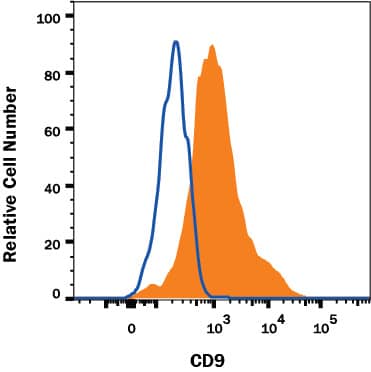
Detection of CD9 in D3 Mouse Cell Line by Flow Cytometry.
D3 mouse embryonic stem cell line was stained with Rat Anti-Mouse CD9 Monoclonal Antibody (Catalog # MAB5218, filled histogram) or isotype control antibody (Catalog # MAB006, open histogram) followed by anti-Rat IgG APC-conjugated antibody (Catalog # F0113). View our protocol for Staining Membrane-associated Proteins.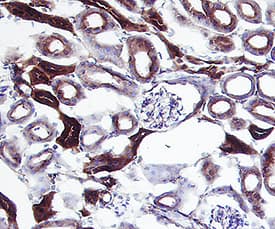
CD9 in Mouse Kidney.
CD9 was detected in perfusion fixed frozen sections of mouse kidney using Rat Anti-Mouse CD9 Monoclonal Antibody (Catalog # MAB5218) at 25 µg/mL overnight at 4 °C. Tissue was stained using the Anti-Mouse HRP-DAB Cell & Tissue Staining Kit (brown; Catalog # CTS002) and counterstained with hematoxylin (blue). Specific staining was localized to cytoplasm in convoluted tubules. View our protocol for Chromogenic IHC Staining of Paraffin-embedded Tissue Sections.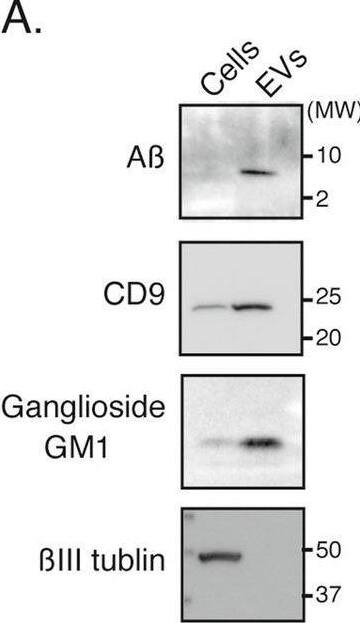
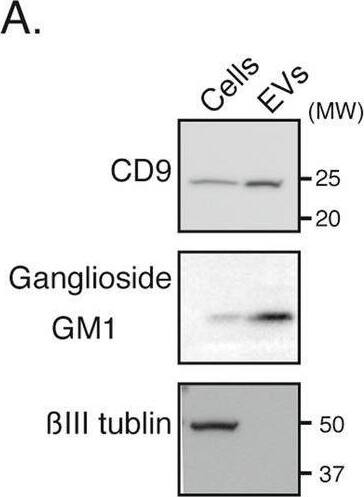
Detection of CD9 by Western Blot
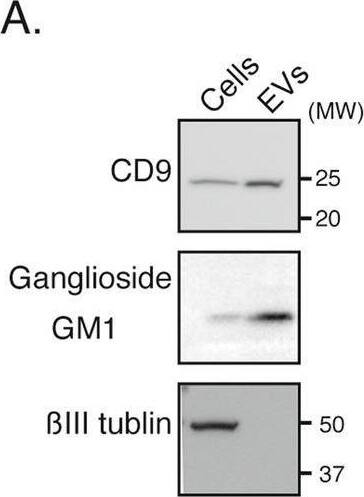
Quantification of A beta-bound and GM1-containing EVs using the idICA. A Western blot analysis of A beta, ganglioside GM1, and betaIII tubulin in APP-N2a cell lysates (1 × 10⁵ cells/lane) and EVs (1 × 10⁷ cells/lane). B Representative fluorescent images of various concentrations of APP-N2a-derived EVs in the idICA, which is constructed from CTB capture and anti-A beta detection. Each image displays a block of well array corresponding to 10,000 microwells. Scale bar, 200 μm. C, D The ratio of fluorescent beads to trapped beads in a block of well array is plotted as the concentration of A beta captured on CTB-coated beads (CTB-BAN50) in APP-N2a-derived EVs. Plots on the semi-logarithmic (C) and linear (D) scales are shown. Data represent mean ± SD (n = 3 each). E Representative images of APP-N2a-derived EVs (2500 ng protein) in the double color idICA using anti-CD9 antibody and BAN50. Each image displays a block of well array corresponding to 10,000 microwells. Scale bar, 200 μm. F The ratio of BAN50 or CD9 fluorescent beads to trapped beads. G The overlap rate between BAN50 and CD9 fluorescent beads. Data represent mean ± SD (n = 5 each) Image collected and cropped by CiteAb from the following open publication (https://pubmed.ncbi.nlm.nih.gov/36184615), licensed under a CC-BY license. Not internally tested by R&D Systems.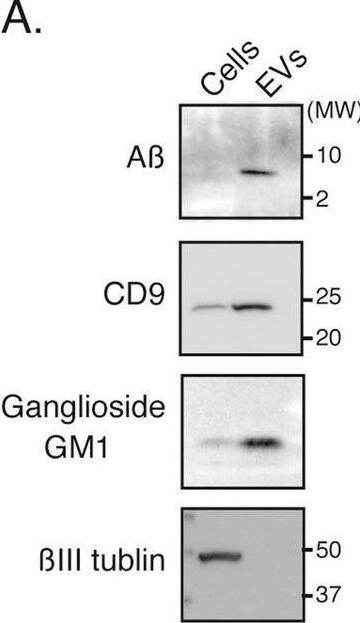
Applications for Mouse CD9 Antibody
Application
Recommended Usage
CyTOF-ready
Ready to be labeled using established conjugation methods. No BSA or other carrier proteins that could interfere with conjugation.
Flow Cytometry
0.25 µg/106 cells
Sample: Mouse D3 cell line
Sample: Mouse D3 cell line
Immunohistochemistry
8-25 µg/mL
Sample: Perfusion fixed frozen sections of mouse kidney
Sample: Perfusion fixed frozen sections of mouse kidney
Formulation, Preparation, and Storage
Purification
Protein A or G purified from hybridoma culture supernatant
Reconstitution
Reconstitute at 0.5 mg/mL in sterile PBS. For liquid material, refer to CoA for concentration.
Formulation
Lyophilized from a 0.2 μm filtered solution in PBS with Trehalose. *Small pack size (SP) is supplied either lyophilized or as a 0.2 µm filtered solution in PBS.
Shipping
Lyophilized product is shipped at ambient temperature. Liquid small pack size (-SP) is shipped with polar packs. Upon receipt, store immediately at the temperature recommended below.
Stability & Storage
Use a manual defrost freezer and avoid repeated freeze-thaw cycles.
- 12 months from date of receipt, -20 to -70 °C as supplied.
- 1 month, 2 to 8 °C under sterile conditions after reconstitution.
- 6 months, -20 to -70 °C under sterile conditions after reconstitution.
Background: CD9
CD9, also known as motility-related protein-1 (MRP-1), is a 24 kDa glycoprotein of the tetraspanin family that is expressed by a variety of hematopoietic and epithelial cells. It forms homotypic and heterotypic associations with other tetraspanin proteins, some integrins and MHC class II proteins. CD9 has been shown to modulate cellular adhesion, migration and proliferation. The extracellular portions of mouse CD9 share 81% and 88% amino acid identity with corresponding regions of human and rat CD9, respectively.
Alternate Names
CD9, DRAP-27, MIC3, p24, TSPAN29
Gene Symbol
CD9
UniProt
Additional CD9 Products
Product Documents for Mouse CD9 Antibody
Product Specific Notices for Mouse CD9 Antibody
For research use only
Loading...
Loading...
Loading...
Loading...
Loading...
Loading...