
Mouse CD200R1 Antibody
R&D Systems, part of Bio-Techne | Catalog # AF2554


Conjugate
Catalog #
Key Product Details
Species Reactivity
Validated:
Mouse
Cited:
Mouse, Rat
Applications
Validated:
Western Blot, Flow Cytometry, Immunocytochemistry, CyTOF-ready
Cited:
Immunohistochemistry, Immunohistochemistry-Paraffin, Immunohistochemistry-Frozen, Western Blot, Flow Cytometry, Immunocytochemistry
Label
Unconjugated
Antibody Source
Polyclonal Goat IgG
Product Specifications
Immunogen
Mouse myeloma cell line NS0-derived recombinant mouse CD200 R1
Thr26-Pro238
Accession # BAE42266
Thr26-Pro238
Accession # BAE42266
Specificity
Detects mouse CD200 R1 in direct ELISAs and Western blots. In direct ELISAs and Western blots, less than 5% cross‑reactivity with recombinant human CD200 R is observed.
Clonality
Polyclonal
Host
Goat
Isotype
IgG
Scientific Data Images for Mouse CD200R1 Antibody
CD200 R1 in Mouse Splenocytes.
CD200 R1 was detected in immersion fixed mouse splenocytes using Goat Anti-Mouse CD200 R1 Antigen Affinity-purified Polyclonal Antibody (Catalog # AF2554) at 15 µg/mL for 3 hours at room temperature. Cells were stained using the NorthernLights™ 557-conjugated Anti-Goat IgG Secondary Antibody (red; Catalog # NL001) and counterstained with DAPI (blue). Specific staining was localized to cytoplasm. View our protocol for Fluorescent ICC Staining of Non-adherent Cells.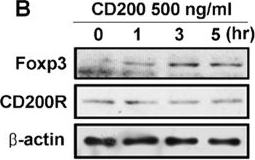
Detection of CD200R1 by Western Blot
Foxp3 expression is dependent upon CD200-CD200R-mediated signalling in microglia.(A) One day after KA treatment, mice were sacrificed and the hippocampus was double-labelled for Foxp3 and CD200R. Foxp3 IR (red, a) co-localized with that of CD200R (green, b; yellow, merge, c). Scale bar, 20 μm. (B) Primary microglia were collected from neonatal rats, plated, and treated with recombinant CD200 protein for the indicated length of time (left). Foxp3 expression (middle), but not CD200R (right), increased 3 h after CD200 treatment. (C) Treatment of rat microglia with CD200 up-regulated expression of the beneficial microglia activation marker, Arg1. (D) BV2 cells were transfected with control (scr) siRNA or siRNA targeting CD200R (si_CD200R) for 24 h, followed by treatment with CD200 for 3 h. Resultant immunoblots (left) and corresponding quantification (middle, CD200R; right, Foxp3) are shown. CD200R siRNA treatment reduced Foxp3 expression, which recovered slightly with CD200 treatment. ***P < 0.001 vs. control. Image collected and cropped by CiteAb from the following open publication (https://pubmed.ncbi.nlm.nih.gov/27731341), licensed under a CC-BY license. Not internally tested by R&D Systems.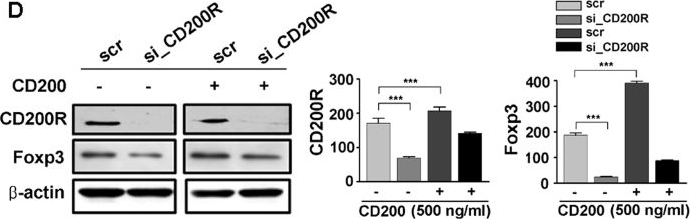
Detection of CD200R1 by Western Blot
Foxp3 expression is dependent upon CD200-CD200R-mediated signalling in microglia.(A) One day after KA treatment, mice were sacrificed and the hippocampus was double-labelled for Foxp3 and CD200R. Foxp3 IR (red, a) co-localized with that of CD200R (green, b; yellow, merge, c). Scale bar, 20 μm. (B) Primary microglia were collected from neonatal rats, plated, and treated with recombinant CD200 protein for the indicated length of time (left). Foxp3 expression (middle), but not CD200R (right), increased 3 h after CD200 treatment. (C) Treatment of rat microglia with CD200 up-regulated expression of the beneficial microglia activation marker, Arg1. (D) BV2 cells were transfected with control (scr) siRNA or siRNA targeting CD200R (si_CD200R) for 24 h, followed by treatment with CD200 for 3 h. Resultant immunoblots (left) and corresponding quantification (middle, CD200R; right, Foxp3) are shown. CD200R siRNA treatment reduced Foxp3 expression, which recovered slightly with CD200 treatment. ***P < 0.001 vs. control. Image collected and cropped by CiteAb from the following open publication (https://pubmed.ncbi.nlm.nih.gov/27731341), licensed under a CC-BY license. Not internally tested by R&D Systems.Applications for Mouse CD200R1 Antibody
Application
Recommended Usage
CyTOF-ready
Ready to be labeled using established conjugation methods. No BSA or other carrier proteins that could interfere with conjugation.
Flow Cytometry
2.5 µg/106 cells
Sample: MC/9-2 mouse masT cell line
Sample: MC/9-2 mouse masT cell line
Immunocytochemistry
5-15 µg/mL
Sample: Immersion fixed mouse splenocytes
Sample: Immersion fixed mouse splenocytes
Western Blot
0.1 µg/mL
Sample: Recombinant Mouse CD200 R1 Fc Chimera (Catalog # 2554-CD)
Sample: Recombinant Mouse CD200 R1 Fc Chimera (Catalog # 2554-CD)
Formulation, Preparation, and Storage
Purification
Antigen Affinity-purified
Reconstitution
Reconstitute at 0.2 mg/mL in sterile PBS. For liquid material, refer to CoA for concentration.
Formulation
Lyophilized from a 0.2 μm filtered solution in PBS with Trehalose. *Small pack size (SP) is supplied either lyophilized or as a 0.2 µm filtered solution in PBS.
Shipping
Lyophilized product is shipped at ambient temperature. Liquid small pack size (-SP) is shipped with polar packs. Upon receipt, store immediately at the temperature recommended below.
Stability & Storage
Use a manual defrost freezer and avoid repeated freeze-thaw cycles.
- 12 months from date of receipt, -20 to -70 °C as supplied.
- 1 month, 2 to 8 °C under sterile conditions after reconstitution.
- 6 months, -20 to -70 °C under sterile conditions after reconstitution.
Background: CD200R1
CD200 R1, also known as OX-2 receptor, is a 90 kDa, type I transmembrane protein that belongs to the immunoglobulin superfamily. CD200 R1 is important in the regulation of myeloid cell activity (1‑3). The mouse CD200 R1 cDNA encodes a 326 aa precursor that includes a 25 aa signal sequence, a 213 aa extracellular domain (ECD), a 21 aa transmembrane segment, and a 67 aa cytoplasmic domain. The ECD is composed of one Ig-like V-type domain and one Ig-like C2-type domain (4). Within the ECD, mouse CD200 R1 shares 56% and 70% aa sequence identity with human and rat CD200 R1, respectively. The ECD of mouse CD200 R1 shares 69%, 38%, 79%, and 83% aa sequence identity with the ECD of CD200 R2, 3, 4, and a CD200 R-like molecule, respectively. CD200 R1 is expressed primarily on mast cells, basophils, macrophages, and dendritic cells, (5‑7) while its ligand, CD200, is widely distributed (8). Disruption of this receptor-ligand pair by knockout of the CD200 gene leads to increased macrophage number and activation, plus a predisposition to autoimmune disorders (9). Association of CD200 with CD200 R1 takes place between their respective N-terminal Ig-like domains (10). The CD200 R-like molecules may interact differently with CD200 (11, 12). The cytoplasmic domain of CD200 R1 contains two non-ITIM tyrosine residues which are required for propagating its inhibitory signals (13‑15). CD200 R-like molecules, in contrast, are potentially activating receptors by means of their association with DAP12 (4, 16).
References
- Rosenblum, M.D. et al. (2006) J. Dermatol. Sci. 41:165.
- Gorczynski, R.M. (2005) Curr. Opin. Invest. Drugs 6:483.
- Barclay, A.N. et al. (2002) Trends Immunol. 23:285.
- Wright, G.J. et al. (2003) J. Immunol. 171:3034.
- Shiratori, I. et al. (2005) J. Immunol. 175:4441.
- Cherwinski, H.M. et al. (2005) J. Immunol. 174:1348.
- Fallarino, F. et al. (2004) J. Immunol. 173:3748.
- Wright, G.J. et al. (2001) Immunology 102:173.
- Hoek, R.M. et al. (2000) Science 290:1768.
- Hatherley, D. and A.N. Barclay (2004) Eur. J. Immunol. 34:1688.
- Hatherley, D. et al. (2005) J. Immunol. 175:2469.
- Gorczynski, R. et al. (2004) J. Immunol. 172:7744.
- Zhang, S. and J.H. Phillips (2006) J. Leukoc. Biol. 79:363.
- Zhang, S. et al. (2004) J. Immunol. 173:6786.
- Jenmalm, M.C. et al. (2006) J. Immunol. 176:191.
- Voehringer, D. et al. (2004) J. Biol. Chem. 279:54117.
Long Name
CD200 Receptor 1
Alternate Names
CD200 R1, MOX2R
Gene Symbol
CD200R1
UniProt
Additional CD200R1 Products
Product Documents for Mouse CD200R1 Antibody
Product Specific Notices for Mouse CD200R1 Antibody
For research use only
Loading...
Loading...
Loading...
Loading...
Loading...
Loading...