
Mouse B7-H3 Antibody
R&D Systems, part of Bio-Techne | Catalog # AF1397


Conjugate
Catalog #
Key Product Details
Species Reactivity
Validated:
Mouse
Cited:
Mouse
Applications
Validated:
Western Blot, Neutralization
Cited:
Western Blot
Label
Unconjugated
Antibody Source
Polyclonal Goat IgG
Product Specifications
Immunogen
Mouse myeloma cell line NS0-derived recombinant mouse B7-H3
Val29-Phe244
Accession # Q8VE98
Val29-Phe244
Accession # Q8VE98
Specificity
Detects mouse B7‑H3 in direct ELISAs and Western blots. In direct ELISAs and Western blots, approximately 50% cross‑reactivity with recombinant human (rh) B7-H3 is observed, and less than 1% cross-reactivity with recombinant mouse (rm) B7‑H1, rmB7-H2 and rmB7-1 is observed.
Clonality
Polyclonal
Host
Goat
Isotype
IgG
Endotoxin Level
<0.10 EU per 1 μg of the antibody by the LAL method.
Scientific Data Images for Mouse B7-H3 Antibody
Detection of Mouse B7‑H3 by Western Blot.
Western blot shows lysates of MEF mouse embryonic feeder cells, P19 mouse embryonal carcinoma cell line, NIH-3T3 mouse embryonic fibroblast cell line, C2C12 mouse myoblast cell line, and 3T3-L1 mouse embryonic fibroblast adipose-like cell line. PVDF membrane was probed with 1 µg/mL of Goat Anti-Mouse B7-H3 Antigen Affinity-purified Polyclonal Antibody (Catalog # AF1397) followed by HRP-conjugated Anti-Goat IgG Secondary Antibody (Catalog # HAF017). A specific band was detected for B7-H3 at approximately 45-55 kDa (as indicated). This experiment was conducted under reducing conditions and using Immunoblot Buffer Group 1.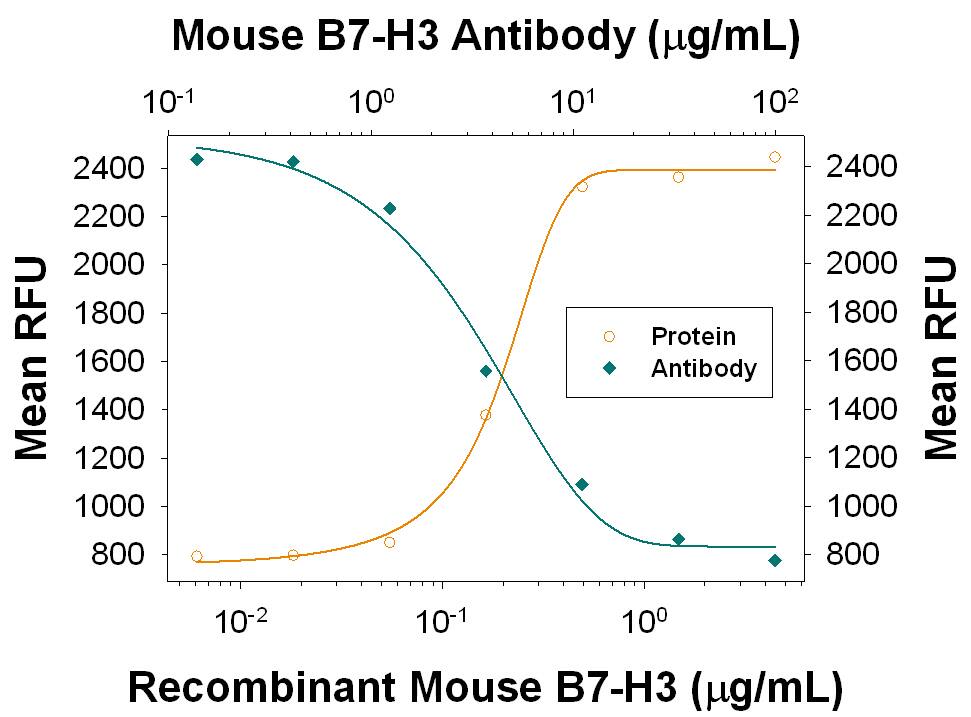
Proliferation Induced by B7‑H3 and Neutralization by Mouse B7‑H3 Antibody.
Recombinant Mouse B7-H3 enhances proliferation in mouse CD3+T cells in the presence of 100 ng/mL Hamster Anti-Mouse CD3e Monoclonal Antibody (Catalog # MAB484) in a dose-dependent manner (orange line), as measured by the Resazurin (Catalog # AR002). Proliferation elicited by Recombinant Mouse B7-H3 (2 µg/mL) is neutralized (green line) by increasing concentrations of Goat Anti-Mouse B7-H3 Antigen Affinity-purified Polyclonal Antibody (Catalog # AF1397). The ND50 is typically 1.5-7.5 µg/mL.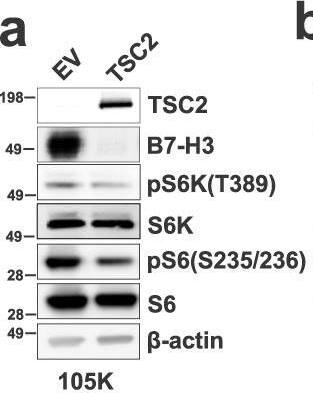
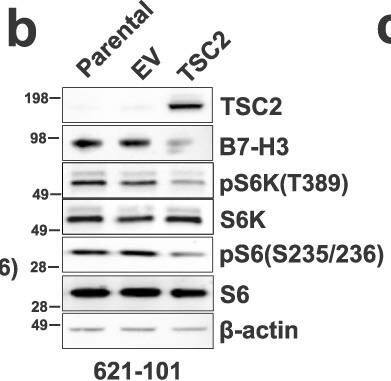
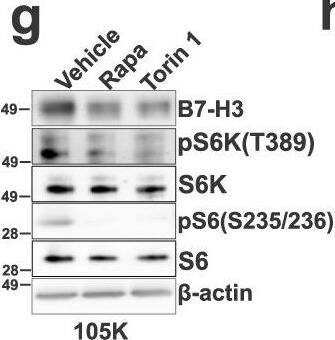
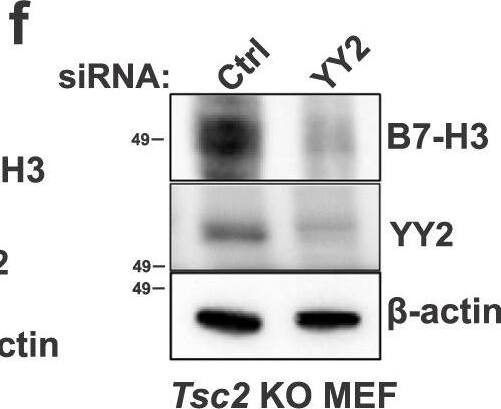
Detection of Mouse B7-H3 by Western Blot
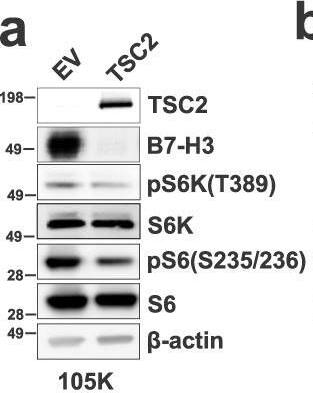
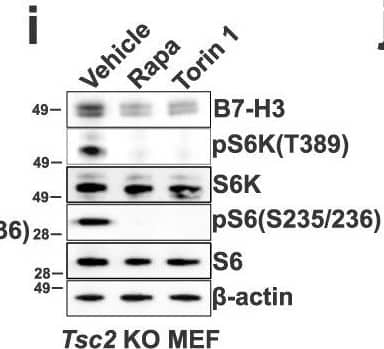
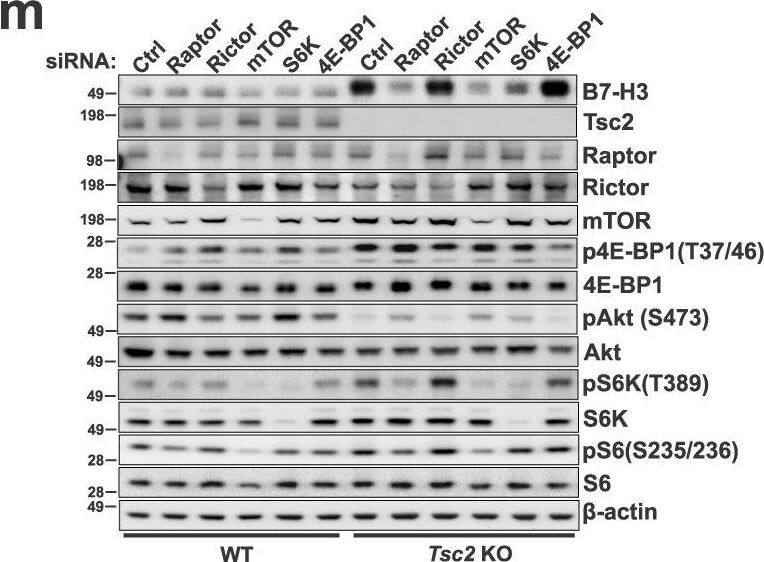
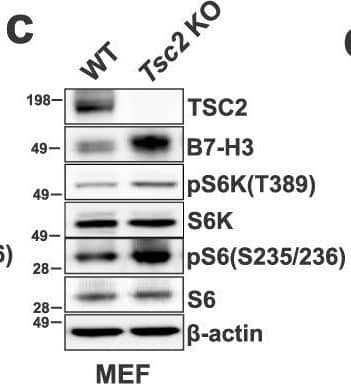
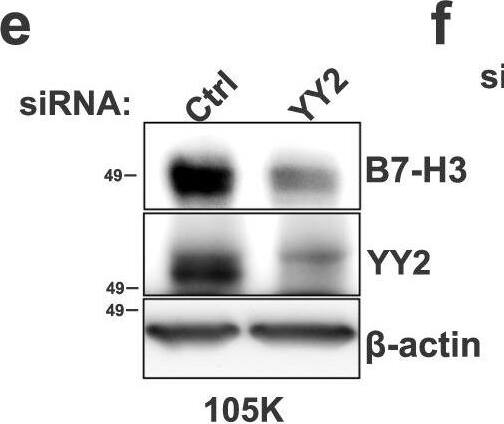
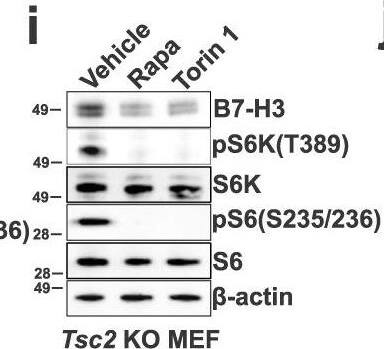
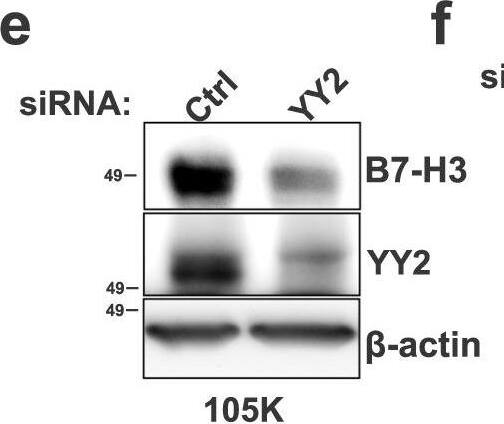
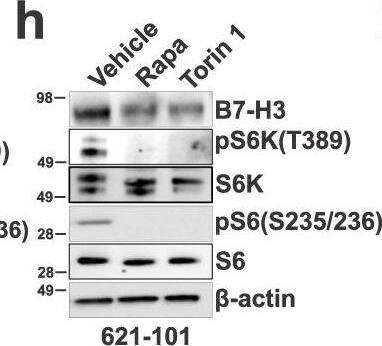
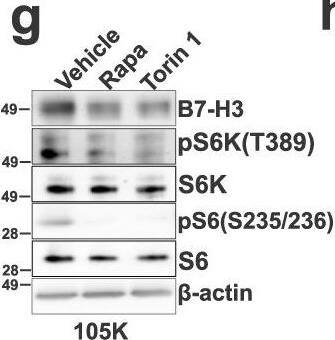
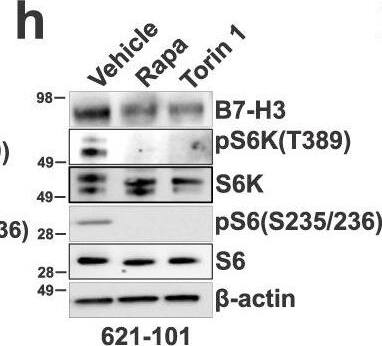
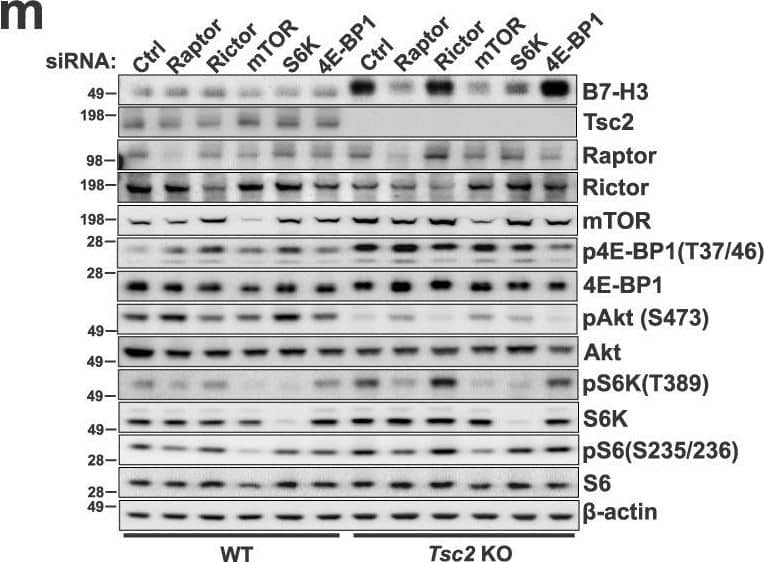
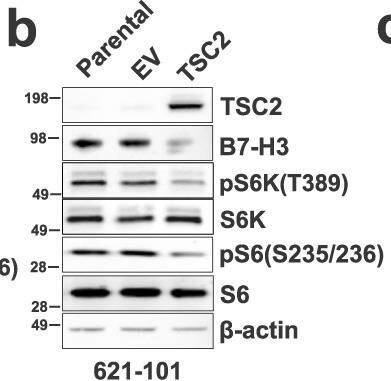
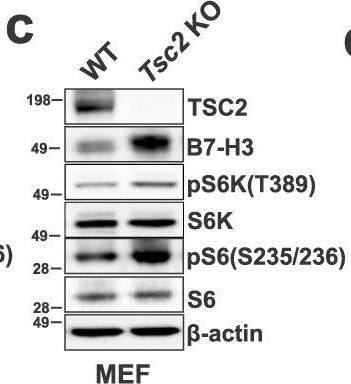
B7-H3 expression is regulated by mTORC1.B7-H3 protein expression in Tsc2−/− 105K cells with stable reconstitution of TSC2 or empty vector (EV) (a), TSC2−/− 621-101 angiomyolipoma-derived cells with reconstitution of TSC2 or empty vector (EV) (b), and Tsc2-WT and Tsc2 KO MEFs (c). For all figure legends, n = 3 indicates representative of 3 biologic samples (n = 3). B7-H3 mRNA expression in Tsc2−/− 105K cells with stable reconstitution of TSC2 or empty vector (EV) (d), TSC2−/− 621-101 angiomyolipoma tumor cells with reconstitution of TSC2 or empty vector (EV) (e), Tsc2-WT and Tsc2 KO MEFs (f). Means ± SD, two-tailed unpaired Student’s t-test (d, f) or one-way ANOVA with Dunnett’s multiple comparisons test (e), *p < 0.05, **p < 0.01. n = 3. B7-H3 protein expression in Tsc2−/− 105K cells (g), TSC2−/− 621-101 angiomyolipoma tumor cells (h), and Tsc2 KO MEFs (i) treated with 20 nM rapamycin (Rapa), 500 nM Torin 1 or vehicle for 24 hr (n = 3). B7-H3 mRNA expression in Tsc2−/− 105K cells (j), TSC2−/− 621-101 angiomyolipoma tumor cells (k), and Tsc2 KO MEFs (l) treated with 20 nM rapamycin (Rapa), 500 nM Torin 1, or vehicle for 24 hr. n = 3, means ± SD, one-way ANOVA with Dunnett’s multiple comparisons test, *p < 0.05, **p < 0.01, ***p < 0.001. m Immunoblotting analysis of Tsc2-WT and Tsc2 KO MEFs transfected with non-targeting control siRNA (Ctrl) or SMARTpool siRNAs targeting Raptor, Rictor, mTOR, S6K, or 4E-BP1 for 48 h hr (n = 3). n qRT-PCR analysis of Tsc2-WT and Tsc2 KO MEFs transfected with non-targeting control siRNA (Ctrl) or SMARTpool siRNAs targeting either Raptor, Rictor, mTOR, S6K, or 4E-BP1 for 48 hr. n = 3, means ± SD, two-way ANOVA with Dunnett’s multiple comparisons test, ***p < 0.001, ****p < 0.0001. Source data and exact p values are provided in the Source data file. Image collected and cropped by CiteAb from the following open publication (https://pubmed.ncbi.nlm.nih.gov/36869048), licensed under a CC-BY license. Not internally tested by R&D Systems.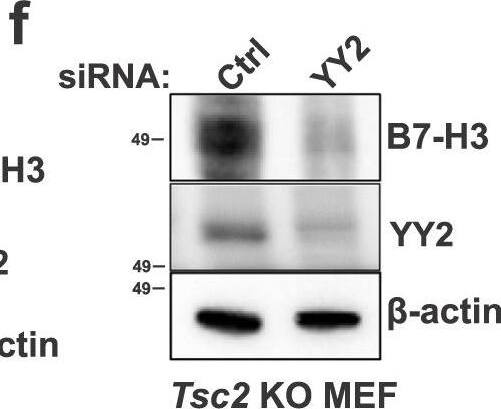
Applications for Mouse B7-H3 Antibody
Application
Recommended Usage
Western Blot
1 µg/mL
Sample: MEF mouse embryonic feeder cells, P19 mouse embryonal carcinoma cell line, NIH‑3T3 mouse embryonic fibroblast cell line, C2C12 mouse myoblast cell line, and 3T3‑L1 mouse embryonic fibroblast adipose-like cell line
Sample: MEF mouse embryonic feeder cells, P19 mouse embryonal carcinoma cell line, NIH‑3T3 mouse embryonic fibroblast cell line, C2C12 mouse myoblast cell line, and 3T3‑L1 mouse embryonic fibroblast adipose-like cell line
Neutralization
Measured by its ability to neutralize B7‑H3-induced proliferation in mouse CD3+ T cells. The Neutralization Dose (ND50) is typically 1.5-7.5 µg/mL in the presence of 2 µg/well Recombinant Mouse B7‑H3 and 100 ng/mL Hamster Anti-Mouse CD3 epsilon Monoclonal Antibody (Catalog # MAB484).
Formulation, Preparation, and Storage
Purification
Antigen Affinity-purified
Reconstitution
Reconstitute at 0.2 mg/mL in sterile PBS. For liquid material, refer to CoA for concentration.
Formulation
Lyophilized from a 0.2 μm filtered solution in PBS with Trehalose. *Small pack size (SP) is supplied either lyophilized or as a 0.2 µm filtered solution in PBS.
Shipping
Lyophilized product is shipped at ambient temperature. Liquid small pack size (-SP) is shipped with polar packs. Upon receipt, store immediately at the temperature recommended below.
Stability & Storage
Use a manual defrost freezer and avoid repeated freeze-thaw cycles.
- 12 months from date of receipt, -20 to -70 °C as supplied.
- 1 month, 2 to 8 °C under sterile conditions after reconstitution.
- 6 months, -20 to -70 °C under sterile conditions after reconstitution.
Background: B7-H3
T cells require a signal induced by the engagement of the T cell receptor and a “co‑stimulatory” signal(s) through distinct T cell surface molecules for optimal T cell expansion and activation. Members of the B7 superfamily of counter-receptors were identified by their ability to interact with co‑stimulatory molecules found on the surface of T cells. Members of the B7 superfamily include B7-1 (CD80), B7-2 (CD86), B7‑H1 (PD-L1), B7-H2 (B7RP-1), B7-H3, and PD-L2 (1). B7-H3 is expressed at very high levels in immature dendritic cells at moderate levels on mature dendritic cells, LPS stimulated immature dendritic cells and LPS stimulated monocytes, and at low levels on resting monocytes. B7-H3 binds to activated T cells via an as-of-yet identified receptor. B7-H3 co-stimulates proliferation of T cells and interferon-gamma (IFN-gamma) production and enhances the induction of cytotoxic T cells. B7-H3 shares 20‑27% amino acid (aa) identity with other B7 family members (2). Murine B7-H3 is a 259 aa protein containing an extracellular domain, a transmembrane domain and a cytoplasmic domain. Mouse and human B7-H3 share 87% aa identity (3).
References
- Coyle, A.J. and J.-C. Gutierrez-Ramos (2001) Nature Immunol. 2:203.
- Chapoval, A.I. et al. (2001) Nature Immunol. 2:269.
- Sun, M. et al. (2002) J. Immunol. 168:6294.
Long Name
B7 Homolog 3
Alternate Names
B7H3, CD276
Gene Symbol
CD276
UniProt
Additional B7-H3 Products
Product Documents for Mouse B7-H3 Antibody
Product Specific Notices for Mouse B7-H3 Antibody
For research use only
Loading...
Loading...
Loading...
Loading...
Loading...