
Human/Rat CaMKK alpha Antibody
R&D Systems, part of Bio-Techne | Catalog # AF4536

Conjugate
Catalog #
Key Product Details
Species Reactivity
Human, Rat
Applications
Western Blot, Simple Western
Label
Unconjugated
Antibody Source
Polyclonal Sheep IgG
Product Specifications
Immunogen
E. coli-derived recombinant human CaMKK alpha
Met1-Ser132
Accession # Q8N5S9
Met1-Ser132
Accession # Q8N5S9
Specificity
Detects endogenous human and rat CaMKK alpha in Western blots. In Western blots, this antibody does not cross-react with recombinant human CaMKK beta.
Clonality
Polyclonal
Host
Sheep
Isotype
IgG
Scientific Data Images for Human/Rat CaMKK alpha Antibody
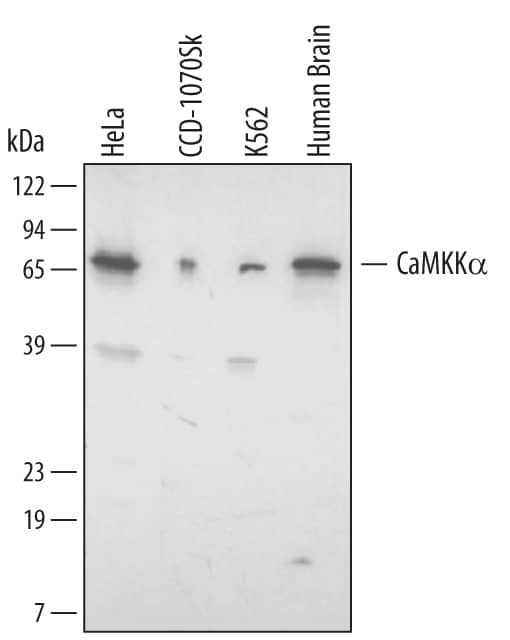
Detection of Human/Rat CaMKK alpha by Western Blot.
Western blot shows lysates of HeLa human cervical epithelial carcinoma cell line, CCD-1070Sk human foreskin fibroblast cell line, K562 human chronic myelogenous leukemia cell line, and human brain tissue. PVDF membrane was probed with 1 µg/mL of Human/Rat CaMKKa Antigen Affinity-purified Polyclonal Antibody (Catalog # AF4536) followed by HRP-conjugated Anti-Sheep IgG Secondary Antibody (Catalog # HAF016). A specific band was detected for CaMKK alpha at approximately 68 kDa (as indicated). This experiment was conducted using Immunoblot Buffer Group 1.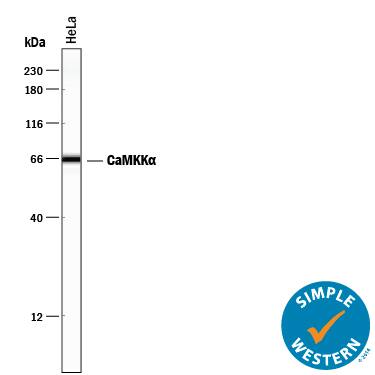
Detection of Human CaMKK alpha by Simple WesternTM.
Simple Western lane view shows lysates of HeLa human cervical epithelial carcinoma cell line, loaded at 0.2 mg/mL. A specific band was detected for CaMKKa at approximately 68 kDa (as indicated) using 10 µg/mL of Sheep Anti-Human/Rat CaMKKa Antigen Affinity-purified Polyclonal Antibody (Catalog # AF4536) followed by 1:50 dilution of HRP-conjugated Anti-Sheep IgG Secondary Antibody (Catalog # HAF016). This experiment was conducted under reducing conditions and using the 12-230 kDa separation system.Applications for Human/Rat CaMKK alpha Antibody
Application
Recommended Usage
Simple Western
10 µg/mL
Sample: HeLa human cervical epithelial carcinoma cell line
Sample: HeLa human cervical epithelial carcinoma cell line
Western Blot
1 µg/mL
Sample: HeLa human cervical epithelial carcinoma cell line, CCD-1070Sk human foreskin fibroblast cell line, K562 human chronic myelogenous leukemia cell line, and human brain tissue
Sample: HeLa human cervical epithelial carcinoma cell line, CCD-1070Sk human foreskin fibroblast cell line, K562 human chronic myelogenous leukemia cell line, and human brain tissue
Formulation, Preparation, and Storage
Purification
Antigen Affinity-purified
Reconstitution
Reconstitute at 0.2 mg/mL in sterile PBS. For liquid material, refer to CoA for concentration.
Formulation
Lyophilized from a 0.2 μm filtered solution in PBS with Trehalose. *Small pack size (SP) is supplied either lyophilized or as a 0.2 µm filtered solution in PBS.
Shipping
Lyophilized product is shipped at ambient temperature. Liquid small pack size (-SP) is shipped with polar packs. Upon receipt, store immediately at the temperature recommended below.
Stability & Storage
Use a manual defrost freezer and avoid repeated freeze-thaw cycles.
- 12 months from date of receipt, -20 to -70 °C as supplied.
- 1 month, 2 to 8 °C under sterile conditions after reconstitution.
- 6 months, -20 to -70 °C under sterile conditions after reconstitution.
Background: CaMKK alpha
The calcium/calmodulin (CaM) kinase signaling cascade includes the upstream kinases CaM kinase kinase alpha (CaMKK alpha; also known as CaMKK1) and CaMKK beta (CaMKK2), and their substrates, the output kinases CaMKI and CaMKIV. Largely by activation of the transcription factor CREB, the CaM kinase cascade is implicated in neuronal development and long-term memory formation. In addition, CaMKK alpha is known to modulate skeletal muscle glucose uptake, and is upregulated during retinoic acid-induced neutrophil maturation.
Long Name
Calcium/Calmodulin-dependent Protein Kinase Kinase alpha
Alternate Names
CaM-kinase IV kinase, CaMKK1
Gene Symbol
CAMKK1
UniProt
Additional CaMKK alpha Products
Product Documents for Human/Rat CaMKK alpha Antibody
Product Specific Notices for Human/Rat CaMKK alpha Antibody
For research use only
Loading...
Loading...
Loading...
Loading...
Loading...