
Human PLUNC Antibody
R&D Systems, part of Bio-Techne | Catalog # MAB1897

Conjugate
Catalog #
Key Product Details
Species Reactivity
Validated:
Human
Cited:
Human, Mouse, Porcine, Chinchilla
Applications
Validated:
Western Blot
Cited:
Immunohistochemistry, Western Blot
Label
Unconjugated
Antibody Source
Monoclonal Mouse IgG2B Clone # 251512
Product Specifications
Immunogen
E. coli-derived recombinant human PLUNC
Gln20-Val256
Accession # Q9NP55
Gln20-Val256
Accession # Q9NP55
Specificity
Detects human PLUNC in direct ELISAs and Western blots.
Clonality
Monoclonal
Host
Mouse
Isotype
IgG2B
Scientific Data Images for Human PLUNC Antibody
Detection of PLUNC by Western Blot
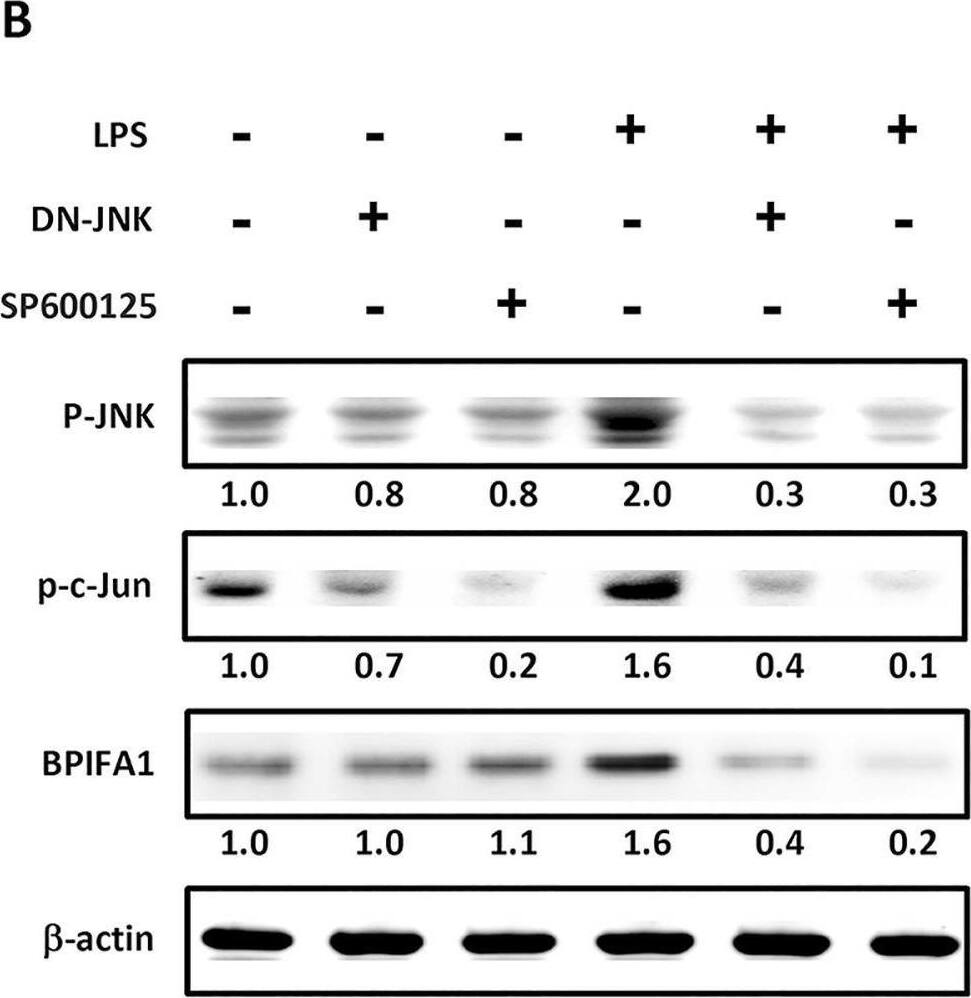
JNK/c-Jun pathway is involved in LPS-mediated up-regulation of BPIFA1 expression in nasal epithelial cells.(A) Cells were pretreated for 1 h with 20 μM PD98059 (ERK inhibitor), 10 μM SP600125 (JNK inhibitor), or 20 μM SB203580 (p38 inhibitor) and incubated with 10 μg/ml LPS for 2 h. (B) Cells were transfected with a JNK-dominant negative (DN-JNK) mutant for 24 h or pretreated with SP600125 for 30 min prior to incubation with LPS for 1 h. The protein expression levels were determined using western blot. beta-actin was used as the loading control. The western blots were carried out independently in triplicate and results were representative of one of three independent experiments. The expression level of each protein was quantified by signal intensity and was indicated at the bottom of each lane. The quantitative analysis of western blot for three independent experiments was shown in S2 Fig. ANOVA with Tukey’s test was used to compare the overall difference between the groups. P < 0.05 was considered statistically significant. Image collected and cropped by CiteAb from the following open publication (https://pubmed.ncbi.nlm.nih.gov/26646664), licensed under a CC-BY license. Not internally tested by R&D Systems.
Detection of PLUNC by Western Blot
AP-1 is involved in LPS-induced BPIFA1 expression. Cells were pretreated with 10 μM curcumin or tanshinone (inhibitors of c-Jun) for 30 min, followed by incubation with LPS (10 μg/ml) for 2 h. Protein expression levels were determined using western blot and normalized to those of beta-actin. The expression level of each protein is quantified by signal intensity and is indicated at the bottom of each lane. The quantitative analysis of western blot for three independent experiments was shown in S3 Fig. ANOVA with Tukey’s test was used to compare the overall difference between the groups. P < 0.05 was considered statistically significant. (B) Cells were transfected with AP-1-Luc reporter and incubated with LPS (10 μg/ml) for another 2 h. Cell lysates were subjected to luciferase activity assays to determine AP-1 luciferase activity. The results represented mean and standard deviation values from three independent experiments. *, P < 0.05 compared between two groups. Image collected and cropped by CiteAb from the following open publication (https://pubmed.ncbi.nlm.nih.gov/26646664), licensed under a CC-BY license. Not internally tested by R&D Systems.
Detection of PLUNC by Western Blot
JNK/c-Jun pathway is involved in LPS-mediated up-regulation of BPIFA1 expression in nasal epithelial cells.(A) Cells were pretreated for 1 h with 20 μM PD98059 (ERK inhibitor), 10 μM SP600125 (JNK inhibitor), or 20 μM SB203580 (p38 inhibitor) and incubated with 10 μg/ml LPS for 2 h. (B) Cells were transfected with a JNK-dominant negative (DN-JNK) mutant for 24 h or pretreated with SP600125 for 30 min prior to incubation with LPS for 1 h. The protein expression levels were determined using western blot. beta-actin was used as the loading control. The western blots were carried out independently in triplicate and results were representative of one of three independent experiments. The expression level of each protein was quantified by signal intensity and was indicated at the bottom of each lane. The quantitative analysis of western blot for three independent experiments was shown in S2 Fig. ANOVA with Tukey’s test was used to compare the overall difference between the groups. P < 0.05 was considered statistically significant. Image collected and cropped by CiteAb from the following open publication (https://pubmed.ncbi.nlm.nih.gov/26646664), licensed under a CC-BY license. Not internally tested by R&D Systems.Applications for Human PLUNC Antibody
Application
Recommended Usage
Western Blot
1 µg/mL
Sample: Recombinant Human PLUNC
Sample: Recombinant Human PLUNC
Reviewed Applications
Read 1 review rated 5 using MAB1897 in the following applications:
Formulation, Preparation, and Storage
Purification
Protein A or G purified from hybridoma culture supernatant
Reconstitution
Reconstitute at 0.5 mg/mL in sterile PBS. For liquid material, refer to CoA for concentration.
Formulation
Lyophilized from a 0.2 μm filtered solution in PBS with Trehalose. *Small pack size (SP) is supplied either lyophilized or as a 0.2 µm filtered solution in PBS.
Shipping
Lyophilized product is shipped at ambient temperature. Liquid small pack size (-SP) is shipped with polar packs. Upon receipt, store immediately at the temperature recommended below.
Stability & Storage
Use a manual defrost freezer and avoid repeated freeze-thaw cycles.
- 12 months from date of receipt, -20 to -70 °C as supplied.
- 1 month, 2 to 8 °C under sterile conditions after reconstitution.
- 6 months, -20 to -70 °C under sterile conditions after reconstitution.
Background: PLUNC
Long Name
Palate, Lung, and Nasal Epithelium Associated
Alternate Names
BPIFA1, LUNX, SPLUNC1
Entrez Gene IDs
51297 (Human)
Gene Symbol
BPIFA1
UniProt
Additional PLUNC Products
Product Documents for Human PLUNC Antibody
Product Specific Notices for Human PLUNC Antibody
For research use only
Loading...
Loading...
Loading...
Loading...
Loading...