
Human Phospho-LRP-6 (S1490) Antibody
R&D Systems, part of Bio-Techne | Catalog # AF6649

Scientific images may be resized, cropped, or adjusted for brightness or contrast for presentation purposes. These updates are limited to presentation and do not affect the underlying scientific interpretation of the data. Where available, additional source data may be provided upon request.
Conjugate
Catalog #
Key Product Details
Validated by
Biological Validation
Species Reactivity
Validated:
Human
Cited:
Human
Applications
Validated:
Western Blot
Cited:
Western Blot
Label
Unconjugated
Antibody Source
Polyclonal Rabbit IgG
Product Specifications
Immunogen
Phosphopeptide containing the human LRP-6 S1490 site.
Specificity
Detects human LRP-6 when phosphorylated at S1490 in Western blots.
Clonality
Polyclonal
Host
Rabbit
Isotype
IgG
Scientific Data Images for Human Phospho-LRP-6 (S1490) Antibody
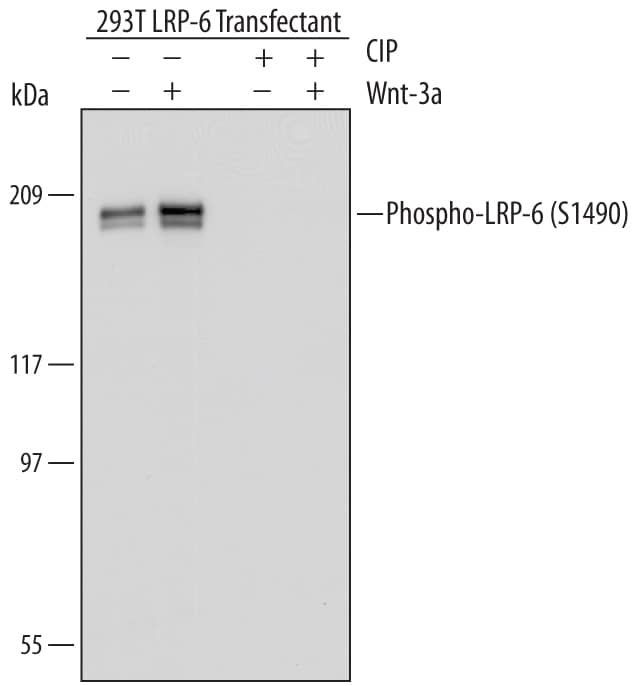
Detection of Human Phospho-LRP‑6 (S1490) by Western Blot.
Western blot shows lysates of 293T human embryonic kidney cell line transfected with human LRP-6 untreated (-) or treated (+) with 100 ng/mL Recombinant Human Wnt-3a (High Purity) (Catalog # 5036-WNP) for 15 minutes. PVDF Membrane was probed with 1 µg/mL of Rabbit Anti-Human Phospho-LRP-6 (S1490) Antigen Affinity-purified Polyclonal Antibody (Catalog # AF6649) followed by HRP-conjugated Anti-Rabbit IgG Secondary Antibody (Catalog # HAF008). A specific band was detected for Phospho-LRP-6 (S1490) at approximately 200 kDa (as indicated). The phospho-specificity of this antibody was supported by decreased labeling following treatment with 300 U/mL CIP for 1 hour. This experiment was conducted under reducing conditions and using Immunoblot Buffer Group 1.Applications for Human Phospho-LRP-6 (S1490) Antibody
Application
Recommended Usage
Western Blot
1 µg/mL
Sample: 293T human embryonic kidney cell line transfected with human LRP-6 treated with Recombinant Human Wnt‑3a (High Purity) (Catalog # 5036-WNP)
Sample: 293T human embryonic kidney cell line transfected with human LRP-6 treated with Recombinant Human Wnt‑3a (High Purity) (Catalog # 5036-WNP)
Formulation, Preparation, and Storage
Purification
Antigen Affinity-purified
Reconstitution
Sterile PBS to a final concentration of 0.2 mg/mL. For liquid material, refer to CoA for concentration.
Formulation
Lyophilized from a 0.2 μm filtered solution in PBS and Sodium Azide with Trehalose. *Small pack size (SP) is supplied either lyophilized or as a 0.2 µm filtered solution in PBS.
Shipping
Lyophilized product is shipped at ambient temperature. Liquid small pack size (-SP) is shipped with polar packs. Upon receipt, store immediately at the temperature recommended below.
Stability & Storage
Use a manual defrost freezer and avoid repeated freeze-thaw cycles.
- 12 months from date of receipt, -20 to -70 °C as supplied.
- 1 month, 2 to 8 °C under sterile conditions after reconstitution.
- 6 months, -20 to -70 °C under sterile conditions after reconstitution.
Background: LRP-6
LRP6 (Low-density lipoprotein receptor-related protein 6) is a 200-210 kDa member of the LDLR family of proteins. It is widely expressed, and serves as a coreceptor for both Wnt and parathyroid hormone. In the Wnt system, LRP6 associates with select Fzd multipass receptors; in the PTH system, LRP6 complexes with PTHR1. Mature human LRP6 is a 1594 amino acid (aa) type I transmembrane glycoprotein. It contains a 1351 aa extracellular region (aa 20-1370) plus a 220 aa cytoplasmic domain (aa 1394-1613). The cytoplasmic domain contains two palmitoylation sites, one ubiquitination residue, and multiple phosphorylation motifs. Ser1490 is a key residue that impacts multiple activities. It undergoes both constitutive and receptor activation-induced phosphorylation. At least three enzymes likely act at this site, including PKA (associated with PTHR1), GSK-3 (associated with Fzd) and Cyclin Y/PFTK1 (associated with G2/M of the cell cycle). In general, Ser1490 phosphorylation results in beta-catenin stabilization, followed by either gene transcription or beta-catenin binding to centrosomes.
Long Name
LDL Receptor-related Protein 6
Alternate Names
ADCAD2, FLJ90062, FLJ90421, LRP6
Gene Symbol
LRP6
Additional LRP-6 Products
Product Documents for Human Phospho-LRP-6 (S1490) Antibody
Product Specific Notices for Human Phospho-LRP-6 (S1490) Antibody
For research use only
Loading...
Loading...
Loading...
Loading...
Loading...