
Human OX40 Antibody
R&D Systems, part of Bio-Techne | Catalog # MAB3388

Scientific images may be resized, cropped, or adjusted for brightness or contrast for presentation purposes. These updates are limited to presentation and do not affect the underlying scientific interpretation of the data. Where available, additional source data may be provided upon request.
Conjugate
Catalog #
Key Product Details
Species Reactivity
Human
Applications
Western Blot, Flow Cytometry, CyTOF-ready
Label
Unconjugated
Antibody Source
Monoclonal Rat IgG2A Clone # 443318
Product Specifications
Immunogen
Mouse myeloma cell line NS0-derived recombinant human OX40/TNFRSF4
Leu29-Ala216
Accession # P43489
Leu29-Ala216
Accession # P43489
Specificity
Detects human OX40/TNFRSF4 in direct ELISAs and Western blots. In Western blots, no cross-reactivity with recombinant human (rh) 4-1BB, rhBAFF R, rhCD27, rhCD30, rhCD40, rhDR3, rhDR6, rhEDAR, rhFAS, rhGITR, rhHVEM, rhLT betaR, rhNGF R, rhRANK, rhRELT, rhTAJ, rhTNF RI, rhTNF RII, rhTRAIL, rhTRAIL R4, rhTRAIL R3, rhTWEAK R, or rhXEDAR is observed.
Clonality
Monoclonal
Host
Rat
Isotype
IgG2A
Scientific Data Images for Human OX40 Antibody
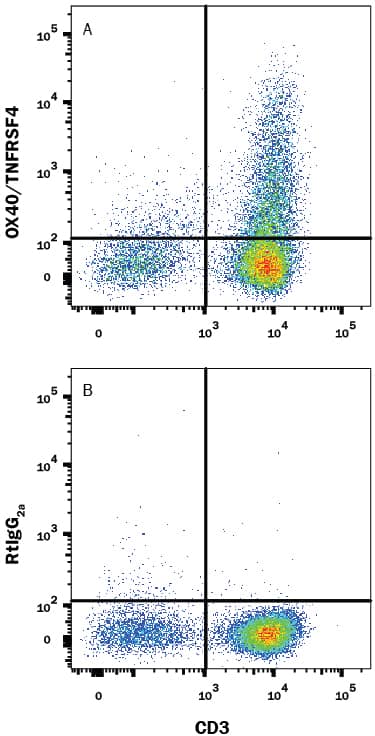
Detection of OX40/TNFRSF4 in Human PBMCs by Flow Cytometry.
Human peripheral blood mononuclear cells (PBMCs) were treated with 5 μg/ml PHA for 5 days then stained with Mouse Anti-Human CD3e APC-conjugated Monoclonal Antibody (Catalog # FAB100A) and either (A) Rat Anti-Human OX40/TNFRSF4 Monoclonal Antibody (Catalog # MAB3388) or (B) Rat IgG2AIsotype Control (MAB006) followed by Phycoerythrin-conjugated Anti-Rat IgG Secondary Antibody (F0105B). View our protocol for Staining Membrane-associated Proteins.Applications for Human OX40 Antibody
Application
Recommended Usage
CyTOF-ready
Ready to be labeled using established conjugation methods. No BSA or other carrier proteins that could interfere with conjugation.
Flow Cytometry
0.25 µg/106 cells
Sample: Human peripheral blood mononuclear cells (PBMCs)
Sample: Human peripheral blood mononuclear cells (PBMCs)
Western Blot
1 µg/mL
Sample: Recombinant Human OX40/TNFRSF4 Fc Chimera (Catalog # 3388-OX)
Sample: Recombinant Human OX40/TNFRSF4 Fc Chimera (Catalog # 3388-OX)
Formulation, Preparation, and Storage
Purification
Protein A or G purified from hybridoma culture supernatant
Reconstitution
Reconstitute at 0.5 mg/mL in sterile PBS. For liquid material, refer to CoA for concentration.
Formulation
Lyophilized from a 0.2 μm filtered solution in PBS with Trehalose. See Certificate of Analysis for details.
*Small pack size (-SP) is supplied either lyophilized or as a 0.2 µm filtered solution in PBS.
*Small pack size (-SP) is supplied either lyophilized or as a 0.2 µm filtered solution in PBS.
Shipping
Lyophilized product is shipped at ambient temperature. Liquid small pack size (-SP) is shipped with polar packs. Upon receipt, store immediately at the temperature recommended below.
Stability & Storage
Use a manual defrost freezer and avoid repeated freeze-thaw cycles.
- 12 months from date of receipt, -20 to -70 °C as supplied.
- 1 month, 2 to 8 °C under sterile conditions after reconstitution.
- 6 months, -20 to -70 °C under sterile conditions after reconstitution.
Background: OX40
OX40 (CD134; TNFRSF4) is a T cell co‑stimulatory molecule of the TNF receptor superfamily that coordinates with other membrane-bound co‑stimulators such as CD28, CD40, CD30, CD27 and 4-1BB (1‑3). OX40 is expressed on naïve CD4+ T cells only after engagement of the TCR by antigen presenting cells (APC; dendritic and B cells), and co‑stimulation by CD40/CD40 ligand and CD28/B7. It is maximal at 2‑5 days post activation, or 4 hours post reactivation of memory T cells (3‑6). Human OX40 is a 48 kDa type I transmembrane glycoprotein with a 28 amino acid (aa) signal sequence, a 185 aa extracellular domain (ECD) that has four TNFR-Cys repeats and an O-glycosylated hinge region, a 20 aa transmembrane segment, and a 41 aa cytoplasmic domain (3). The ECD of human OX40 shows 71%, 68%, 67%, 64% and 64% aa identity with feline, canine, rabbit, mouse and rat OX40 ECD, respectively. Engagement of OX40 on activated CD4+ T cells by OX40 ligand on activated dendritic cells promotes T cell survival and proliferation, prolongs the immune response, and enhances the number of cells making the transition from effector to memory T cells (1‑6). OX40 signal transduction includes binding TNF receptor-associated factors (TRAFs), and activating NF kappaB and PI3 kinase to enhance expression of cytokines, antiapoptotic Bcl-2 family members, survivin and the chemokine receptor CXCR5 (5‑8). CXCR5 promotes T cell migration to germinal centers to deliver B cell help (5). Studies using knockout or transgenic mice, and agonistic or blocking antibodies, show that OX40/OX40L interaction is critical for establishing or reactivating memory T cells and breaking immune tolerance (9). Blockade of OX40 engagement is efficacious in animal models of allergic airway inflammation, graft-versus-host disease and autoimmune disease (10‑14).
References
- Salek-Ardakani, S. and M. Croft (2006) Vaccine 24:872.
- Hori, T. (2006) Int. J. Hematol. 83:17.
- Latza, U. et al. (1994) Eur. J. Immunol. 24:677.
- Murata, K. et al. (2000) J. Exp. Med. 191:365.
- Fillatreau, S and D. Gray (2003) J. Exp. Med. 197:195.
- Gramaglia, I. et al. (1998) J. Immunol. 161:6510.
- Rogers, P.R. et al. (2001) Immunity 15:445.
- Song, J. et al. (2005) Immunity 22:621.
- Bansal-Pakala, P. et al. (2001) Nat. Med. 7:907.
- Salek-Ardakani, S. et al. (2003) J. Exp. Med. 198:315.
- Jember, A. G. et al. (2001) J. Exp. Med. 193:387.
- Demirci, G. et al. (2004) J. Immunol. 172:1691.
- Blazar, B.R. et al. (2003) Blood 101:3741.
- Higgins, L.M. et al. (1999) J. Immunol. 162:486.
Alternate Names
ACT-135, CD134, Ly-70, TNFRSF4, Txgp1, TXGP1L
Gene Symbol
TNFRSF4
UniProt
Additional OX40 Products
Product Documents for Human OX40 Antibody
Product Specific Notices for Human OX40 Antibody
For research use only
Loading...
Loading...
Loading...
Loading...
Loading...
Loading...