
Human NQO-1 Antibody
R&D Systems, part of Bio-Techne | Catalog # MAB7567

Scientific images may be resized, cropped, or adjusted for brightness or contrast for presentation purposes. These updates are limited to presentation and do not affect the underlying scientific interpretation of the data. Where available, additional source data may be provided upon request.
Conjugate
Catalog #
Key Product Details
Species Reactivity
Validated:
Human
Cited:
Human, Xenograft
Applications
Validated:
Western Blot, Immunoprecipitation
Cited:
Immunohistochemistry, Western Blot
Label
Unconjugated
Antibody Source
Monoclonal Mouse IgG2B Clone # 844142
Product Specifications
Immunogen
E. coli-derived recombinant human NQO-1
Met1-Lys274
Accession # P15559
Met1-Lys274
Accession # P15559
Specificity
Detects human NQO-1 in direct ELISAs and Western blots. In direct ELISAs, no cross-reactivity
with recombinant human NQO-2 is observed.
Clonality
Monoclonal
Host
Mouse
Isotype
IgG2B
Scientific Data Images for Human NQO-1 Antibody
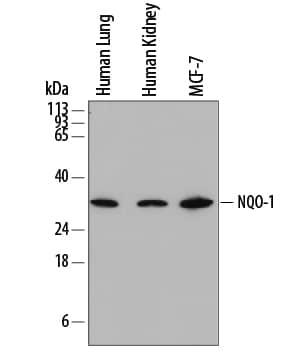
Detection of Human NQO-1 by Western Blot.
Western blot shows lysates of human lung tissue, human kidney tissue, and MCF-7 human breast cancer cell line. PVDF membrane was probed with 0.5 µg/mL of Mouse Anti-Human NQO-1 Monoclonal Antibody (Catalog # MAB7567) followed by HRP-conjugated Anti-Mouse IgG Secondary Antibody (Catalog # HAF018). A specific band was detected for NQO-1 at approximately 30 kDa (as indicated). This experiment was conducted under reducing conditions and using Immunoblot Buffer Group 1.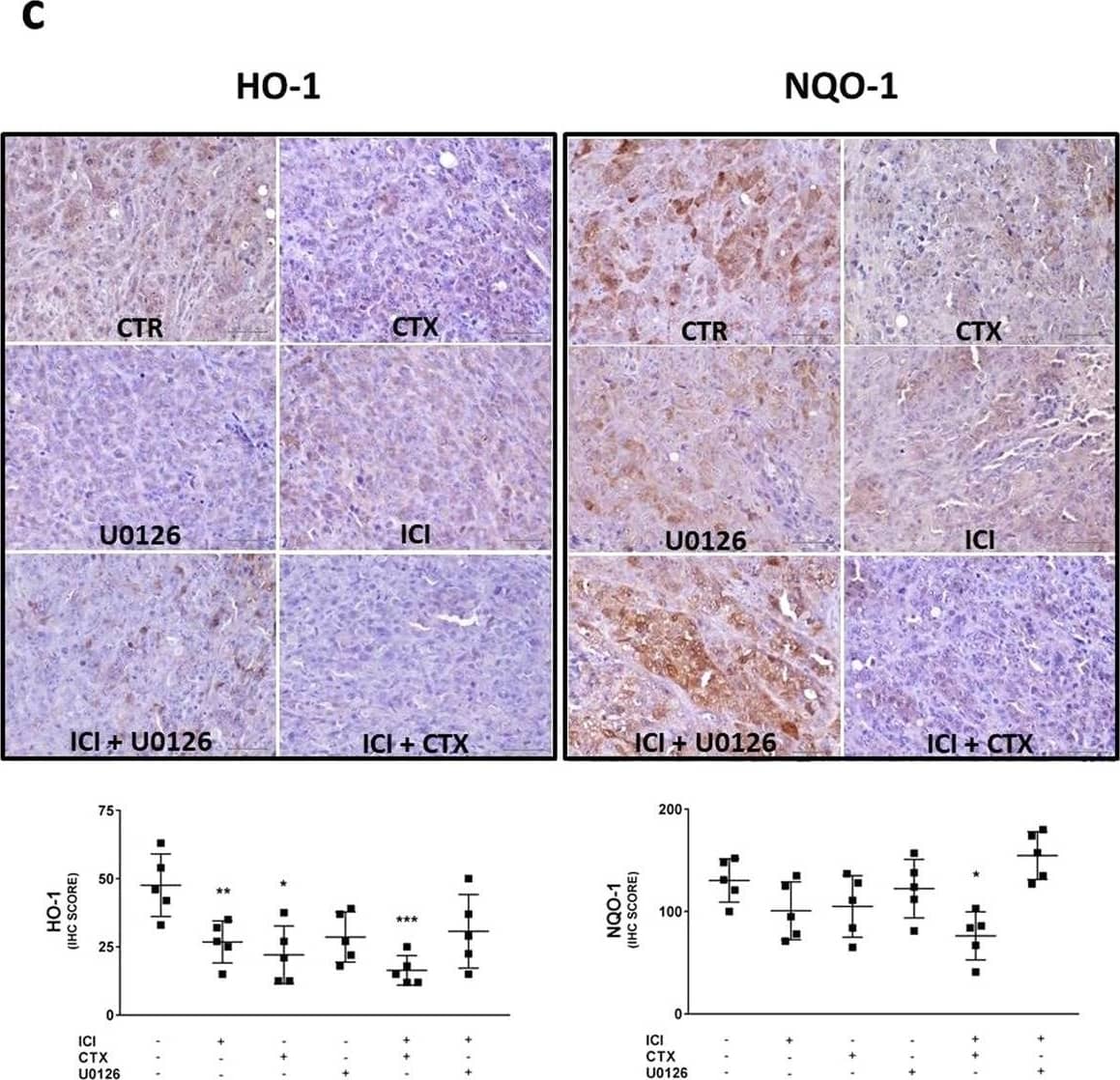
Detection of NQO-1 by Immunohistochemistry
beta2-AR and EGFR pathways regulate the ROS metabolism NRF-2 mediated. Evaluation of the ROS metabolism in cancer cells directly obtained from the HNSCC-bearing mice. a Western Blot analysis of Nrf-2 expression in both cytoplasmic and nuclear protein extracts. ICI treatment reduced the Nrf-2 nuclear translocation, in a more evident way if in combination with CTX. b RT-PCR for the HO-1, NQO-1, GCLC, and G6PD gene expression level analysis. The beta2-AR blockade diminishes the gene expression level of HO-1, with a synergistic effect in combination with CTX, which is able to induce a milder effect by itself. The MEK 1/2 inhibition did not replicate this effect. No significant effects have been observed about the NQO-1 expression. The expression of GCLC and G6PDH is significantly reduced only after treatment with ICI in combination with CTX. c Immunohistochemistry assay on mice tongues engrafted with UMSCC 103 for the HO-1 and NQO1 detection. The ICI and CTX treatments sensibly reduced the expression of HO1, which increases if we combine the drugs. The expression of NQO1 was affected only in mice subjected to the combination of ICI plus CTX. d Cell-ROX assay for the evaluation of the oxidative stress in UMSCC 103 induced by our drugs. With both flow cytometer and e fluorescent microscopy analysis, we observed an increased level of oxidation after treatment with the beta2-AR inhibitor, as well as with CTX and U0126. The same drugs are even more effective in combination, but this increased effect is counteracted by the KI696. (*P ≤ 0.05; **P ≤ 0.01; ****P ≤ 0.0001 vs. CTR). Image collected and cropped by CiteAb from the following open publication (https://pubmed.ncbi.nlm.nih.gov/37723219), licensed under a CC-BY license. Not internally tested by R&D Systems.Applications for Human NQO-1 Antibody
Application
Recommended Usage
Immunoprecipitation
25 µg/mL
Sample: Cell lysates spiked with recombinant human NQO-1, see our available Western blot detection antibodies.
Sample: Cell lysates spiked with recombinant human NQO-1, see our available Western blot detection antibodies.
Western Blot
0.5 µg/mL
Sample: Human lung tissue, human kidney tissue, and MCF‑7 human breast cancer cell line
Sample: Human lung tissue, human kidney tissue, and MCF‑7 human breast cancer cell line
Formulation, Preparation, and Storage
Purification
Protein A or G purified from hybridoma culture supernatant
Reconstitution
Sterile PBS to a final concentration of 0.5 mg/mL. For liquid material, refer to CoA for concentration.
Formulation
Lyophilized from a 0.2 μm filtered solution in PBS with Trehalose. *Small pack size (SP) is supplied either lyophilized or as a 0.2 µm filtered solution in PBS.
Shipping
Lyophilized product is shipped at ambient temperature. Liquid small pack size (-SP) is shipped with polar packs. Upon receipt, store immediately at the temperature recommended below.
Stability & Storage
Use a manual defrost freezer and avoid repeated freeze-thaw cycles.
- 12 months from date of receipt, -20 to -70 °C as supplied.
- 1 month, 2 to 8 °C under sterile conditions after reconstitution.
- 6 months, -20 to -70 °C under sterile conditions after reconstitution.
Background: NQO-1
Long Name
NAD(P)H Dehydrogenase, Quinone 1
Alternate Names
Azoreductase, DHQU, DIA4, Diaphorase-4, Dioxin-inducible 1, DTD, Menadione Reductase, NMOR1, NQO1, QR1, Quinone Reductase 1
Entrez Gene IDs
1728 (Human)
Gene Symbol
NQO1
UniProt
Additional NQO-1 Products
Product Documents for Human NQO-1 Antibody
Product Specific Notices for Human NQO-1 Antibody
For research use only
Loading...
Loading...
Loading...
Loading...
Loading...