
Human NPRA/NPR1 Antibody
R&D Systems, part of Bio-Techne | Catalog # MAB48601


Conjugate
Catalog #
Key Product Details
Species Reactivity
Validated:
Human
Cited:
Human
Applications
Validated:
Immunohistochemistry
Cited:
Western Blot
Label
Unconjugated
Antibody Source
Monoclonal Mouse IgG1 Clone # 377018
Product Specifications
Immunogen
Mouse myeloma cell line NS0-derived recombinant human NPR1/NPRA
Gly33-Glu473
Accession # P16066
Gly33-Glu473
Accession # P16066
Specificity
Detects human NPR1/NPRA in direct ELISAs.
Clonality
Monoclonal
Host
Mouse
Isotype
IgG1
Scientific Data Images for Human NPRA/NPR1 Antibody
NPRA/NPR1 in Human Kidney.
NPRA/NPR1 was detected in immersion fixed paraffin-embedded sections of human kidney using Mouse Anti-Human NPRA/NPR1 Monoclonal Antibody (Catalog # MAB48601) at 5 µg/mL for 1 hour at room temperature followed by incubation with the Anti-Mouse IgG VisUCyte™ HRP Polymer Antibody (Catalog # VC001). Tissue was stained using DAB (brown) and counterstained with hematoxylin (blue). Specific staining was localized to epithelial cell membranes. View our protocol for IHC Staining with VisUCyte HRP Polymer Detection Reagents.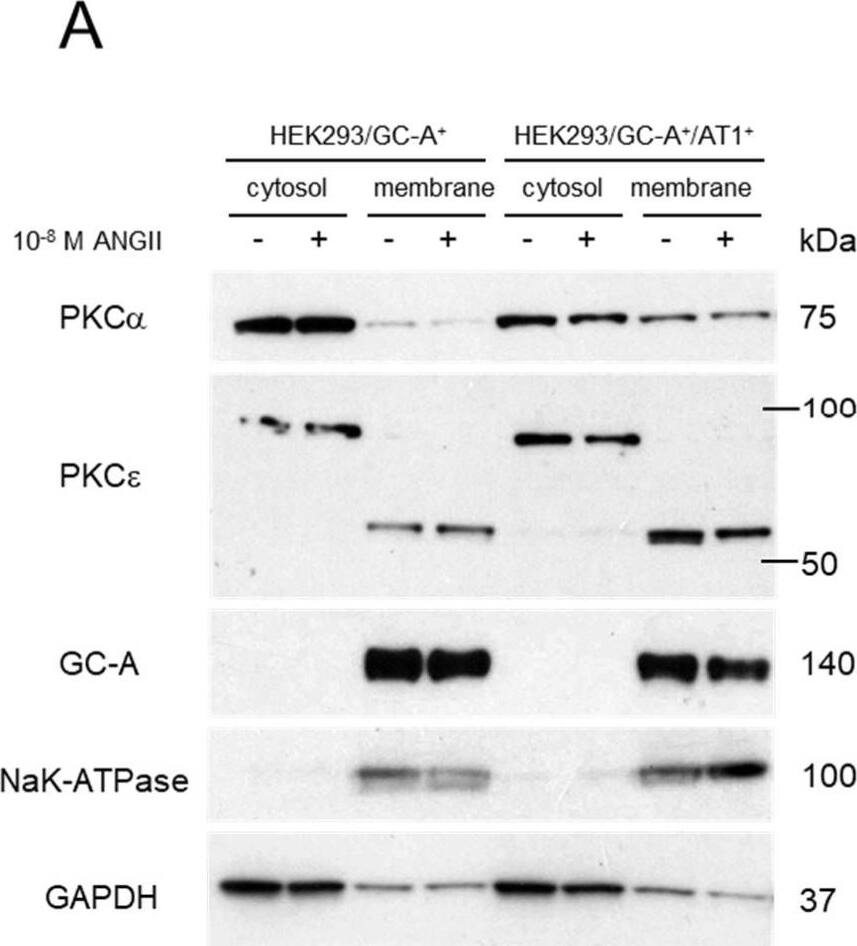
Detection of NPRA/NPR1 by Western Blot
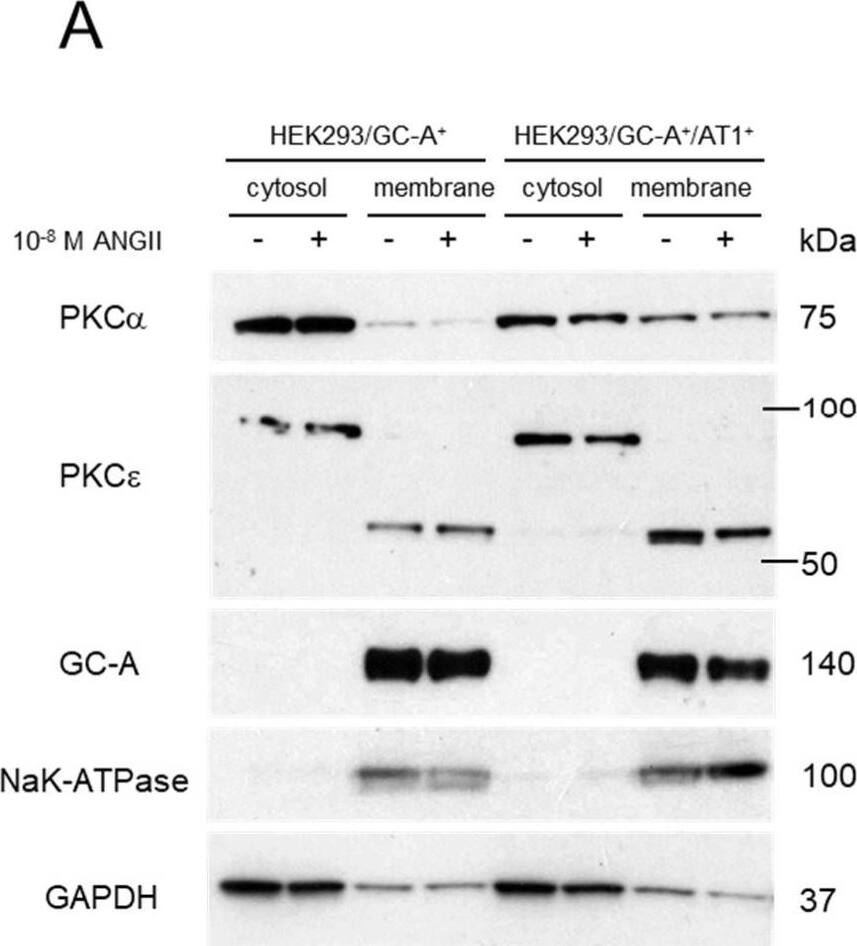
Involvement of PKC Signaling in the Crosstalk between ANGII and GC-A. (A) Protein expression of different human PKC isoforms in the membrane and cytosol fractions of different HEK293 cell lines (with or without treatment of ANGII). GC-A and NaK-ATPase serve as quality control for the separation of membrane and cytosol fractions. GAPDH serves as an additional control as it is primarily expressed in the cytosol fraction compared to membrane fraction. (B) Protein expression of phosphorylated PKC substrates, phosphorylated p38 MAPK, and p38 MAPK in HEK293/GC-A+/AT1+ cells treated with different PKC modulators. GAPDH serves as a loading control and 50 µg of total protein (determined using BCA method) was loaded in each lane. PMA, phorbol 12-myristate 13-acetate. (C) In vitro cGMP generation in HEK293/GC-A+/AT1+ in response to ANP (10−8 M) with or without ANGII (10−8 M) and valsartan (10−6 M) or Go6983 (5 µM). Values of cGMP were normalized to vehicle group (blue) under ANP treatment. * indicates p < 0.05, one-way ANOVA with Dunnett multiple comparisons test. (D) Hypothetical mechanism underlying the crosstalk between ANGII and GC-A derived from our in vitro studies: (1) ANGII naturally suppresses GC-A mediated cGMP production via AT1 receptor, but not the AT2 receptor nor direct effect on GC-A; (2) PKC is a critical downstream target of AT1 mediating this RAAS/NPS interaction. Image collected and cropped by CiteAb from the following open publication (https://pubmed.ncbi.nlm.nih.gov/37239899), licensed under a CC-BY license. Not internally tested by R&D Systems.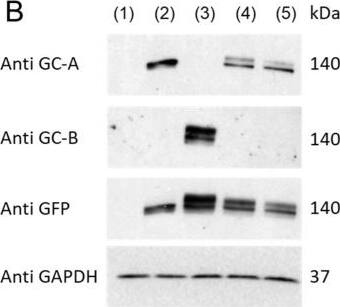
Detection of NPRA/NPR1 by Western Blot
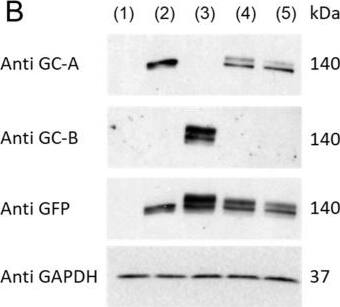
ANGII Attenuates GC-A Mediated cGMP Generation via AT1 Receptor. (A) Construction and nomenclature of three different HEK293 transfected cells. (B) Protein expression of human GC-A and GC-B in HEK293 parental and transfected cells by western blotting. 1, HEK293 parental cells; 2, HEK293/GC-A+; 3, HEK293/GC-B+; 4, HEK293/GC-A+/AT1+; 5, HEK293/GC-A+/AT2+. Each lane was loaded with 40 µg total protein. Antibody against GFP detected protein expression incurred by either GC-A or GC-B transfection. HEK293/GC-B+ cells served as a negative control for GC-A specific overexpression in other transfected cells. (C) mRNA expression of human AGTR1 (AT1 coding gene) in HEK293/GC-A+/AT1+ cells and human AGTR2 (AT2 coding gene) in HEK293/GC-A+/AT2+ cells, compared to HEK293/GC-A+ cells. Expression levels were normalized to human GAPDH. (D) In vitro cGMP generation in HEK293 transfected cells in response to different doses of ANP with or without ANGII (10−8 M). Values of cGMP in ANGII treated group (red) were normalized to corresponding vehicle group (blue) under each dose of ANP. Absolute values of cGMP are shown in Supplementary Figure S3. * indicates p < 0.05, two-way ANOVA with Sidak multiple comparisons test. N = 3 biological replicates (defined as cells grown in 3 independent plates) in each designed group. Image collected and cropped by CiteAb from the following open publication (https://pubmed.ncbi.nlm.nih.gov/37239899), licensed under a CC-BY license. Not internally tested by R&D Systems.Applications for Human NPRA/NPR1 Antibody
Application
Recommended Usage
Immunohistochemistry
5-25 µg/mL
Sample: Immersion fixed paraffin-embedded sections of human kidney
Sample: Immersion fixed paraffin-embedded sections of human kidney
Formulation, Preparation, and Storage
Purification
Protein A or G purified from hybridoma culture supernatant
Reconstitution
Reconstitute at 0.5 mg/mL in sterile PBS. For liquid material, refer to CoA for concentration.
Formulation
Lyophilized from a 0.2 μm filtered solution in PBS with Trehalose. *Small pack size (SP) is supplied either lyophilized or as a 0.2 µm filtered solution in PBS.
Shipping
Lyophilized product is shipped at ambient temperature. Liquid small pack size (-SP) is shipped with polar packs. Upon receipt, store immediately at the temperature recommended below.
Stability & Storage
Use a manual defrost freezer and avoid repeated freeze-thaw cycles.
- 12 months from date of receipt, -20 to -70 °C as supplied.
- 1 month, 2 to 8 °C under sterile conditions after reconstitution.
- 6 months, -20 to -70 °C under sterile conditions after reconstitution.
Background: NPRA/NPR1
Natriuretic peptide receptor A/guanylate cyclase A (NPR1), also called NPRA or GC-A, is a 120‑140 kDa type I transmembrane glycoprotein that is the primary receptor for natrietic peptides ANP and BNP. Binding of ANP to the extracellular ligand binding domain (aa 54‑415), plus ATP to the intracellular kinase homology domain (aa 528‑805) activates a cytoplasmic guanylate cyclase (aa 840‑1023). NPR1 is expressed most highly in kidney, adrenal and adipose tissue. Human NPR1 extracellular domain shows 86%, 44% and 34% aa identity with mouse NPR1, human NPRB and human NPRC, respectively.
Long Name
Natriuretic Peptide Receptor A
Alternate Names
ANPa, ANPRA, GC-A, GUCY2A, NPR1, NPRA, Pndr
Gene Symbol
NPR1
UniProt
Additional NPRA/NPR1 Products
Product Documents for Human NPRA/NPR1 Antibody
Product Specific Notices for Human NPRA/NPR1 Antibody
For research use only
Loading...
Loading...
Loading...
Loading...
Loading...