
Human Nectin-1 APC-conjugated Antibody
R&D Systems, part of Bio-Techne | Catalog # FAB2880A

Discontinued Product
FAB2880A has been discontinued.
View all Nectin-1 products.
Key Product Details
Species Reactivity
Human
Applications
Flow Cytometry
Label
Allophycocyanin (Excitation = 620-650 nm, Emission = 660-670 nm)
Antibody Source
Monoclonal Mouse IgG2A Clone # 610835
Product Specifications
Immunogen
Mouse myeloma cell line NS0-derived recombinant human Nectin-1
Gln31-Thr334
Accession # Q15223
Gln31-Thr334
Accession # Q15223
Specificity
Detects human Nectin-1 in direct ELISAs. In direct ELISAs, no cross-reactivity with recombinant human Nectin-2, 3, 4, or recombinant mouse Nectin-1 is observed.
Clonality
Monoclonal
Host
Mouse
Isotype
IgG2A
Scientific Data Images for Human Nectin-1 APC-conjugated Antibody
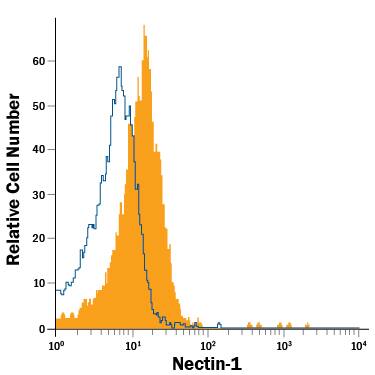
Detection of Nectin‑1 in U937 Human Cell Line by Flow Cytometry.
U937 human histiocytic lymphoma cell line was stained with Mouse Anti-Human Nectin-1 APC-conjugated Monoclonal Antibody (Catalog # FAB2880A, filled histogram) or isotype control antibody (Catalog # IC003A, open histogram). View our protocol for Staining Membrane-associated Proteins.Applications for Human Nectin-1 APC-conjugated Antibody
Application
Recommended Usage
Flow Cytometry
10 µL/106 cells
Sample: U937 human histiocytic lymphoma cell line
Sample: U937 human histiocytic lymphoma cell line
Formulation, Preparation, and Storage
Purification
Protein A or G purified from hybridoma culture supernatant
Formulation
Supplied in a saline solution containing BSA and Sodium Azide.
Shipping
The product is shipped with polar packs. Upon receipt, store it immediately at the temperature recommended below.
Stability & Storage
Store the unopened product at 2 - 8° C. Do not use past expiration date. Protect from light.
Background: Nectin-1
Nectin-1 (designated CD111), also called PRR-1 (poliovirus receptor-related protein 1) or HVEC (herpesvirus entry mediator C), is a widely expressed 110 kDa type I transmembrane glycoprotein important in formation of adherens junctions and synapses. It is a member of the nectin family within the Ig superfamily (1, 2). The Latin word necto means “to connect”, indicating the role of nectins in Ca2+-independent cell-cell adhesion (2). Nectin-1 forms homodimers in cis, followed by interactions in trans with Nectin-1, -3 or -4 (2). The 517 amino acid (aa) human Nectin-1 isoform 1 contains a 30 aa signal sequence, a 325 aa extracellular domain (ECD), a 21 aa transmembrane segment (TM), and a 141 aa cytoplasmic region. Nectin ECDs contain three Ig-like domains: an N-terminal V-type that mediates ligand binding and two C2-type (3). Nectin-1, like other nectins, has a splice form (isoform 2 or HigR, 458 aa) with alternate TM and cytoplasmic sequences. Another, isoform 3, is a 352 aa secreted protein (4). The common region of mature human Nectin-1 (aa 31-334) shares 93%, 94%, 96% and 96% aa identity with mouse, rat, bovine and porcine Nectin-1, respectively. Nectin-1 binds viral glycoprotein D to mediate herpesvirus (but not poxvirus) entry into vaginal mucosa, sensory neurons and fibroblasts (4 - 7). In forming adherens junctions and synapses, nectins 1 and 3 initiate cell-cell interactions, recruiting alphav beta3 integrin extracellularly and cadherins intracellularly through afadin and other junctional proteins (2, 8 - 11). These interactions organize the cytoskeleton, strengthen attachment to basement membrane and promote further cell-cell connections. Nectin-1 also recognizes CD96 on NK cells (12). Deficiency of Nectin-1 can result in cleft lip/palate ectodermal dysplasia (13). Nectin-1 downregulation in epithelial cancers, mediated in part by ectodomain shedding, may contribute to invasiveness (14).
References
- Lopez, M. et al. (1995) Gene 155:261.
- Takai, Y. et al. (2008) Nat. Rev. Mol. Cell Biol. 9:603.
- Fabre, S. et al. (2002) J. Biol. Chem. 277:27006.
- Lopez, M. et al. (2001) J. Virol. 75:5684.
- Cocchi, F. et al. (1998) Proc. Natl. Acad. Sci. USA 95:15700.
- Linehan, M. M. et al. (2004) J. Virol. 78:2530.
- Simpson, S. A. et al. (2005) J. Neurovirol. 11:208.
- Mizoguchi, A. et al. (2002) J. Cell Biol. 156:555.
- Togashi, H. et al. (2006) J. Cell Biol. 174:141.
- Tachibana, K. et al. (2000) J. Cell Biol. 150:1161.
- Takai, Y. and H. Nakanishi (2003) J. Cell Science 116:17.
- Seth, S. et al. (2007) Biochem. Biophys. Res. Commun. 364:959.
- Suzuki, K. et al. (2000) Nat. Genet. 25:427.
- Tanaka, Y. et al. (2002) Biochem. Biophys. Res. Commun. 299:472.
Long Name
Poliovirus Receptor Related 1
Alternate Names
CD111, HVEC, Nectin1, PRR1, PVRL1, PVRR1
Gene Symbol
NECTIN1
UniProt
Additional Nectin-1 Products
Product Documents for Human Nectin-1 APC-conjugated Antibody
Product Specific Notices for Human Nectin-1 APC-conjugated Antibody
For research use only
Loading...
Loading...
Loading...
Loading...
Loading...