
Human/Mouse WASF1/WAVE1 Antibody
R&D Systems, part of Bio-Techne | Catalog # AF5514


Conjugate
Catalog #
Key Product Details
Species Reactivity
Validated:
Human, Mouse
Cited:
Human
Applications
Validated:
Western Blot
Cited:
Western Blot
Label
Unconjugated
Antibody Source
Polyclonal Goat IgG
Product Specifications
Immunogen
E. coli-derived recombinant human WASF1/WAVE1
Met1-Tyr250
Accession # Q92558
Met1-Tyr250
Accession # Q92558
Specificity
Detects endogenous human and mouse WASF1/WAVE1 in Western blots.
Clonality
Polyclonal
Host
Goat
Isotype
IgG
Scientific Data Images for Human/Mouse WASF1/WAVE1 Antibody
Detection of Human/Mouse WASF1/WAVE1 by Western Blot.
Western blot shows lysates of K562 human chronic myelogenous leukemia cell line, A172 human glioblastoma cell line, and 293T human embryonic kidney cell line, and mouse brain tissue. PVDF membrane was probed with 1 µg/mL of Human/Mouse WASF1/WAVE1 Antigen Affinity-purified Polyclonal Antibody (Catalog # AF5514) followed by HRP-conjugated Anti-Goat IgG Secondary Antibody (Catalog # HAF109). A specific band was detected for WASF1/WAVE1 at approximately 90 kDa (as indicated). This experiment was conducted under reducing conditions and using Immunoblot Buffer Group 1.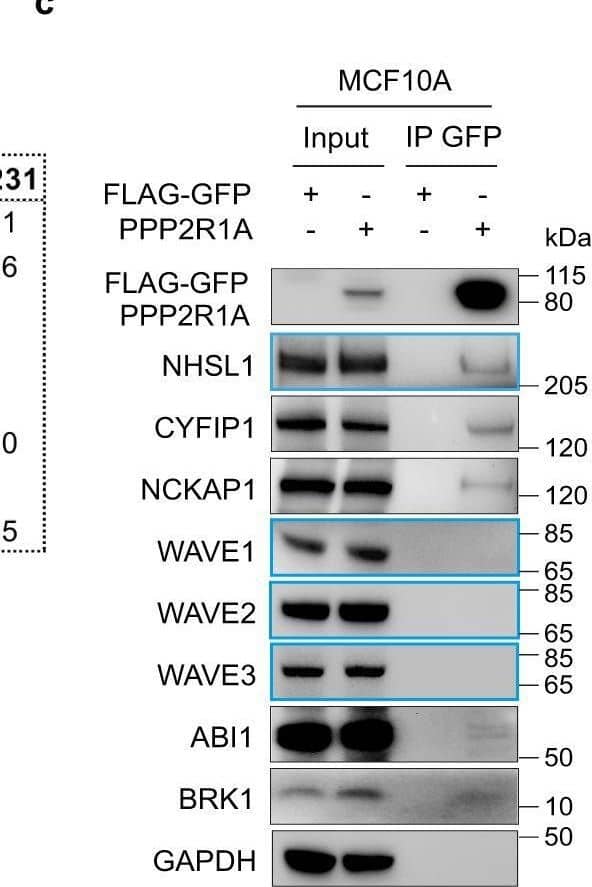
Detection of Human WASF1/WAVE1 by Western Blot
PPP2R1A interacts with the WAVE Shell Complex (WSC) that contains NHSL1 instead of WAVE proteins.a MCF10A or MDA-MB-231 cells stably expressing FLAG-GFP or FLAG-GFP PPP2R1A were subjected to FLAG-GFP Tandem Affinity Purification and purified proteins were resolved by SDS–PAGE and silver stained. The same samples were used for mass spectrometry and Western blots. Three biological repeats with similar results. b Label-free quantification (LFQ) of proteins identified by mass spectrometry. In both cell lines, NHSL1 is present at the expense of WAVE subunits. Log10 of LFQ values, mean ± sem of three biological repeats. c GFP immunoprecipitates were analyzed by Western blots with the indicated antibodies. Three biological repeats with similar results. d PPP2R1A associates with the WSC through NHSL1. MCF10A cells expressing FLAG-GFP PPP2R1A were transfected with pools of siRNAs targeting NHSL1 or non-targeting siRNAs (CTRL). GFP immunoprecipitates were analyzed by western blots. Three biological repeats with similar results. e A MCF10A cell line stably transfected with two plasmids expressing FLAG-GFP PPP2R1A and PC-HA BRK1 was subjected to FLAG-PC Tandem Affinity Purification to purify the WSC. WSC composition was analyzed by mass spectrometry. Silver stained SDS–PAGE of purified WSC. The identity of WSC subunits and the lack of WAVE2 was confirmed using Western blots. 3 biological repeats with similar results. f Comparison of the structural model of the WSC obtained using AlphaFold2 with the X-ray crystal structure WAVE Regulatory Complex (PDB:3P8C [https://www.wwpdb.org/pdb?id=pdb_00003p8c]). The WSC was composed of NHSL1 (1-123) in purple, CYFIP1 in green, NCKAP1 in cyan, BRK1 in yellow and ABI2 (1–160) in salmon. Image collected and cropped by CiteAb from the following open publication (https://pubmed.ncbi.nlm.nih.gov/37322026), licensed under a CC-BY license. Not internally tested by R&D Systems.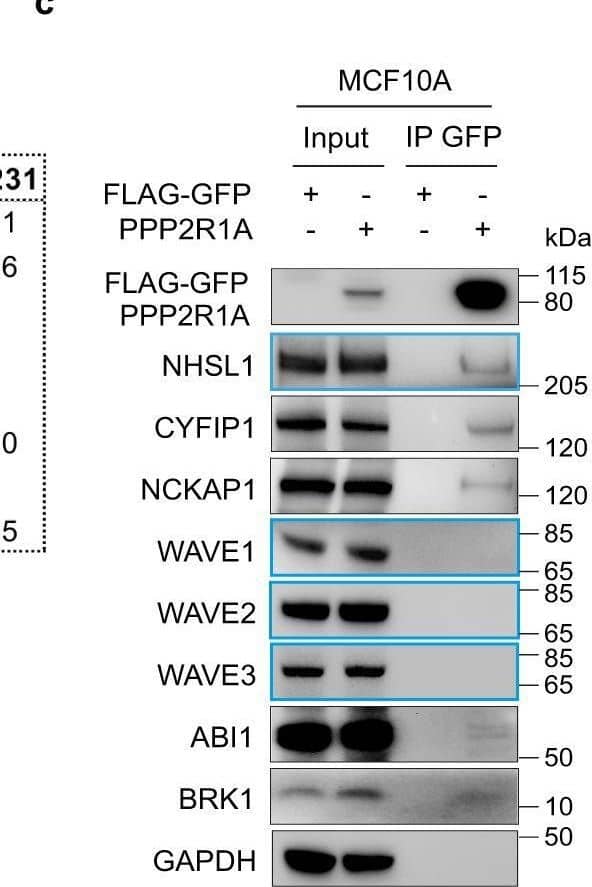
Detection of Human WASF1/WAVE1 by Western Blot
PPP2R1A interacts with the WAVE Shell Complex (WSC) that contains NHSL1 instead of WAVE proteins.a MCF10A or MDA-MB-231 cells stably expressing FLAG-GFP or FLAG-GFP PPP2R1A were subjected to FLAG-GFP Tandem Affinity Purification and purified proteins were resolved by SDS–PAGE and silver stained. The same samples were used for mass spectrometry and Western blots. Three biological repeats with similar results. b Label-free quantification (LFQ) of proteins identified by mass spectrometry. In both cell lines, NHSL1 is present at the expense of WAVE subunits. Log10 of LFQ values, mean ± sem of three biological repeats. c GFP immunoprecipitates were analyzed by Western blots with the indicated antibodies. Three biological repeats with similar results. d PPP2R1A associates with the WSC through NHSL1. MCF10A cells expressing FLAG-GFP PPP2R1A were transfected with pools of siRNAs targeting NHSL1 or non-targeting siRNAs (CTRL). GFP immunoprecipitates were analyzed by western blots. Three biological repeats with similar results. e A MCF10A cell line stably transfected with two plasmids expressing FLAG-GFP PPP2R1A and PC-HA BRK1 was subjected to FLAG-PC Tandem Affinity Purification to purify the WSC. WSC composition was analyzed by mass spectrometry. Silver stained SDS–PAGE of purified WSC. The identity of WSC subunits and the lack of WAVE2 was confirmed using Western blots. 3 biological repeats with similar results. f Comparison of the structural model of the WSC obtained using AlphaFold2 with the X-ray crystal structure WAVE Regulatory Complex (PDB:3P8C [https://www.wwpdb.org/pdb?id=pdb_00003p8c]). The WSC was composed of NHSL1 (1-123) in purple, CYFIP1 in green, NCKAP1 in cyan, BRK1 in yellow and ABI2 (1–160) in salmon. Image collected and cropped by CiteAb from the following open publication (https://pubmed.ncbi.nlm.nih.gov/37322026), licensed under a CC-BY license. Not internally tested by R&D Systems.Applications for Human/Mouse WASF1/WAVE1 Antibody
Application
Recommended Usage
Western Blot
1 µg/mL
Sample: K562 human chronic myelogenous leukemia cell line, A172 human glioblastoma cell line, and 293T human embryonic kidney cell line, and mouse brain tissue
Sample: K562 human chronic myelogenous leukemia cell line, A172 human glioblastoma cell line, and 293T human embryonic kidney cell line, and mouse brain tissue
Formulation, Preparation, and Storage
Purification
Antigen Affinity-purified
Reconstitution
Reconstitute at 0.2 mg/mL in sterile PBS. For liquid material, refer to CoA for concentration.
Formulation
Lyophilized from a 0.2 μm filtered solution in PBS with Trehalose. *Small pack size (SP) is supplied either lyophilized or as a 0.2 µm filtered solution in PBS.
Shipping
Lyophilized product is shipped at ambient temperature. Liquid small pack size (-SP) is shipped with polar packs. Upon receipt, store immediately at the temperature recommended below.
Stability & Storage
Use a manual defrost freezer and avoid repeated freeze-thaw cycles.
- 12 months from date of receipt, -20 to -70 °C as supplied.
- 1 month, 2 to 8 °C under sterile conditions after reconstitution.
- 6 months, -20 to -70 °C under sterile conditions after reconstitution.
Background: WASF1/WAVE1
WASF1/WAVE1 (Wiscott-Aldrich syndrome protein family Verprolin-homologous protein 1) is an 80‑85 kDa member of the SCAR/WAVE family of proteins. It is expressed in diverse cell types such as neurons, fibroblasts, macrophages, platelets, oligodendroglia and breast epithelium. WASF1/WAVE1 is normally inactive, being phosphorylated at Ser310 and complexed with HSPC300, PIR121 and Nap125. Upon activation, it is dephosphorylated and decoupled, heterodimerizes with WASP, and initiates actin polymerization. Human WASF1/WAVE1 is 559 amino acids (aa) in length. It contains five sequential poly-Pro regions (aa 278‑435) and one VPH domain (aa 497‑514) that binds to actin and Arp2/3. There is one isoform that shows a 23 aa N-terminal extension. In mouse, a 60 kDa proteolytic cleavage form is reported. Over aa 1‑250, human WASF1/WAVE1 shares 99% aa identity with mouse WASF1/WAVE1.
Long Name
Wiskott-Aldrich Syndrome Protein Family Member 1
Alternate Names
SCAR1, WASP1, WAVE1
Gene Symbol
WASF1
UniProt
Additional WASF1/WAVE1 Products
Product Documents for Human/Mouse WASF1/WAVE1 Antibody
Product Specific Notices for Human/Mouse WASF1/WAVE1 Antibody
For research use only
Loading...
Loading...
Loading...
Loading...
Loading...