
Human/Mouse/Rat Smad7 Antibody
R&D Systems, part of Bio-Techne | Catalog # MAB2029


Conjugate
Catalog #
Key Product Details
Validated by
Knockout/Knockdown, Biological Validation
Species Reactivity
Validated:
Human, Mouse, Rat
Cited:
Human, Mouse, Rat
Applications
Validated:
Immunohistochemistry, Western Blot, Simple Western
Cited:
Immunohistochemistry, Immunohistochemistry-Paraffin, Western Blot, Immunofluorescence, Immunocytochemistry, Simple Western, Immunoprecipitation, Proximity Ligation Assay, IF/ICC
Label
Unconjugated
Antibody Source
Monoclonal Mouse IgG2B Clone # 293039
Product Specifications
Immunogen
E. coli-derived recombinant human Smad7
Gly320-Ser398
Accession # O15105
Gly320-Ser398
Accession # O15105
Specificity
Detects human, mouse, and rat Smad7.
Clonality
Monoclonal
Host
Mouse
Isotype
IgG2B
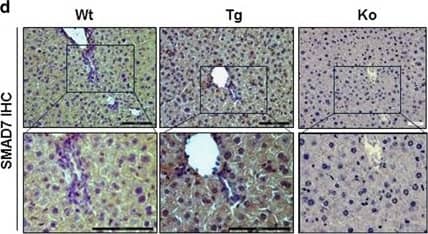
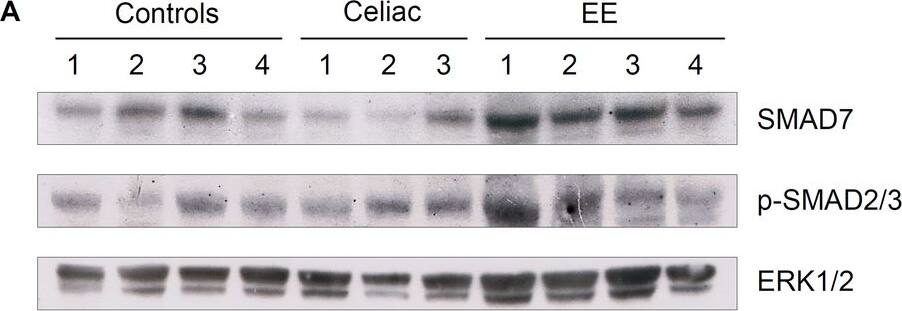
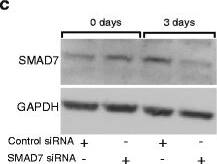
Scientific Data Images for Human/Mouse/Rat Smad7 Antibody
Smad7 in Human Liver Cancer Tissue.
Smad7 was detected in immersion fixed paraffin-embedded sections of human liver cancer tissue using 25 µg/mL Human/Mouse/Rat Smad7 Monoclonal Antibody (Catalog # MAB2029) overnight at 4 °C. Tissue was stained with the Anti-Mouse HRP-DAB Cell & Tissue Staining Kit (brown; Catalog # CTS002) and counterstained with hematoxylin (blue). View our protocol for Chromogenic IHC Staining of Paraffin-embedded Tissue Sections.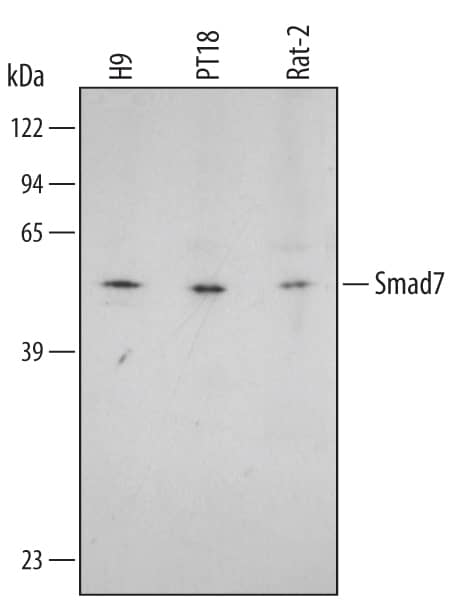
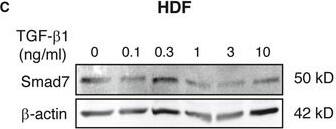
Detection of Human/Mouse/Rat Smad7 by Western Blot.
Western blot shows lysates of H9 human cutaneous T lymphoma cell line, PT18 mouse mast/basophil cell line, and Rat-2 rat embryonic fibroblast cell line. PVDF membrane was probed with 1 µg/mL of Human/Mouse/Rat Smad7 Monoclonal Antibody (Catalog # MAB2029) followed by HRP-conjugated Anti-Mouse IgG Secondary Antibody (Catalog # HAF007). A specific band was detected for Smad7 at approximately 50 kDa (as indicated). This experiment was conducted under reducing conditions and using Immunoblot Buffer Group 2.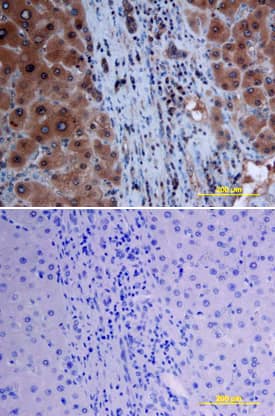
Smad7 in Human Liver.
Smad7 was detected in immersion fixed paraffin-embedded sections of human liver array using Human/Mouse/Rat Smad7 Monoclonal Antibody (Catalog # MAB2029) at 25 µg/mL overnight at 4 °C. Tissue was stained using the Anti-Mouse HRP-DAB Cell & Tissue Staining Kit (brown; Catalog # CTS002) and counterstained with hematoxylin (blue). Lower panel shows a lack of labeling if primary antibodies are omitted and tissue is stained only with secondary antibody followed by incubation with detection reagents. View our protocol for Chromogenic IHC Staining of Paraffin-embedded Tissue Sections.

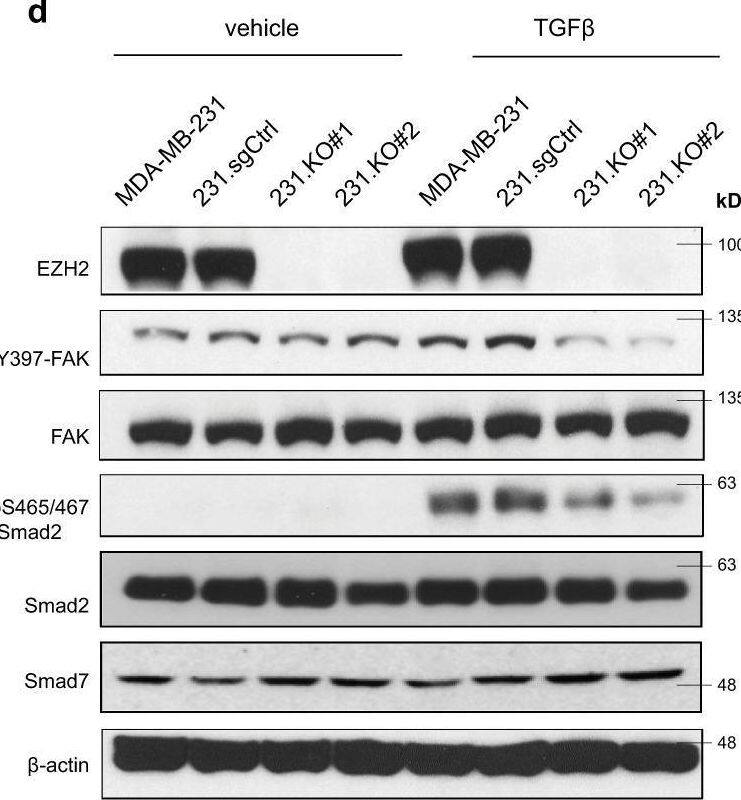
Applications for Human/Mouse/Rat Smad7 Antibody
Application
Recommended Usage
Immunohistochemistry
8-25 µg/mL
Sample: Immersion fixed paraffin-embedded sections of human liver and human liver cancer tissue
Sample: Immersion fixed paraffin-embedded sections of human liver and human liver cancer tissue
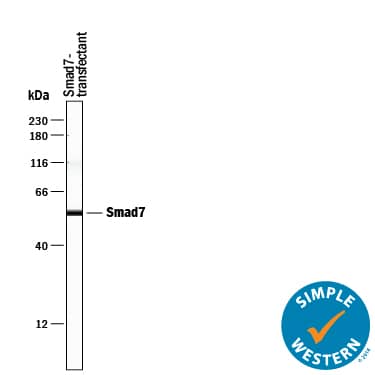
Simple Western
10 µg/mL
Sample: Sf 21 S. frugiperda insect ovarian cell line transfected with human Smad7
Sample: Sf 21 S. frugiperda insect ovarian cell line transfected with human Smad7
Western Blot
1 µg/mL
Sample: H9 human cutaneous T lymphoma cell line, PT18 mouse mast/basophil cell line, and Rat-2 rat embryonic fibroblast cell line
Sample: H9 human cutaneous T lymphoma cell line, PT18 mouse mast/basophil cell line, and Rat-2 rat embryonic fibroblast cell line
Reviewed Applications
Read 3 reviews rated 4.3 using MAB2029 in the following applications:
Formulation, Preparation, and Storage
Purification
Protein A or G purified from hybridoma culture supernatant
Reconstitution
Reconstitute at 0.5 mg/mL in sterile PBS. For liquid material, refer to CoA for concentration.
Formulation
Lyophilized from a 0.2 μm filtered solution in PBS with Trehalose. *Small pack size (SP) is supplied either lyophilized or as a 0.2 µm filtered solution in PBS.
Shipping
Lyophilized product is shipped at ambient temperature. Liquid small pack size (-SP) is shipped with polar packs. Upon receipt, store immediately at the temperature recommended below.
Stability & Storage
Use a manual defrost freezer and avoid repeated freeze-thaw cycles.
- 12 months from date of receipt, -20 to -70 °C as supplied.
- 1 month, 2 to 8 °C under sterile conditions after reconstitution.
- 6 months, -20 to -70 °C under sterile conditions after reconstitution.
Background: Smad7
Smads are a family of intracellular proteins that transmit transforming growth factor beta (TGF-beta) superfamily signals from the cell surface to the nucleus. The Smad family is divided into three subclasses: receptor regulated Smads, (Smads 1, 2, 3, 5 and 8); the common partner, (Smad4) that functions via its interaction to the various Smads; and the inhibitory Smads, (Smads 6 and 7). Smad7, also known as Mothers Against Decapentaplegic homolog 7 (MADH7), inhibits selected pathways by binding directly to cell-surface receptors and preventing the activation-induced phosphorylation of other Smad subunits.
Long Name
Mothers Against DPP Homolog 7
Alternate Names
MADH7, MADH8
Entrez Gene IDs
4092 (Human)
Gene Symbol
SMAD7
UniProt
Additional Smad7 Products
Product Documents for Human/Mouse/Rat Smad7 Antibody
Product Specific Notices for Human/Mouse/Rat Smad7 Antibody
For research use only
Loading...
Loading...
Loading...
Loading...
Loading...