
Human/Mouse/Rat/Hamster ACE-2 Antibody
R&D Systems, part of Bio-Techne | Catalog # MAB3437

Conjugate
Catalog #
Key Product Details
Species Reactivity
Validated:
Human, Mouse, Rat, Hamster
Cited:
Mouse, Primate - Cercopithecus aethiops (African Green Monkey), Transgenic Mouse
Applications
Validated:
Western Blot
Cited:
Immunohistochemistry, Western Blot
Label
Unconjugated
Antibody Source
Monoclonal Rat IgG2B Clone # 460502
Product Specifications
Immunogen
Chinese hamster ovary cell line CHO-derived recombinant mouse ACE-2
Gln18-Thr740 (predicted)
Accession # Q8R0I0
Gln18-Thr740 (predicted)
Accession # Q8R0I0
Specificity
Detects mouse ACE-2 in direct ELISAs and human, mouse, rat and hamster ACE-2 in Western blots. In direct ELISAs and Western blots, no cross-reactivity with recombinant mouse ACE-1 is observed.
Clonality
Monoclonal
Host
Rat
Isotype
IgG2B
Scientific Data Images for Human/Mouse/Rat/Hamster ACE-2 Antibody
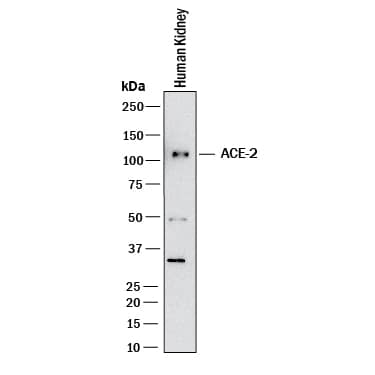
Detection of Human ACE-2 by Western Blot.
Western blot shows lysates of human kidney. PVDF membrane was probed with 0.5 µg/mL of Rat Anti-Human/Mouse/Rat/Hamster ACE-2 Monoclonal Antibody (Catalog # MAB3437) followed by HRP-conjugated Anti-Rat IgG Secondary Antibody (HAF005). A specific band was detected for ACE-2 at approximately 120 kDa (as indicated). This experiment was conducted under reducing conditions and using Western Blot Buffer Group 1.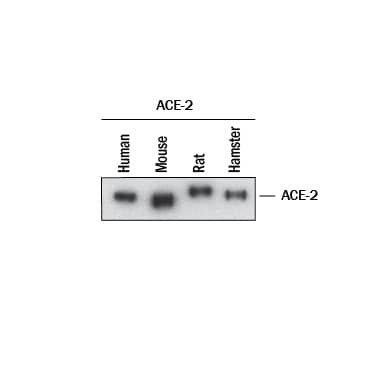
Detection of Human, Mouse, Rat, and Hamster ACE-2 by Western Blot.
Western blot shows recombinant human ACE-2 protein, recombinant mouse ACE-2 protein, recombinant rat ACE-2 protein, and recombinant hamster ACE-2 protein. PVDF membrane was probed with 0.5 µg/mL of Rat Anti-Human/Mouse/Rat/Hamster ACE-2 Monoclonal Antibody (Catalog # MAB3437) followed by HRP-conjugated Anti-Rat IgG Secondary Antibody (HAF005). A specific band was detected for ACE-2 at approximately 120 kDa (as indicated). This experiment was conducted under reducing conditions and using Western Blot Buffer Group 1.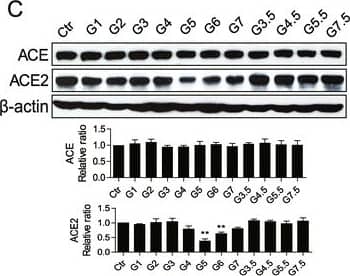
Detection of ACE-2 by Western Blot
Down-regulated ACE2 expression in mice challenged with cationic PAMAM dendrimers. (A) Levels of AngII in the plasma of the vehicle- (control) and nanoparticle-treated (15 μg/g) mice at 3 hrs after administration. AngII levels were determined using radioimmunoassays. n = 4–5 mice per group. *p < 0.05 or **p < 0.01 for the comparison of the G4, G5-, and G6-treated groups with the vehicle (control) group (two-tailed t-test). (B) The ACE2 mRNA relative expression level of the vehicle- (control) and nanoparticle-treated (15 μg/g) mice at 3 hrs after administration. Data were normalized to the expression of beta-actin reference gene. (two-tailed t-test). (C) Western blots of total lung samples obtained 3 hrs after the instillation of nanoparticles (15 μg/g). The blots are representative of three different mice for each treatment. Quantitative analyses of the ACE and ACE2 protein levels are illustrated. The levels are shown as the mean ACE- and ACE2-to-beta -actin ratios ± SEM. n = 3 mice per treatment. **p < 0.01 for the comparison of the G5-, and G6-treated groups with the vehicle group (two-tailed t-test). (D) Binding of G5 and G5.5 nanoparticles to recombinant human ACE2 at different concentrations was measured by surface plasmon resonance (SPR). The detailed dynamic binding constant and equilibrium dissociation constant are shown in Table S2. (E) G5 and G5.5 nanoparticles at different concentrations were incubated with recombinant ACE2 and AngII. The levels of AngII in the enzymatic activity measurement system were determined by radioimmunoassay. n = 3 tests per group. (two-tailed t-tests). Data are shown as the mean values ± SEM. *p < 0.05 or **p < 0.01; N.S. means not significant. Image collected and cropped by CiteAb from the following open publication (https://pubmed.ncbi.nlm.nih.gov/25890286), licensed under a CC-BY license. Not internally tested by R&D Systems.Applications for Human/Mouse/Rat/Hamster ACE-2 Antibody
Application
Recommended Usage
Western Blot
0.5 µg/mL
Sample: Human kidney and recombinant human ACE-2 protein, recombinant mouse ACE-2 protein, recombinant rat ACE-2 protein, and recombinant hamster ACE-2 protein
Sample: Human kidney and recombinant human ACE-2 protein, recombinant mouse ACE-2 protein, recombinant rat ACE-2 protein, and recombinant hamster ACE-2 protein
Formulation, Preparation, and Storage
Purification
Protein A or G purified from hybridoma culture supernatant
Reconstitution
Reconstitute at 0.5 mg/mL in sterile PBS. For liquid material, refer to CoA for concentration.
Formulation
Lyophilized from a 0.2 μm filtered solution in PBS with Trehalose. *Small pack size (SP) is supplied either lyophilized or as a 0.2 µm filtered solution in PBS.
Shipping
Lyophilized product is shipped at ambient temperature. Liquid small pack size (-SP) is shipped with polar packs. Upon receipt, store immediately at the temperature recommended below.
Stability & Storage
Use a manual defrost freezer and avoid repeated freeze-thaw cycles.
- 12 months from date of receipt, -20 to -70 °C as supplied.
- 1 month, 2 to 8 °C under sterile conditions after reconstitution.
- 6 months, -20 to -70 °C under sterile conditions after reconstitution.
Background: ACE-2
ACE-2, also called ACEH (ACE homologue), is an integral membrane protein and a zinc metalloprotease of the ACE family that also includes somatic and germinal ACE (1). Mouse ACE-2 has about 40% amino acid identity to the N- and C-terminal domains of mouse somatic ACE. The predicted mouse ACE-2 protein sequence consists of 798 amino acids, including a N-terminal signal peptide, a single catalytic domain, a C-terminal membrane anchor, and a short cytoplasmic tail. ACE-2 cleaves angiotensins I and II as a carboxypeptidase. ACE-2 mRNA is found at high levels in testis, kidney and heart and at moderate levels in colon, small intestine and ovary. Classical ACE inhibitors such as captopril and lisinopril do not inhibit ACE-2 activity. Novel peptide inhibitors of ACE-2 do not inhibit ACE activity (2). Genetic data from Drosophila, mice and rats show that ACE-2 is an essential regulator of heart function in vivo (3). In addition, ACE-2 is a key SARS-CoV Spike protein receptor in vivo and has a critical function in acute lung injury (4, 5).
References
- Tipnis, S.R. et al. (2000) J. Biol. Chem. 275:33238.
- Crackower, M.A. et al. (2002) Nature 417:822.
- Huang, L. et al. (2003) J. Biol. Chem. 278:15532.
- Kuba, K. et al. (2005) Nature Med. 11:875.
- Ima, Y. et al. (2005) Nature 436:112.
Long Name
Angiotensin I Converting Enzyme 2
Alternate Names
ACE2, ACEH
Entrez Gene IDs
Gene Symbol
ACE2
UniProt
Additional ACE-2 Products
Product Documents for Human/Mouse/Rat/Hamster ACE-2 Antibody
Product Specific Notices for Human/Mouse/Rat/Hamster ACE-2 Antibody
For research use only
Loading...
Loading...
Loading...
Loading...
Loading...