
Human/Mouse/Rat FKBP52 Antibody
R&D Systems, part of Bio-Techne | Catalog # AF4095

Conjugate
Catalog #
Key Product Details
Species Reactivity
Validated:
Human, Mouse, Rat
Cited:
Human
Applications
Validated:
Western Blot
Cited:
Western Blot
Label
Unconjugated
Antibody Source
Polyclonal Goat IgG
Product Specifications
Immunogen
E. coli-derived recombinant human FKBP52
Met1-Ala459
Accession # Q02790
Met1-Ala459
Accession # Q02790
Specificity
Detects endogenous human, mouse and rat FKBP52 in Western blots. In Western blots, this antibody does not cross-react with recombinant human FKBP12, FKBP13, FKBP38 or FKBP51.
Clonality
Polyclonal
Host
Goat
Isotype
IgG
Scientific Data Images for Human/Mouse/Rat FKBP52 Antibody
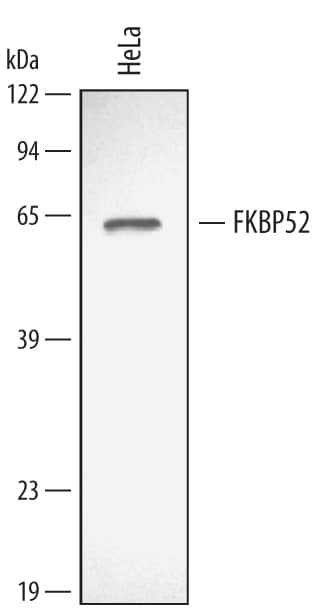
Detection of Human/Mouse/Rat FKBP52 by Western Blot.
Western blot shows lysates of HeLa human cervical epithelial carcinoma cell line. PVDF membrane was probed with 0.3 µg/mL of Human/Mouse/Rat FKBP52 Antigen Affinity‑purified Polyclonal Antibody (Catalog # AF4095) followed by HRP-conjugated Anti‑Goat IgG Secondary Antibody (Catalog # HAF109). A specific band was detected for FKBP52 at approximately 52 kDa (as indicated). This experiment was conducted using Immunoblot Buffer Group 2.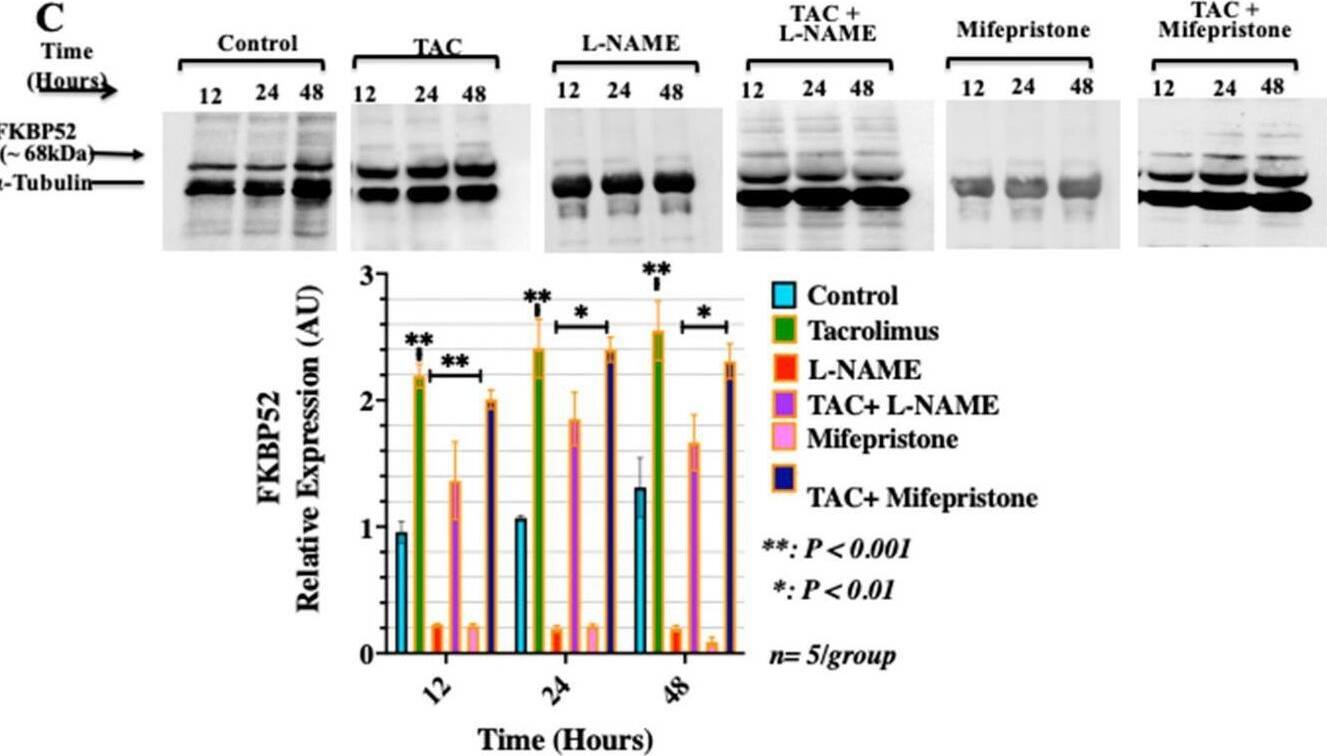
Detection of FKBP52 by Western Blot
Effect of low-dose tacrolimus, L-NAME or mifepristone and their combination formulations on the levels of expression and cellular localization of FKBP52 and PGR in HTR-8/SVneo cells. (A) Representative confocal fluorescent microscope images of monolayers of confluent HTR-8/SVneo cells treated for 24 h with low-dose tacrolimus (10 ng/mL), L-NAME or a combination of both. Cells were stained with antibodies to PGR (red channel) and FKBP52 (green channel) and cell images were captured and analyzed for their fluorescent intensity using Quorum Wave Effects Spinning disc confocal microscope. Nuclei were counterstained with DAPI (blue channel) and the colocalization of PGR and FKBP52 appears as yellow on the overlay images. (B) Histogram depicting differences in the intensity of colocalization of PGR and FKBP52 (yellow channel) showing significant effect of low-dose tacrolimus on the expression of the PGR-FKBP52 complex in treated HTR-8/SVneo cells. (C) Representative WB images and associated histograms of the expression levels of FKBP52 protein in the tacrolimus- and L-NAME-treated HTR-8/SVneo cells. Note the statistically significant effects (p < 0.001) of tacrolimus in antagonizing the suppressive actions of L-NAME and those of mifepristone on the protein expression of FKBP52 in the HTR-8/SVneo cells. Data in (B,C) are represented as the mean with error bars representing S.D. Scale bars in A = 15 μm. Mifepristone was used to determine the mode of action of tacrolimus in potentiating the PGR signaling in HTR-8/SVneo cells. Image collected and cropped by CiteAb from the following open publication (https://pubmed.ncbi.nlm.nih.gov/35955565), licensed under a CC-BY license. Not internally tested by R&D Systems.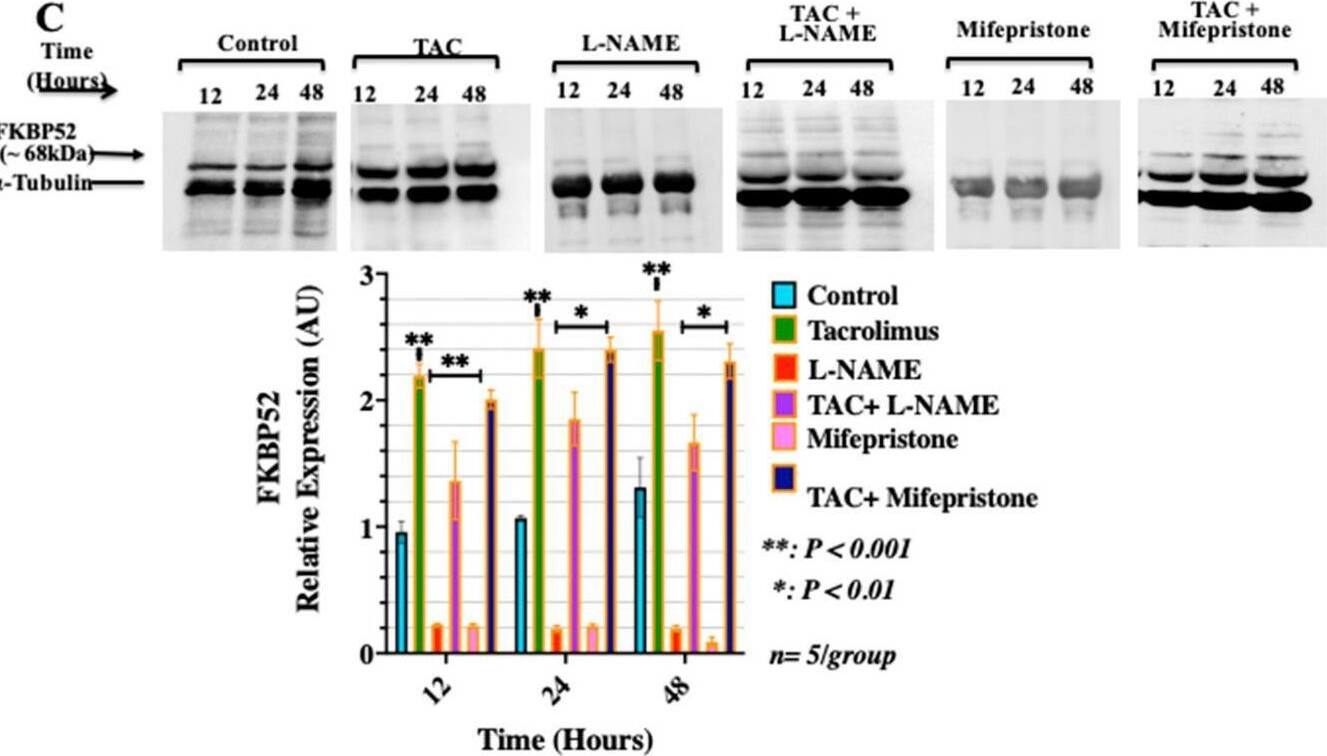
Detection of FKBP52 by Western Blot
Effect of low-dose tacrolimus, L-NAME or mifepristone and their combination formulations on the levels of expression and cellular localization of FKBP52 and PGR in HTR-8/SVneo cells. (A) Representative confocal fluorescent microscope images of monolayers of confluent HTR-8/SVneo cells treated for 24 h with low-dose tacrolimus (10 ng/mL), L-NAME or a combination of both. Cells were stained with antibodies to PGR (red channel) and FKBP52 (green channel) and cell images were captured and analyzed for their fluorescent intensity using Quorum Wave Effects Spinning disc confocal microscope. Nuclei were counterstained with DAPI (blue channel) and the colocalization of PGR and FKBP52 appears as yellow on the overlay images. (B) Histogram depicting differences in the intensity of colocalization of PGR and FKBP52 (yellow channel) showing significant effect of low-dose tacrolimus on the expression of the PGR-FKBP52 complex in treated HTR-8/SVneo cells. (C) Representative WB images and associated histograms of the expression levels of FKBP52 protein in the tacrolimus- and L-NAME-treated HTR-8/SVneo cells. Note the statistically significant effects (p < 0.001) of tacrolimus in antagonizing the suppressive actions of L-NAME and those of mifepristone on the protein expression of FKBP52 in the HTR-8/SVneo cells. Data in (B,C) are represented as the mean with error bars representing S.D. Scale bars in A = 15 μm. Mifepristone was used to determine the mode of action of tacrolimus in potentiating the PGR signaling in HTR-8/SVneo cells. Image collected and cropped by CiteAb from the following open publication (https://pubmed.ncbi.nlm.nih.gov/35955565), licensed under a CC-BY license. Not internally tested by R&D Systems.Applications for Human/Mouse/Rat FKBP52 Antibody
Application
Recommended Usage
Western Blot
0.3 µg/mL
Sample: HeLa human cervical epithelial carcinoma cell line
Sample: HeLa human cervical epithelial carcinoma cell line
Formulation, Preparation, and Storage
Purification
Antigen Affinity-purified
Reconstitution
Reconstitute at 0.2 mg/mL in sterile PBS. For liquid material, refer to CoA for concentration.
Formulation
Lyophilized from a 0.2 μm filtered solution in PBS with Trehalose. *Small pack size (SP) is supplied either lyophilized or as a 0.2 µm filtered solution in PBS.
Shipping
Lyophilized product is shipped at ambient temperature. Liquid small pack size (-SP) is shipped with polar packs. Upon receipt, store immediately at the temperature recommended below.
Stability & Storage
Use a manual defrost freezer and avoid repeated freeze-thaw cycles.
- 12 months from date of receipt, -20 to -70 °C as supplied.
- 1 month, 2 to 8 °C under sterile conditions after reconstitution.
- 6 months, -20 to -70 °C under sterile conditions after reconstitution.
Background: FKBP52
FK506 binding protein, 52 kDa molecular weight (FKBP52), also called FKBP4, is a peptidyl-prolyl isomerase that catalyzes the transition between cis- and trans- proline residues critical for proper folding of proteins. It associates with HSP90 complexes that are critical for the proper folding of steroid receptors. FKBP52 knockout mice have abnormal reproductive organ development due to disruption of androgen receptor folding.
Long Name
52 kDa FK506 Binding Protein
Alternate Names
FKBP4, FKBP59, HBI, Hsp56
Gene Symbol
FKBP4
UniProt
Additional FKBP52 Products
Product Documents for Human/Mouse/Rat FKBP52 Antibody
Product Specific Notices for Human/Mouse/Rat FKBP52 Antibody
For research use only
Loading...
Loading...
Loading...
Loading...
Loading...