
Human/Mouse MCPIP1 Antibody
R&D Systems, part of Bio-Techne | Catalog # MAB7875

Conjugate
Catalog #
Key Product Details
Validated by
Biological Validation
Species Reactivity
Validated:
Human, Mouse
Cited:
Human, Mouse
Applications
Validated:
Western Blot
Cited:
Western Blot, Immunoprecipitation
Label
Unconjugated
Antibody Source
Monoclonal Mouse IgG2A Clone # 604421
Product Specifications
Immunogen
E. coli-derived recombinant human MCPIP1
Asp426-Glu599
Accession # Q5D1E8
Asp426-Glu599
Accession # Q5D1E8
Specificity
Detects human MCPIP1 in direct ELISAs and human and mouse MCPIP1 in Western blots. In direct ELISAs, no cross-reactivity with recombinant human MCPIP3 is observed.
Clonality
Monoclonal
Host
Mouse
Isotype
IgG2A
Scientific Data Images for Human/Mouse MCPIP1 Antibody
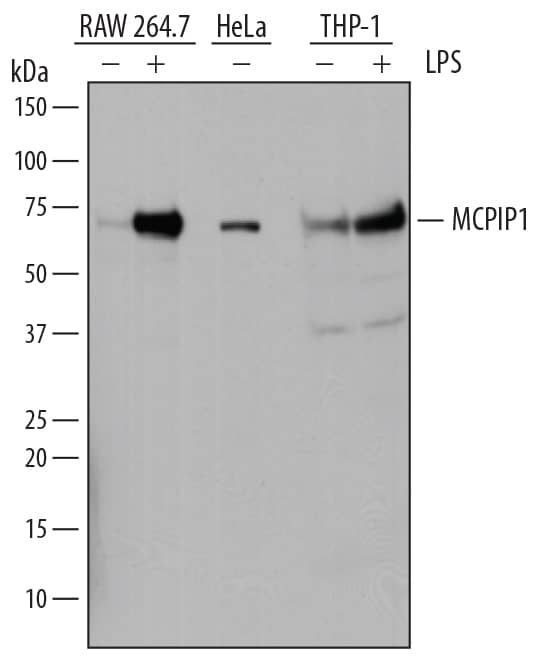
Detection of Human and Mouse MCPIP1 by Western Blot.
Western blot shows lysates of untreated (-) HeLa human cervical epithelial carcinoma cell line and RAW 264.7 mouse monocyte/macrophage cell line and THP-1 human acute monocytic leukemia cell line untreated (-) or treated (+) with 1 µg/mL LPS for 24 hours or 10 µg/mL LPS for 3 hours, respectively. PVDF membrane was probed with 1 µg/mL of Mouse Anti-Human MCPIP1 Monoclonal Antibody (Catalog # MAB7875) followed by HRP-conjugated Anti-Mouse IgG Secondary Antibody (Catalog # HAF018). A specific band was detected for MCPIP1 at approximately 70 kDa (as indicated). This experiment was conducted under reducing conditions and using Immunoblot Buffer Group 1.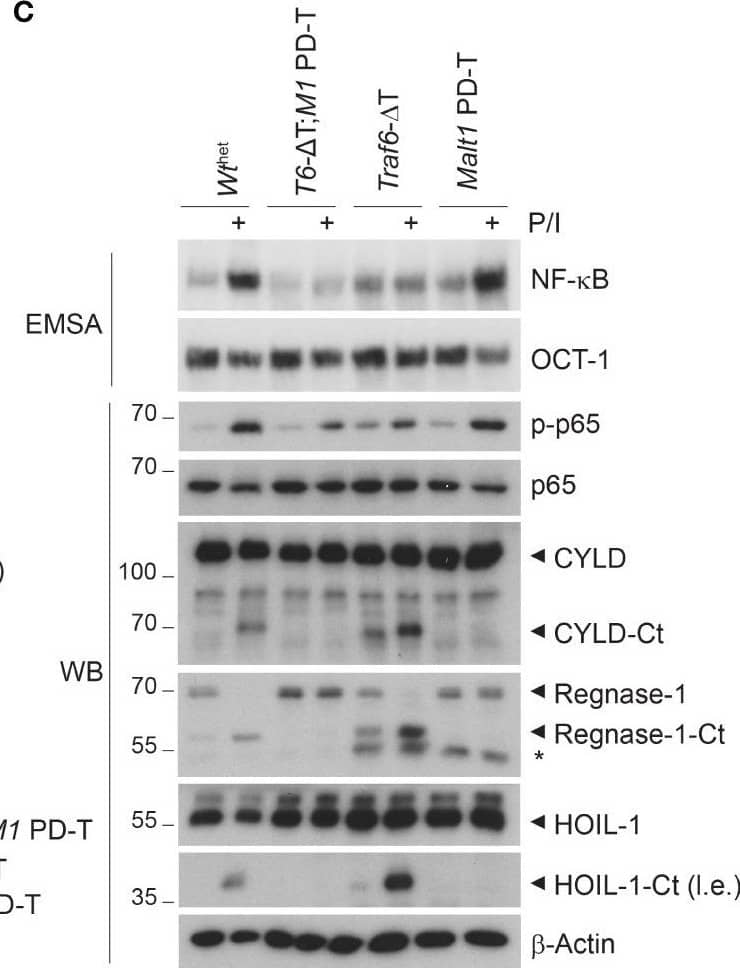
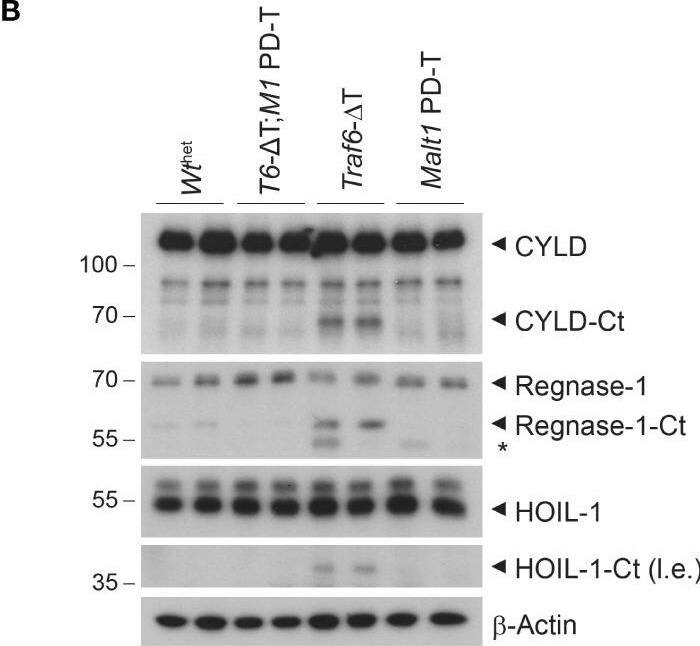
Detection of Mouse MCPIP1 by Western Blot
Effects of single or combined TRAF6 KO and MALT1 paracaspase mutation on signaling in CD4+ T cells. (A) Schematic overview of the four conditional mouse strains used in the analyses. (B) Western blots showing MALT1 substrate cleavage in unstimulated purified CD4+ T cells from Wthet, T6-delta T;M1 PD-T, Traf6-delta T and Malt1 PD-T mice (two independent mice each). Asterisks indicate unspecific signals. (C) Analyses of NF-kappa B activation (EMSA), p65 phosphorylation and MALT1 substrate cleavage (Western blot, WB) in PMA/Ionomycin (P/I) stimulated purified CD4+ T cells of mice as depicted in (A). (D) Expression of ICOS on CD4+ and CD8+ T cells by flow cytometric analysis of spleen of mice as depicted in (A). Bars show the means ± SEM, and P values were calculated by one-way ANOVA with Tukey’s multiple comparison test. All analyses were performed with mice 9-11 weeks of age. Each dot represents one mouse. Ct, C-terminus; l.e., long exposure. Image collected and cropped by CiteAb from the following open publication (https://pubmed.ncbi.nlm.nih.gov/36761777), licensed under a CC-BY license. Not internally tested by R&D Systems.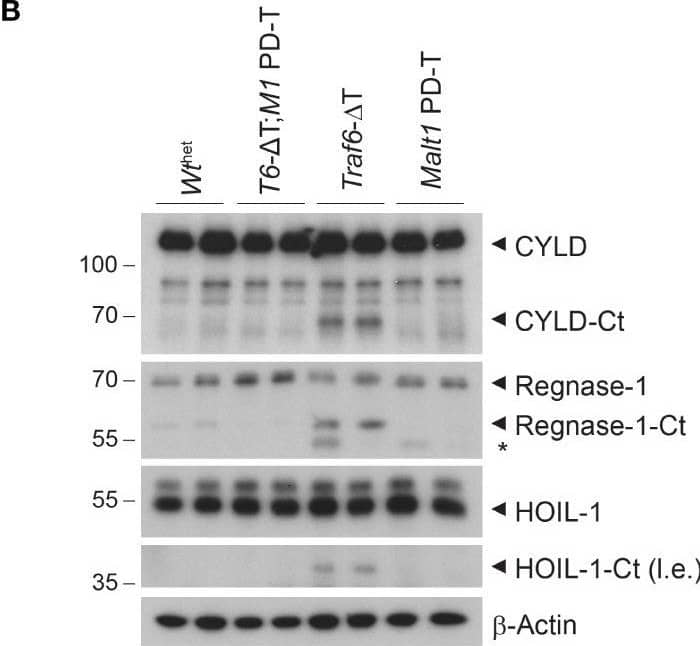
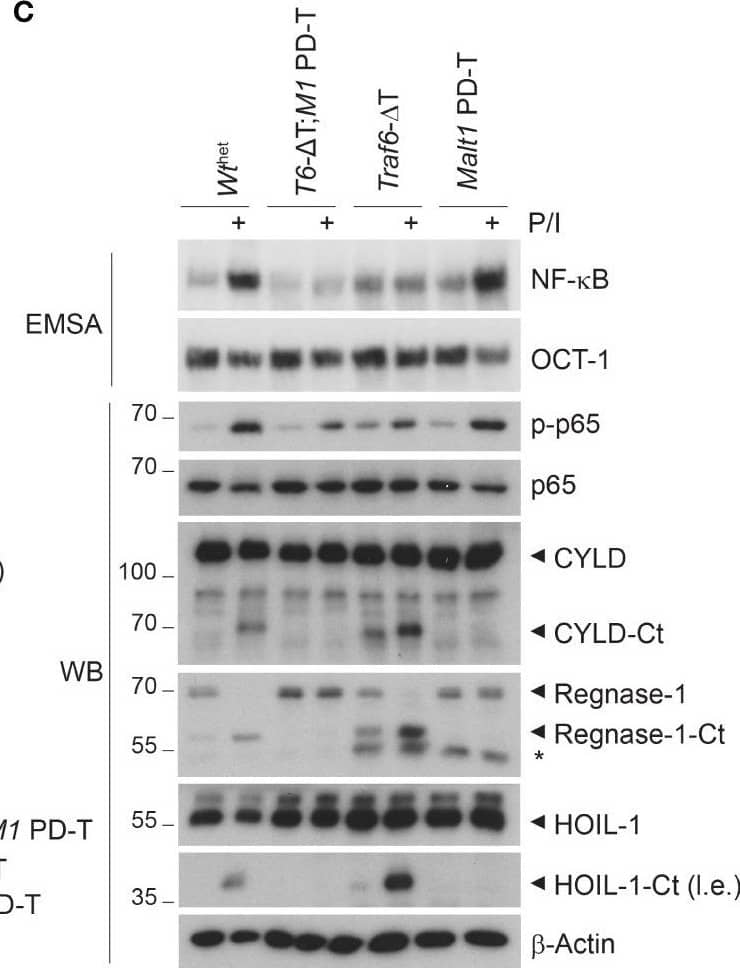
Detection of Mouse MCPIP1 by Western Blot
Effects of single or combined TRAF6 KO and MALT1 paracaspase mutation on signaling in CD4+ T cells. (A) Schematic overview of the four conditional mouse strains used in the analyses. (B) Western blots showing MALT1 substrate cleavage in unstimulated purified CD4+ T cells from Wthet, T6-delta T;M1 PD-T, Traf6-delta T and Malt1 PD-T mice (two independent mice each). Asterisks indicate unspecific signals. (C) Analyses of NF-kappa B activation (EMSA), p65 phosphorylation and MALT1 substrate cleavage (Western blot, WB) in PMA/Ionomycin (P/I) stimulated purified CD4+ T cells of mice as depicted in (A). (D) Expression of ICOS on CD4+ and CD8+ T cells by flow cytometric analysis of spleen of mice as depicted in (A). Bars show the means ± SEM, and P values were calculated by one-way ANOVA with Tukey’s multiple comparison test. All analyses were performed with mice 9-11 weeks of age. Each dot represents one mouse. Ct, C-terminus; l.e., long exposure. Image collected and cropped by CiteAb from the following open publication (https://pubmed.ncbi.nlm.nih.gov/36761777), licensed under a CC-BY license. Not internally tested by R&D Systems.Applications for Human/Mouse MCPIP1 Antibody
Application
Recommended Usage
Western Blot
1 µg/mL
Sample: Untreated HeLa human cervical epithelial carcinoma cell line and RAW 264.7 mouse monocyte/macrophage cell line and THP‑1 human acute monocytic leukemia cell line, both treated with LPS
Sample: Untreated HeLa human cervical epithelial carcinoma cell line and RAW 264.7 mouse monocyte/macrophage cell line and THP‑1 human acute monocytic leukemia cell line, both treated with LPS
Reviewed Applications
Read 2 reviews rated 5 using MAB7875 in the following applications:
Formulation, Preparation, and Storage
Purification
Protein A or G purified from hybridoma culture supernatant
Reconstitution
Sterile PBS to a final concentration of 0.5 mg/mL. For liquid material, refer to CoA for concentration.
Formulation
Lyophilized from a 0.2 μm filtered solution in PBS with Trehalose. *Small pack size (SP) is supplied either lyophilized or as a 0.2 µm filtered solution in PBS.
Shipping
Lyophilized product is shipped at ambient temperature. Liquid small pack size (-SP) is shipped with polar packs. Upon receipt, store immediately at the temperature recommended below.
Stability & Storage
Use a manual defrost freezer and avoid repeated freeze-thaw cycles.
- 12 months from date of receipt, -20 to -70 °C as supplied.
- 1 month, 2 to 8 °C under sterile conditions after reconstitution.
- 6 months, -20 to -70 °C under sterile conditions after reconstitution.
Background: MCPIP1
Long Name
MCP-1-induced Protein 1
Alternate Names
ZC3H12A
Gene Symbol
ZC3H12A
UniProt
Additional MCPIP1 Products
Product Documents for Human/Mouse MCPIP1 Antibody
Product Specific Notices for Human/Mouse MCPIP1 Antibody
For research use only
Loading...
Loading...
Loading...
Loading...
Loading...