
Human/Mouse Carbonic Anhydrase II/CA2 Antibody
R&D Systems, part of Bio-Techne | Catalog # MAB2184

Conjugate
Catalog #
Key Product Details
Species Reactivity
Validated:
Human, Mouse
Cited:
Human, Mouse, Transgenic Mouse
Applications
Validated:
Immunohistochemistry, Western Blot
Cited:
Immunohistochemistry, Western Blot
Label
Unconjugated
Antibody Source
Monoclonal Rat IgG2A Clone # 322706
Product Specifications
Immunogen
E. coli-derived recombinant human Carbonic Anhydrase II/CA2
Ser2-Lys260
Accession # P00918
Ser2-Lys260
Accession # P00918
Specificity
Detects human Carbonic Anhydrase II/CA2 in direct ELISAs and Western blots. In direct ELISAs and Western blots, no cross-reactivity with recombinant human (rh) CA-1, -3, -4, -5A, -5B, -6, -7, -8, or -9 is observed.
Clonality
Monoclonal
Host
Rat
Isotype
IgG2A
Scientific Data Images for Human/Mouse Carbonic Anhydrase II/CA2 Antibody
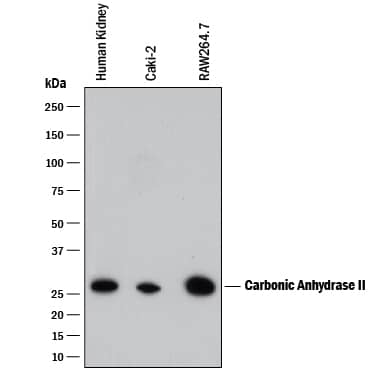
Detection of Human and Mouse Carbonic Anhydrase II/CA2 by Western Blot.
Western blot shows lysates of human kidney tissue, Caki-2 human clear cell carcinoma epithelial cell line, and RAW 264.7 mouse monocyte/macrophage cell line. PVDF membrane was probed with 2 µg/mL of Rat Anti-Human/Mouse Carbonic Anhydrase II/ CA2 Monoclonal Antibody (Catalog # MAB2184) followed by HRP-conjugated Anti-Rat IgG Secondary Antibody (Catalog # HAF005). A specific band was detected for Carbonic Anhydrase II/CA2 at approximately 27 kDa (as indicated). This experiment was conducted under reducing conditions and using Immunoblot Buffer Group 1.
Carbonic Anhydrase II/CA2 in Human Descending Colon and Ileum.
Carbonic Anhydrase II/CA2 was detected in immersion fixed paraffin-embedded sections of human descending colon (left panel) and ileum (right panel) using Rat Anti-Human/Mouse Carbonic Anhydrase II/CA2 Monoclonal Antibody (Catalog # MAB2184) at 0.5 µg/mL overnight at 4 °C. Tissue was stained using the NorthernLights™ 557-conjugated Anti-Rat IgG Secondary Antibody (red; Catalog # NL013) and counterstained with DAPI (blue).
Detection of Mouse Carbonic Anhydrase II/CA2 by Western Blot
Inhibition of induction of carbonic anhydrase II (CAII), anion exchange protein 2 (Ae2), chloride channel 7 (ClC-7), vacuolar-type H(+)-ATPase (V-ATPase), and cathapsin K (A,B), matrix metalloproteinase 9 (MMP-9) secretion (C), and bone resorption (D) by aesculetin. Raw 264.7 cells were cultured in minimum essential medium alpha medium ( alpha-MEM) with 50 ng/mL receptor activator of nuclear factor-kappa B ligand (RANKL) in the absence or presence of 1–10 μM aesculetin for 5 days. Whole-cell lysates were subject to SDS-PAGE and Western blot with a specific antibody against CAII, Ae2, ClC-7 V-ATPase, and cathapsin K (A,B). An equal volume of culture medium was subject to sodium dodecyl sulphate-polyacrylamide gel electrophoresis (SDS-PAGE) and Western blot with a specific antibody against MMP-9 (C). beta-Actin was used as internal control. The bar graphs (mean ± SEM, n = 3) represent quantitative results of blots obtained from a densitometer. Respective values in double-bar graphs not sharing a small letter are significantly different at p < 0.05. The osteoclast bone resorption was assayed using a commercially available bone resorption assay kit ((D), three separate experiments). Attached cells were removed, and resorption pits on the plate were visualized under light microscopy. Scale bar = 20 µm. Image collected and cropped by CiteAb from the following open publication (https://pubmed.ncbi.nlm.nih.gov/33203061), licensed under a CC-BY license. Not internally tested by R&D Systems.Applications for Human/Mouse Carbonic Anhydrase II/CA2 Antibody
Application
Recommended Usage
Immunohistochemistry
0.5-25 µg/mL
Sample: Immersion fixed paraffin-embedded sections of human ileum and descending colon
Sample: Immersion fixed paraffin-embedded sections of human ileum and descending colon
Western Blot
2 µg/mL
Sample: Human kidney tissue, Caki‑2 human clear cell carcinoma epithelial cell line, and RAW 264.7 mouse monocyte/macrophage cell line
Sample: Human kidney tissue, Caki‑2 human clear cell carcinoma epithelial cell line, and RAW 264.7 mouse monocyte/macrophage cell line
Formulation, Preparation, and Storage
Purification
Protein A or G purified from hybridoma culture supernatant
Reconstitution
Reconstitute at 0.5 mg/mL in sterile PBS. For liquid material, refer to CoA for concentration.
Formulation
Lyophilized from a 0.2 μm filtered solution in PBS with Trehalose. *Small pack size (SP) is supplied either lyophilized or as a 0.2 µm filtered solution in PBS.
Shipping
Lyophilized product is shipped at ambient temperature. Liquid small pack size (-SP) is shipped with polar packs. Upon receipt, store immediately at the temperature recommended below.
Stability & Storage
Use a manual defrost freezer and avoid repeated freeze-thaw cycles.
- 12 months from date of receipt, -20 to -70 °C as supplied.
- 1 month, 2 to 8 °C under sterile conditions after reconstitution.
- 6 months, -20 to -70 °C under sterile conditions after reconstitution.
Background: Carbonic Anhydrase II/CA2
Carbonic Anhydrase (CA) catalyzes the reversible reaction of CO2 + H2O = HCO3- + H+, which is fundamental to many processes such as respiration, renal tubular acidification and bone resorption (1). Topics in the CA meeting (6th International Conference on the CAs, June 20‑25, 2003, Slovakia) ranged from use of CAs as markers for tumor and hypoxia in the clinic, as nutritional supplement in milk, and as a tool for CO2 removal and mosquito control in industry. CA2 is a cytosolic enzyme with the highest activity among all known CAs. Mutations in the CA2 gene result in the CA II deficiency syndrome, an autosomal recessive disorder that produces osteopetrosis, renal tubular acidosis and cerebral calcification (2).
References
- Hewett-Emmett, D. and R.E. Tashian (1996) Mol. Phylogenet. Evol. 5:50.
- Shah, G.N. et al. (2004) Hum. Mutat. 24:272.
Alternate Names
CA2
Entrez Gene IDs
760 (Human)
Gene Symbol
CA2
UniProt
Additional Carbonic Anhydrase II/CA2 Products
Product Documents for Human/Mouse Carbonic Anhydrase II/CA2 Antibody
Product Specific Notices for Human/Mouse Carbonic Anhydrase II/CA2 Antibody
For research use only
Loading...
Loading...
Loading...
Loading...
Loading...