
Human MICB Antibody
R&D Systems, part of Bio-Techne | Catalog # AF1599


Scientific images may be resized, cropped, or adjusted for brightness or contrast for presentation purposes. These updates are limited to presentation and do not affect the underlying scientific interpretation of the data. Where available, additional source data may be provided upon request.
Conjugate
Catalog #
Key Product Details
Species Reactivity
Validated:
Human
Cited:
Human, Mouse
Applications
Validated:
Western Blot
Cited:
Immunohistochemistry, Western Blot
Label
Unconjugated
Antibody Source
Polyclonal Goat IgG
Product Specifications
Immunogen
Mouse myeloma cell line NS0-derived recombinant human MICB
Ala23-Gly298
Accession # CAI18747
Ala23-Gly298
Accession # CAI18747
Specificity
Detects human MICB in direct ELISAs and Western blots. In direct ELISAs, less than 20% cross-reactivity with recombinant human MICA is observed.
Clonality
Polyclonal
Host
Goat
Isotype
IgG
Scientific Data Images for Human MICB Antibody
Detection of Human MICB by Western Blot
U21 expression destabilizes MICB.(A) MICB cells or MICB cells expressing U21 were pulse-labeled for 15 minutes and chased for 0, 2, or 6 hours. MICB (BMO2) and U21 were recovered from Triton X-100 lysates. Migration positions of MICB, U21, and class I MHC heavy chains are indicated, as are approximate molecular weight markers. Note that U21 and MICB migrate at nearly identical positions. (B) Quantification of (A) showing the percent MICB remaining after a 2 hr chase relative to the 0 hr chase point (n = 1). (C) The data represent the quantification of MICB stability in MICB or MICB-U21 cells from three independent experiments (n = 3). Error bars indicate the standard deviation. Image collected and cropped by CiteAb from the following open publication (https://pubmed.ncbi.nlm.nih.gov/22102813), licensed under a CC-BY license. Not internally tested by R&D Systems.
Detection of Human MICB by Western Blot
U21 expression reduces steady state levels of mature and secreted MICB.(A) Immunoblot analysis of lysates or supernatants from MICB or MICB-U21 cells. Lysates and concentrated supernatants were prepared from 4×10⁵ MICB or MICB-U21 cells. (B) MICB or MICB-U21 cells were pulse-labeled for 15 min and chased for 0, 0.5, 1, 2, and 4 hrs. MICB was recovered from Triton X-100 lysates (panel i) or cell supernatants (panel ii). Migration positions of MICB, soluble MICB (sMICB), and molecular weight markers are indicated. In U21-expressing cells, the faster-migrating mature (MICB*) and secreted (sMICB*) MICB are noted separately at the right. Image collected and cropped by CiteAb from the following open publication (https://pubmed.ncbi.nlm.nih.gov/22102813), licensed under a CC-BY license. Not internally tested by R&D Systems.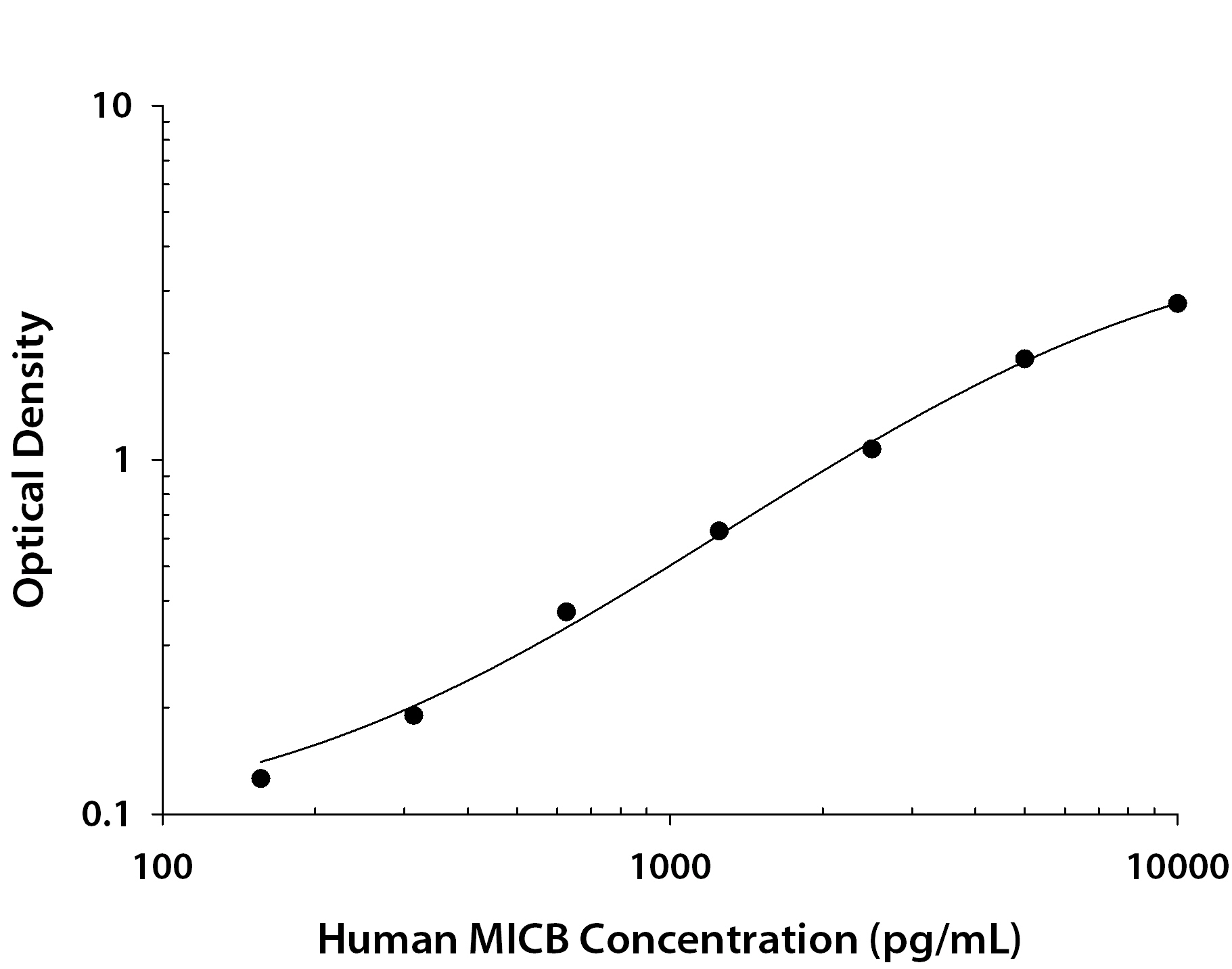
Human MICB ELISA Standard Curve
Recombinant Human MICB Fc Chimera, aa 23-298 (Catalog # 1599-MB) was serially diluted and captured by Mouse Anti-Human MICB Monoclonal Antibody (Catalog # MAB1599) coated on a Clear Polystyrene Microplate (Catalog # DY990). Goat Anti-Human MICB Antigen Affinity-purified Polyclonal Antibody (Catalog # AF1599) was biotinylated and incubated with the protein captured on the plate. Detection of the standard curve was achieved by incubating Streptavidin-HRP (Catalog # DY998)Applications for Human MICB Antibody
Application
Recommended Usage
Western Blot
0.1 µg/mL
Sample: Recombinant Human MICB Fc Chimera, aa 23-298 (Catalog # 1599-MB)
Sample: Recombinant Human MICB Fc Chimera, aa 23-298 (Catalog # 1599-MB)
Formulation, Preparation, and Storage
Purification
Antigen Affinity-purified
Reconstitution
Reconstitute at 0.2 mg/mL in sterile PBS. For liquid material, refer to CoA for concentration.
Formulation
Lyophilized from a 0.2 μm filtered solution in PBS with Trehalose. *Small pack size (SP) is supplied either lyophilized or as a 0.2 µm filtered solution in PBS.
Shipping
Lyophilized product is shipped at ambient temperature. Liquid small pack size (-SP) is shipped with polar packs. Upon receipt, store immediately at the temperature recommended below.
Stability & Storage
Use a manual defrost freezer and avoid repeated freeze-thaw cycles.
- 12 months from date of receipt, -20 to -70 °C as supplied.
- 1 month, 2 to 8 °C under sterile conditions after reconstitution.
- 6 months, -20 to -70 °C under sterile conditions after reconstitution.
Background: MICB
MICB (MHC class I chain-related gene B) is a transmembrane glycoprotein that functions as a ligand for NKG2D. A closely related protein, MICA, shares 85% amino acid identity with MICB. These 2 proteins are distantly related to the MHC class I proteins. MICA and MICB (MICA/B) possess three extracellular immunoglobulin-like domains, but have no capacity to bind peptide or interact with beta2-microglobulin. The genes encoding MICA/B are found within the major histocompatibility complex on human chromosome 6. The MICB locus is polymorphic with more than 15 recognized human alleles. MICA/B are minimally expressed on normal cells, but are frequently expressed on epithelial tumors and can be induced by bacterial and viral infections. MICA/B are ligands for NKG2D, an activating receptor expressed on NK cells, NKT cells, gamma delta T cells, and CD8+ alpha beta T cells. Recognition of MICA/B by NKG2D results in the activation of cytolytic activity and/or cytokine production by these effector cells. MICA/B recognition is involved in tumor surveillance, viral infections, and autoimmune diseases. The release of soluble forms of MICA/B from tumors down-regulates NKG2D surface expression on effector cells resulting in the impairment of anti-tumor immune response (1-7).
References
- Groh, V. et al. (2001) Nature Immunol. 2:255.
- Stephens, H. (2001) Trends Immunol. 22:378.
- Bauer, S. et al. (1999) Science 285:727.
- Groh, V. et al. (2002) Nature 419:734.
- Steinle, A. et al. (2001) Immunogenetics 53:279.
- Pende, D. et al. (2002) Cancer Res. 62:6178.
- Salih, H. et al. (2003) Blood 102:1389.
Long Name
MHC Class I-related Protein B
Alternate Names
MHC class I chain-related protein B, MHC class I mic-B antigen, MHC class I polypeptide-related sequence B, MIC-B, PERB11.2MHC class I-like molecule PERB11.2-IMX, stress inducible class I homolog
Entrez Gene IDs
4277 (Human)
Gene Symbol
MICB
UniProt
Additional MICB Products
Product Documents for Human MICB Antibody
Product Specific Notices for Human MICB Antibody
For research use only
Loading...
Loading...
Loading...
Loading...
Loading...