
Human LRIG3 Antibody
R&D Systems, part of Bio-Techne | Catalog # AF3495


Conjugate
Catalog #
Key Product Details
Species Reactivity
Validated:
Human
Cited:
Human
Applications
Validated:
Immunohistochemistry, Western Blot
Cited:
Western Blot
Label
Unconjugated
Antibody Source
Polyclonal Goat IgG
Product Specifications
Immunogen
Mouse myeloma cell line NS0-derived recombinant human LRIG3 isoform 1 (R&D Systems, Catalog # 3495-LR)
Asp28-Thr807
Accession # Q6UXM1
Asp28-Thr807
Accession # Q6UXM1
Specificity
Detects human LRIG3 in direct ELISAs and Western blots. In direct ELISAs, less than 1% cross-reactivity with recombinant mouse LRIG1 is observed.
Clonality
Polyclonal
Host
Goat
Isotype
IgG
Scientific Data Images for Human LRIG3 Antibody
LRIG3 in Human Cervical Cancer Tissue.
LRIG3 was detected in immersion fixed paraffin-embedded sections of human cervical cancer tissue using Goat Anti-Human LRIG3 Antigen Affinity-purified Polyclonal Antibody (Catalog # AF3495) at 3 µg/mL overnight at 4 °C. Tissue was stained using the Anti-Goat HRP-DAB Cell & Tissue Staining Kit (brown; Catalog # CTS008) and counterstained with hematoxylin (blue). Specific staining was localized to cytoplasm of cancer cells. View our protocol for Chromogenic IHC Staining of Paraffin-embedded Tissue Sections.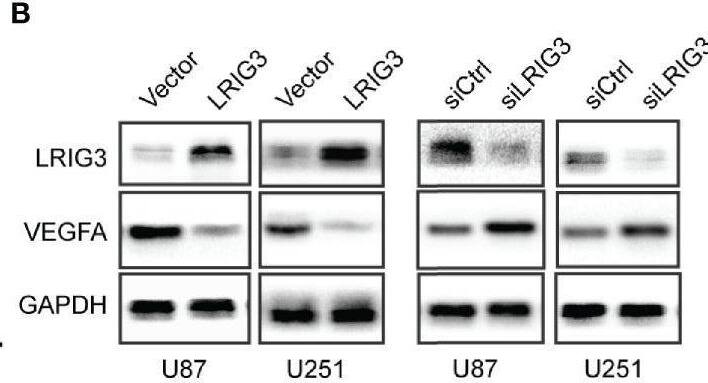
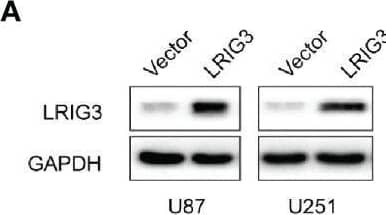
Detection of LRIG3 by Western Blot
LRIG3 inhibited glioma angiogenesis by regulating VEGFA expression. (A) qRT-PCR analysis targeting angiogenic factors in glioma cells transduced with LRIG3 and control siRNAs. (B) Western blot analysis of VEGFA, LRIG3, and GAPDH. (C) Integrated density of the bands was normalized to GAPDH in LRIG3 knockdown or overexpression glioma cells. (D) Levels of VEGFA protein in the CM from glioma cells with LRIG3 knockdown or overexpression were detected by ELISA. Data are means ± SD of 3 independent replicates. *p < 0.05; **p < 0.01; ***p < 0.001. CM, conditioned medium. Image collected and cropped by CiteAb from the following open publication (https://pubmed.ncbi.nlm.nih.gov/33718179), licensed under a CC-BY license. Not internally tested by R&D Systems.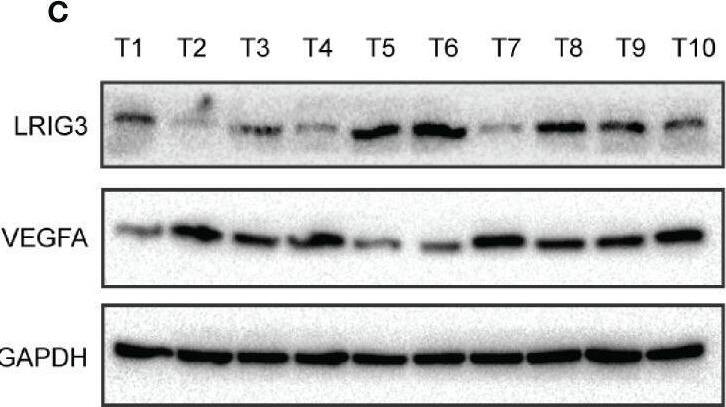
Detection of LRIG3 by Western Blot
Clinical relevance of LRIG3, p-AKT, and VEGFA expression in gliomas. (A) IHC staining targeting LRIG3, p-AKT, and VEGFA in two representative GBM specimens. Brown staining, positive immunoreactivity. (B) Relative levels of LRIG3, p-AKT, and VEGFA proteins in GBM specimens (with low and high LRIG3 expression levels in 28 GBM patients). (C) Expression analysis (left) and correlation (right) between LRIG3 and VEGFA expression in 10 freshly collected human glioma samples. Data are means ± SD of 3 independent replicates. ***p < 0.001. Image collected and cropped by CiteAb from the following open publication (https://pubmed.ncbi.nlm.nih.gov/33718179), licensed under a CC-BY license. Not internally tested by R&D Systems.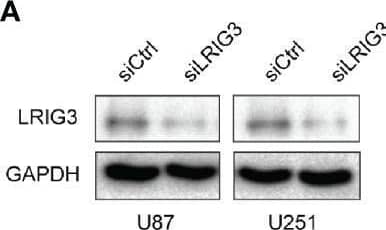
Applications for Human LRIG3 Antibody
Application
Recommended Usage
Immunohistochemistry
3-15 µg/mL
Sample: Immersion fixed paraffin-embedded sections of human cervical cancer tissue
Sample: Immersion fixed paraffin-embedded sections of human cervical cancer tissue
Western Blot
0.1 µg/mL
Sample: Recombinant Human LRIG3 (Catalog # 3495-LR)
Sample: Recombinant Human LRIG3 (Catalog # 3495-LR)
Formulation, Preparation, and Storage
Purification
Antigen Affinity-purified
Reconstitution
Reconstitute at 0.2 mg/mL in sterile PBS. For liquid material, refer to CoA for concentration.
Formulation
Lyophilized from a 0.2 μm filtered solution in PBS with Trehalose. *Small pack size (SP) is supplied either lyophilized or as a 0.2 µm filtered solution in PBS.
Shipping
Lyophilized product is shipped at ambient temperature. Liquid small pack size (-SP) is shipped with polar packs. Upon receipt, store immediately at the temperature recommended below.
Stability & Storage
Use a manual defrost freezer and avoid repeated freeze-thaw cycles.
- 12 months from date of receipt, -20 to -70 °C as supplied.
- 1 month, 2 to 8 °C under sterile conditions after reconstitution.
- 6 months, -20 to -70 °C under sterile conditions after reconstitution.
Background: LRIG3
LRIG3 (leucine-rich repeats and Ig-like domains-3) is a 140 kDa type I transmembrane glycoprotein member of the mammalian LRIG glycoprotein family. This family contains three members who share 45 - 50% amino acid (aa) identity (1). All members contain at least fifteen LRRs, accompanied by two flanking cysteine-rich regions, and three C2-type Ig-like domains in their extracellular domains (ECD) (1). LRIG3 mRNA is widely expressed, with highest levels in stomach, skin, thyroid and small intestine (1). Human LRIG3 is synthesized as a 1120 amino acid (aa) precursor. It contains a 24 aa signal sequence, a 786 aa ECD, a 21 aa transmembrane sequence, and a 289 aa intracellular region. One splice variant exists that has a 19 aa substitution for the first 79 aa of the standard (or long) form. This substitution appears to encode an alternate signal sequence, resulting in a mature protein that lacks the first and part of the second LRR. LRIG1, a related family member, is known to bind the EGF family receptors ErbB1-4, via either its LRR or Ig-like domains. It also binds the ubiquitin ligase, c-Cbl, and promotes ubiquitination, internalization and destruction of these receptors (2, 3). It is not known whether LRIG3 performs similar functions. Within the cell, LRIG3 is expressed in the perinuclear region as well as on the cell surface. Perinuclear location of LRIG3 in grade III and IV astrocytic tumors has been associated with better patient survival (4). Human LRIG3 ECD shows 91%, 92%, 95% and 98% aa identity with mouse, rat, bovine and canine LRIG3 ECD, respectively.
References
- Guo, D. et al. (2004) Genomics 84:157.
- Gur, G. et al. (2004) EMBO J. 23:3270.
- Laederich, M.B. (2004) J. Biol. Chem. 279:47050.
- Guo, D. et al. (2006) Acta Neuropathol. (Berl.) 111:238.
Long Name
Leucine-rich Repeats and Immunoglobulin-like Domains 3
Alternate Names
LIG-3
Gene Symbol
LRIG3
UniProt
Additional LRIG3 Products
Product Documents for Human LRIG3 Antibody
Product Specific Notices for Human LRIG3 Antibody
For research use only
Loading...
Loading...
Loading...
Loading...
Loading...