
Human IGFBP-3 Antibody
R&D Systems, part of Bio-Techne | Catalog # AF675


Scientific images may be resized, cropped, or adjusted for brightness or contrast for presentation purposes. These updates are limited to presentation and do not affect the underlying scientific interpretation of the data. Where available, additional source data may be provided upon request.
Conjugate
Catalog #
Key Product Details
Species Reactivity
Validated:
Human
Cited:
Human, Mouse, Primate - Chlorocebus aethiops (African Green Monkey)
Applications
Validated:
Immunohistochemistry, Western Blot, Neutralization
Cited:
Immunohistochemistry, Immunohistochemistry-Paraffin, Western Blot, Neutralization, Immunocytochemistry
Label
Unconjugated
Antibody Source
Polyclonal Goat IgG
Product Specifications
Immunogen
Mouse myeloma cell line NS0-derived recombinant human IGFBP‑3
Gly28-Lys291
Accession # CAA46087
Gly28-Lys291
Accession # CAA46087
Specificity
Detects human IGFBP‑3 in direct ELISAs and Western blots. In direct ELISAs, approximately 10% cross reactivity with recombinant mouse IGFBP-3 is observed, and less than 1% cross-reactivity with recombinant human (rh) IGFBP‑1, rhIGFBP‑2, and rhIGFBP‑4 is observed.
Clonality
Polyclonal
Host
Goat
Isotype
IgG
Endotoxin Level
<0.10 EU per 1 μg of the antibody by the LAL method.
Scientific Data Images for Human IGFBP-3 Antibody
IGFBP-3 in Human Colon.
IGFBP-3 was detected in immersion fixed paraffin-embedded sections of human colon using 10 µg/mL Human IGFBP-3 Antigen Affinity-purified Polyclonal Antibody (Catalog # AF675) overnight at 4 °C. Tissue was stained with the Anti-Goat HRP-DAB Cell & Tissue Staining Kit (brown; Catalog # CTS008) and counterstained with hematoxylin (blue). View our protocol for Chromogenic IHC Staining of Paraffin-embedded Tissue Sections.
IGFBP-3 Inhibition of IGF-II-dependent Cell Proliferation and Neutralization by Human IGFBP-3 Antibody.
Recombinant Human IGFBP-3 (Catalog # 675-B3) inhibits Recombinant Human IGF-II (Catalog # 292-G2) induced proliferation in the MCF-7 human breast cancer cell line in a dose-dependent manner (orange line). Inhibition of Recombinant Human IGF-II (14 ng/mL) activity elicited by Recombinant Human IGFBP-3 (0.2 µg/mL) is neutralized (green line) by increasing concentrations of Human IGFBP-3 Antigen Affinity-purified Polyclonal Antibody (Catalog # AF675). The ND50 is typically 0.75-3.0 µg/mL.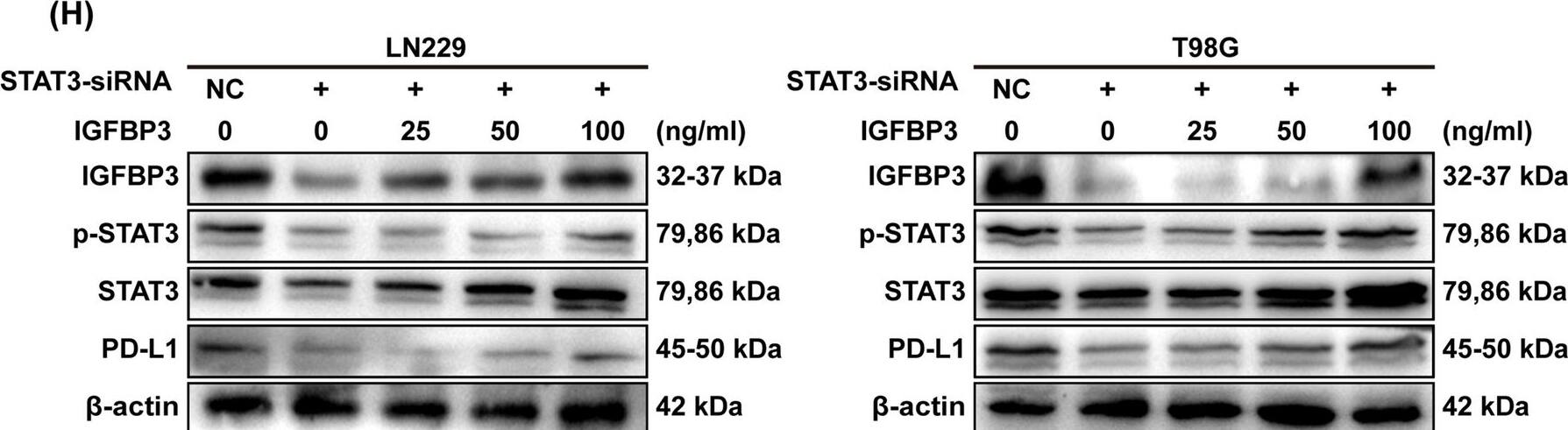
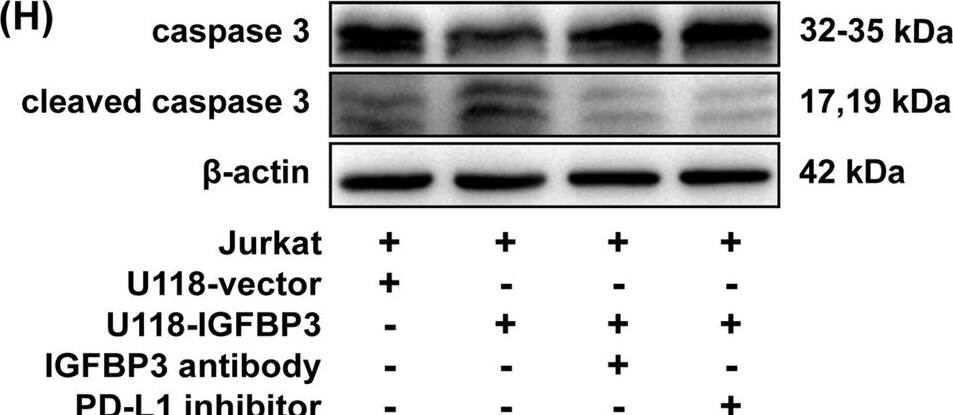
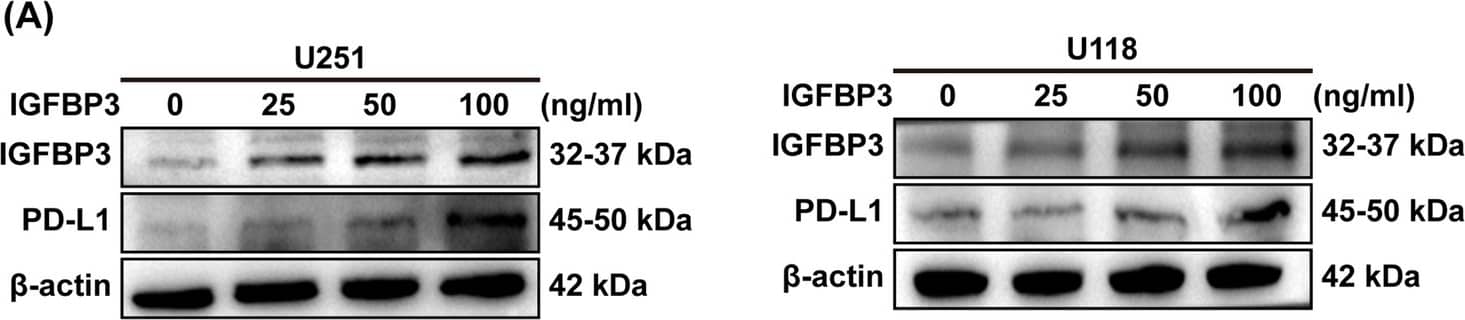
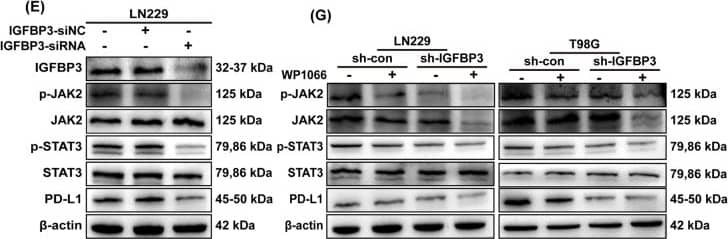
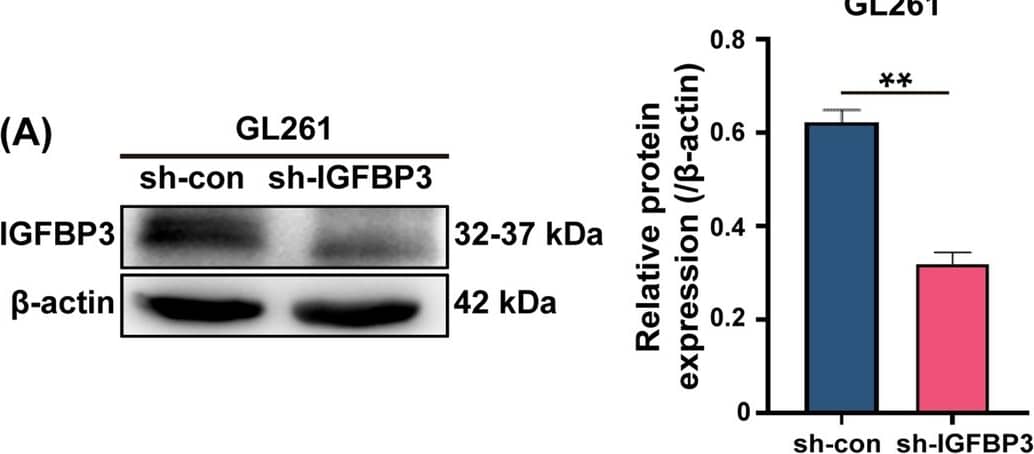
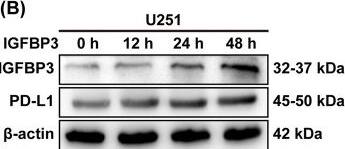
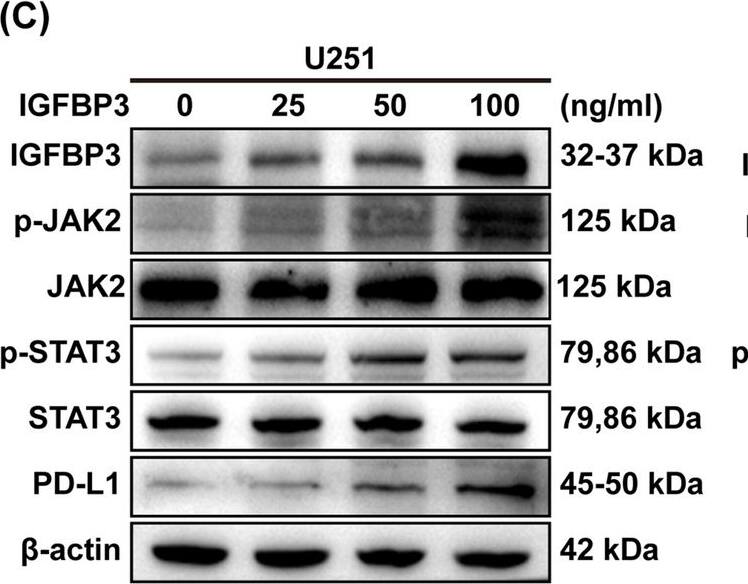
Detection of IGFBP-3 by Western Blot
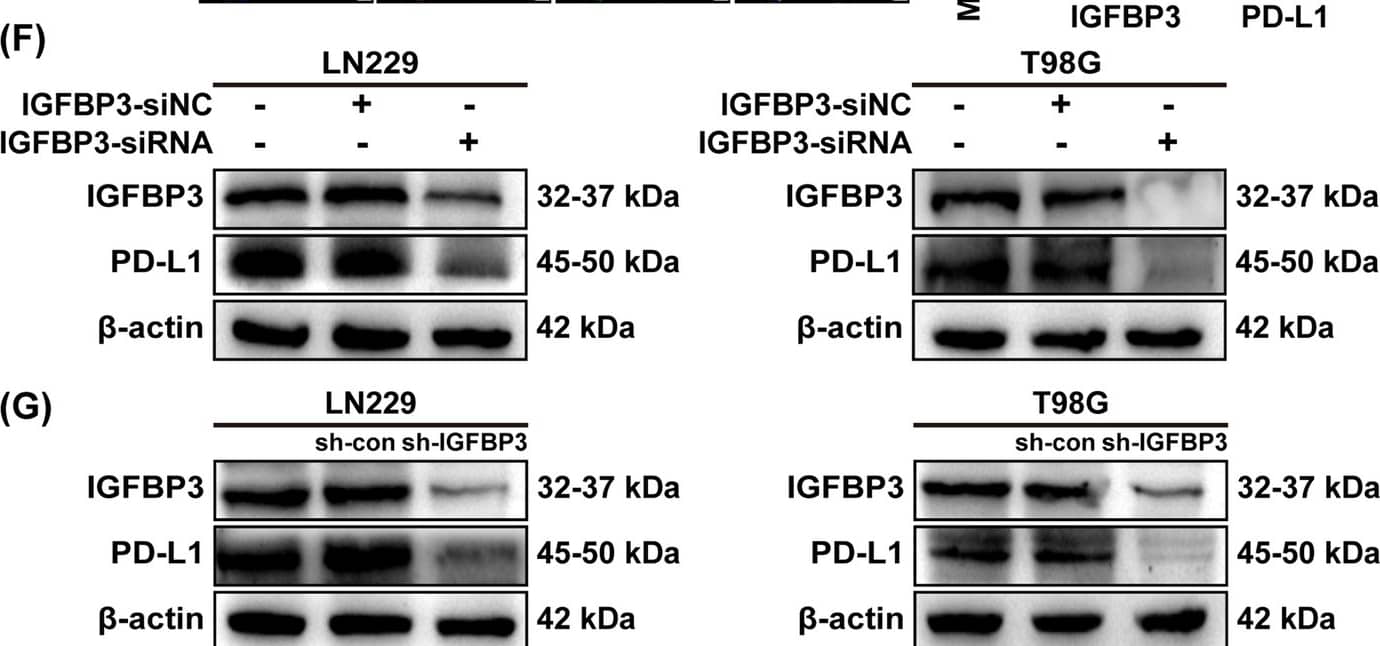
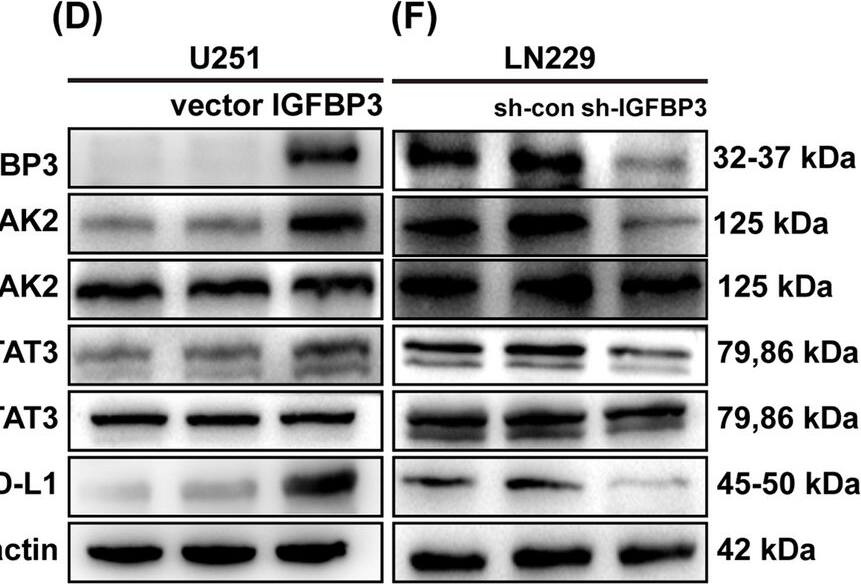
IGFBP3 increases PD-L1 expression by up-regulating the phosphorylation of STAT3 in GBM cells. A KEGG analysis of differential genes. B Correlation analysis of IGFBP3 and STAT3 in TCGA and CGGA databases, and statistical significance was assessed using the spearman’s rank test. C Immunoblotting analysis of IGFBP3, p-JAK2, p-STAT3, and PD-L1 expression in U251 cell treated with different concentrations of IGFBP3 for 24 h. D Immunoblotting analysis of IGFBP3, p-JAK2, p-STAT3, and PD-L1 expression in U251 cells infected with IGFBP3 overexpressing and empty vector lentivirus. E Immunoblotting was performed to examine the expression of IGFBP3, p-JAK2, p-STAT3, and PD-L1 in LN229 cell transfected with si-IGFBP3 and si-NC. F Immunoblotting analysis of IGFBP3, p-JAK2, p-STAT3, and PD-L1 expression in LN229 cell infected with sh-IGFBP3 and sh-con. G LN229 and T98G cells with IGFBP3 knockdown were treated with the JAK2/STAT3 inhibitor WP1066 for 24 h, cell lysate was used to analyze the expression of p-JAK2, p-STAT3 and PD-L1. H Immunoblotting was used to analyze the expression of IGFBP3, p-STAT3, and PD-L1 in STAT3-silenced LN229 and T98G cells stimulated with different concentrations of exogenous IGFBP3 for 24 h Image collected and cropped by CiteAb from the following open publication (https://cancerci.biomedcentral.com/articles/10.1186/s12935-024-03234-3), licensed under a CC-BY license. Not internally tested by R&D Systems.

Applications for Human IGFBP-3 Antibody
Application
Recommended Usage
Immunohistochemistry
5-15 µg/mL
Sample: Immersion fixed paraffin-embedded sections of human colon
Sample: Immersion fixed paraffin-embedded sections of human colon
Western Blot
0.1 µg/mL
Sample: Recombinant Human IGFBP-3 (Catalog # 675-B3)
Sample: Recombinant Human IGFBP-3 (Catalog # 675-B3)
Neutralization
Measured by its ability to neutralize IGFBP‑3 inhibition of IGF‑II-dependent proliferation in the MCF‑7 human breast cancer cell line [Karey, K.P. et al. (1988) Cancer Research 48:4083]. The Neutralization Dose (ND50) is typically 0.75-3.0 µg/mL in the presence of 0.2 µg/mL Recombinant Human IGFBP‑3 and 14 ng/mL Recombinant Human IGF‑II.
Formulation, Preparation, and Storage
Purification
Antigen Affinity-purified
Reconstitution
Reconstitute at 0.2 mg/mL in sterile PBS. For liquid material, refer to CoA for concentration.
Formulation
Lyophilized from a 0.2 μm filtered solution in PBS with Trehalose. *Small pack size (SP) is supplied either lyophilized or as a 0.2 µm filtered solution in PBS.
Shipping
Lyophilized product is shipped at ambient temperature. Liquid small pack size (-SP) is shipped with polar packs. Upon receipt, store immediately at the temperature recommended below.
Stability & Storage
Use a manual defrost freezer and avoid repeated freeze-thaw cycles.
- 12 months from date of receipt, -20 to -70 °C as supplied.
- 1 month, 2 to 8 °C under sterile conditions after reconstitution.
- 6 months, -20 to -70 °C under sterile conditions after reconstitution.
Background: IGFBP-3
The superfamily of insulin-like growth factor (IGF) binding proteins include the six high-affinity IGF binding proteins (IGFBP) and at least four additional low-affinity binding proteins referred to as IGFBP related proteins (IGFBP-rP). All IGFBP superfamily members are cysteine-rich proteins with conserved cysteine residues, which are clustered in the amino- and carboxy-terminal thirds of the molecule. IGFBPs modulate the biological activities of IGF proteins. Some IGFBPs may also have intrinsic bioactivity that is independent of their ability to bind IGF proteins. Post-translational modifications of IGFBPs, including glycosylation, phosphorylation and proteolysis, have been shown to modify the affinities of the binding proteins to IGF.
Human IGFBP-3 cDNA encodes a 291 amino acid (aa) residue precursor protein with a putative 27 aa residue signal peptide that is processed to generate the 264 aa residue mature protein with three potential N-linked and two potential O-linked glycosylation sites. Human IGFBP-3 is expressed in multiple tissues. The highest expression level is found in the non-paranchymal cells of the liver. Expression levels are also higher during extrauterine life and peak during puberty. Human IGFBP-3 is the major IGF binding protein in plasma where it exists in a ternary complex with IGF-I or IGF-II and the acid-labile subunit (ALS).
References
- Jones, J.I. and D.R. Clemmons (1995) Endocrine Rev. 16:3.
- Kelley, K.M. et al. (1996) Int. J. Biochem. Cell Biol. 28:619.
- Spagnoli, A. and R.G. Rosenfeld (1997) Curr. Op. Endocrinology and Diabetes 4:1.
Long Name
Insulin-like Growth Factor Binding Protein 3
Alternate Names
IGFBP3
Gene Symbol
IGFBP3
UniProt
Additional IGFBP-3 Products
Product Documents for Human IGFBP-3 Antibody
Product Specific Notices for Human IGFBP-3 Antibody
For research use only
Loading...
Loading...
Loading...
Loading...
Loading...