
Human G-CSFR/CD114 PE-conjugated Antibody
R&D Systems, part of Bio-Techne | Catalog # FAB381P

Conjugate
Catalog #
Key Product Details
Species Reactivity
Validated:
Human
Cited:
Human
Applications
Validated:
Flow Cytometry
Cited:
Flow Cytometry
Label
Phycoerythrin (Excitation = 488 nm, Emission = 565-605 nm)
Antibody Source
Monoclonal Mouse IgG1 Clone # 38660
Product Specifications
Immunogen
Mouse myeloma cell line NS0-derived recombinant human G‑CSF R/CD114
Glu25-Pro621
Accession # Q99062
Glu25-Pro621
Accession # Q99062
Specificity
Detects human G‑CSF R/CD114 in direct ELISAs and Western blots. In direct ELISAs and Western blots, no cross-reactivity with recombinant human (rh) GM-CSF R alpha, rhGM-CSF R beta, or rhM-CSF R is observed.
Clonality
Monoclonal
Host
Mouse
Isotype
IgG1
Scientific Data Images for Human G-CSFR/CD114 PE-conjugated Antibody
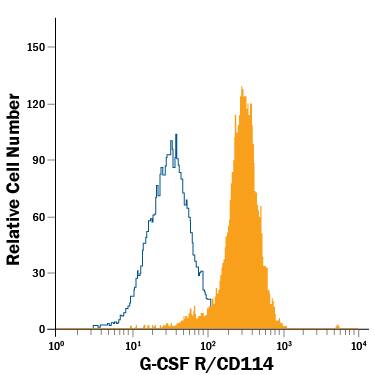
Detection of G‑CSF R/CD114 in Human Granulocytes by Flow Cytometry.
Human granulocytes were stained with Mouse Anti-Human G-CSF R/CD114 PE-conjugated Monoclonal Antibody (Catalog # FAB381P, filled histogram) or isotype control antibody (Catalog # IC002P, open histogram). View our protocol for Staining Membrane-associated Proteins.Applications for Human G-CSFR/CD114 PE-conjugated Antibody
Application
Recommended Usage
Flow Cytometry
10 µL/106 cells
Sample: Human granulocytes
Sample: Human granulocytes
Spectra Viewer
Plan Your Experiments
Use our spectra viewer to interactively plan your experiments, assessing multiplexing options. View the excitation and emission spectra for our fluorescent dye range and other commonly used dyes.
Spectra Viewer
Formulation, Preparation, and Storage
Purification
Protein A or G purified from hybridoma culture supernatant
Formulation
Supplied in a saline solution containing BSA and Sodium Azide.
Shipping
The product is shipped with polar packs. Upon receipt, store it immediately at the temperature recommended below.
Stability & Storage
Store the unopened product at 2 - 8° C. Do not use past expiration date. Protect from light.
Background: G-CSFR/CD114
Granulocyte Colony Stimulating Factor (G-CSF) is a pleiotropic cytokine best known for its specific effects on the proliferation, differentiation, and activation of hematopoietic cells of the neutrophilic granulocyte lineage. G-CSF plays an important role in defense against infection, in inflammation and repair, and in the maintenance of steady state hematopoiesis. Recombinant human G-CSF has been approved for the amelioration of chemotherapy induced neutropenia as well as for severe chronic neutropenia following marrow transplant.
Cell activation by G-CSF is mediated by a type I membrane protein belonging to the cytokine receptor superfamily. Human G-CSF R, also known as colony-stimulating factor 3 receptor (CSF3R) and designated CD114, is 863 amino acids (aa) in length, with a 604 aa extracellular domain, a 26 aa transmembrane domain, and a 183 aa cytoplasmic domain that include a 23 amino acid signal sequence. As a result of alternative splicing, at least four isoforms of G-CSF R that differ in their C-terminal region exist. Isoform 2 lacks the transmembrane region and may represent a soluble form of the receptor; however the existence of soluble G-CSF R in human serum has not been reported (1). Mutations have been found in the gene encoding G-CSF R in some patients with severe congenital neutropenia. These mutations typically led to a truncation in the cytoplasmic domain of the G-CSF R leading to maturation arrest of neutrophil precursors in the bone marrow and neutropenia in peripheral blood (2). Human and mouse G-CSF R have a homology of 62.5%.
G-CSF R is expressed in mature neutrophils, neutrophilic precursors, myeloid leukemia cells, and placenta. Binding of G-CSF to its receptor induces dimerization or oligomerization of the receptor activating cytoplasmic tyrosine kinases. Signal transduction from pathways that involve Janus tyrosine kinases/signal transducer and activator of transcription proteins (Jak1, Jak2, and Tyk2/STAT3, STAT3, and STATG), src-related protein tyrosine kinases (Lyn and Syk), Ras/MAP kinase, and phosphatidylinositol have been reported to be activated upon G-CSF stimulation (1).
References
- Nicola, N.A., in Cytokine Reference, (2001) Oppenhiem, J.J. and M. Feldmann, eds. Academic Press p. 1935
- Mitsui, T. et. al. (2003) Blood. 101:2990.
Long Name
Granulocyte Colony Stimulating Factor Receptor
Alternate Names
CD114, CSF3R, Csfgr, G-CSF R, GCSFR
Gene Symbol
CSF3R
UniProt
Additional G-CSFR/CD114 Products
Product Documents for Human G-CSFR/CD114 PE-conjugated Antibody
Product Specific Notices for Human G-CSFR/CD114 PE-conjugated Antibody
For research use only
Loading...
Loading...
Loading...
Loading...
Loading...