
Human Fibroblast Activation Protein alpha/FAP Antibody
R&D Systems, part of Bio-Techne | Catalog # MAB3715


Scientific images may be resized, cropped, or adjusted for brightness or contrast for presentation purposes. These updates are limited to presentation and do not affect the underlying scientific interpretation of the data. Where available, additional source data may be provided upon request.
Conjugate
Catalog #
Key Product Details
Species Reactivity
Validated:
Human
Cited:
Human, Xenograft
Applications
Validated:
ELISA Capture (Matched Antibody Pair), Flow Cytometry, CyTOF-ready
Cited:
Immunohistochemistry, Immunohistochemistry-Paraffin, Western Blot, Flow Cytometry, Immunocytochemistry, Immunoprecipitation, Cell Capture, Cell Culture, FACS, Functional Assay
Label
Unconjugated
Antibody Source
Monoclonal Mouse IgG1 Clone # 427819
Product Specifications
Immunogen
S. frugiperda insect ovarian cell line Sf 21-derived recombinant human Fibroblast Activation Protein alpha/FAP
Leu26-Asp760
Accession # Q12884
Leu26-Asp760
Accession # Q12884
Specificity
Detects human Fibroblast Activation Protein alpha/FAP in direct ELISAs. In direct ELISAs, no cross-reactivity with recombinant human DPP6 and DPP4 is observed.
Clonality
Monoclonal
Host
Mouse
Isotype
IgG1
Scientific Data Images for Human Fibroblast Activation Protein alpha/FAP Antibody
Detection of Fibroblast Activation Protein alpha/FAP in WI‑38 Human Cell Line by Flow Cytometry.
WI-38 human lung fibroblast cell line was stained with Mouse Anti-Human Fibroblast Activation Protein a/FAP Monoclonal Antibody (Catalog # MAB3715, filled histogram) or isotype control antibody (Catalog # MAB002, open histogram), followed by Phycoerythrin-conjugated Anti-Mouse IgG Secondary Antibody (Catalog # F0102B). View our protocol for Staining Membrane-associated Proteins.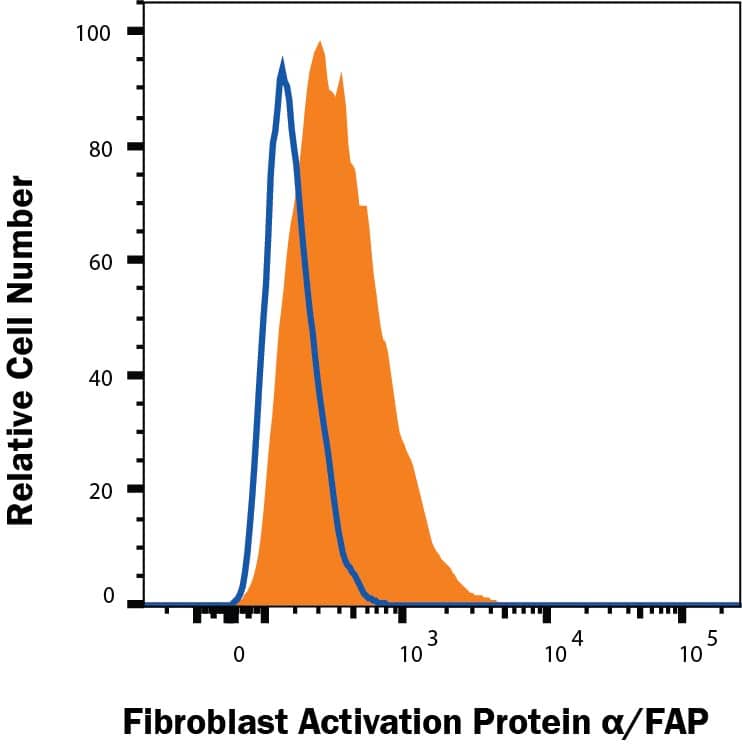
Detection of Fibroblast Activation Protein alpha/FAP in U-87 MG cells by Flow Cytometry.
U-87 MG cells were stained with Mouse Anti-Human Fibroblast Activation Protein alpha/FAP Monoclonal Antibody (Catalog # MAB3715, filled histogram) or isotype control antibody (Catalog # MAB002, open histogram), followed by Fluorescein-conjugated Anti-Mouse IgG Secondary Antibody (Catalog # F0103B). View our protocol for Staining Membrane-associated Proteins.
Detection of Fibroblast Activation Protein alpha /FAP by Immunohistochemistry
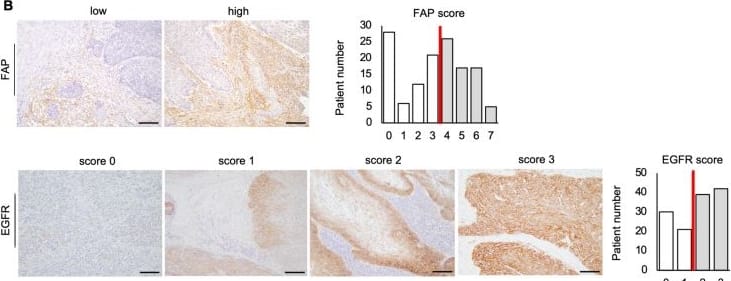
The expression of FAP and EGFR and clinical outcome in 132 cases of esophageal cancer. (A) IHC for FAP and EGFR are shown at low and high magnification (40 × and 200 ×). Scale bars: 500 µm (40 ×), 100 µm (200 ×). The expression of FAP and EGFR is different between intra-tumoral and peri-tumoral tissue. (B) Representative example of a low- and high-FAP and EGFR case. Scale bars: 200 µm (100 ×). The FAP score of 4 + or more were defined as high, that of 3 + or less were low; the EGFR expression level of 2 + or 3 + were defined as high, that of 0 or 1 + were low. (C) Survival analysis showed that FAP high patients had significantly worse OS than those with low FAP (P < 0.001, log-rank test; *P < 0.05). (D) Patients with high EGFR tended to show poorer OS than those with low EGFR (P = 0.074, log-rank test). (E) Survival curve of three groups divided by combination of EGFR and FAP scores (double negative, single positive, double positive), double positive group had worse survival than others (P = 0.005: vs. double negative, P = 0.089: vs. single positive, log-rank test; *P < 0.05). Image collected and cropped by CiteAb from the following open publication (https://pubmed.ncbi.nlm.nih.gov/36418422), licensed under a CC-BY license. Not internally tested by R&D Systems.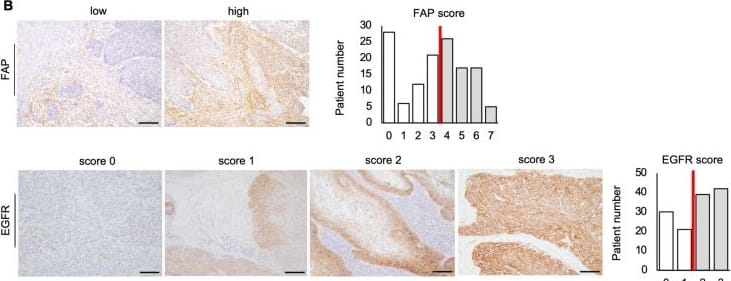


Applications for Human Fibroblast Activation Protein alpha/FAP Antibody
Application
Recommended Usage
CyTOF-ready
Ready to be labeled using established conjugation methods. No BSA or other carrier proteins that could interfere with conjugation.
Flow Cytometry
0.25 µg/106 cells
Sample: WI‑38 human lung fibroblast cell line and U‑87 MG human glioblastoma/astrocytoma cell line
Sample: WI‑38 human lung fibroblast cell line and U‑87 MG human glioblastoma/astrocytoma cell line
Human Fibroblast Activation Protein alpha/FAP Sandwich Immunoassay
Please Note: Optimal dilutions of this antibody should be experimentally determined.
Reviewed Applications
Read 3 reviews rated 5 using MAB3715 in the following applications:
Formulation, Preparation, and Storage
Purification
Protein A or G purified from hybridoma culture supernatant
Reconstitution
Reconstitute at 0.5 mg/mL in sterile PBS. For liquid material, refer to CoA for concentration.
Formulation
Lyophilized from a 0.2 μm filtered solution in PBS with Trehalose. *Small pack size (SP) is supplied either lyophilized or as a 0.2 µm filtered solution in PBS.
Shipping
Lyophilized product is shipped at ambient temperature. Liquid small pack size (-SP) is shipped with polar packs. Upon receipt, store immediately at the temperature recommended below.
Stability & Storage
Use a manual defrost freezer and avoid repeated freeze-thaw cycles.
- 12 months from date of receipt, -20 to -70 °C as supplied.
- 1 month, 2 to 8 °C under sterile conditions after reconstitution.
- 6 months, -20 to -70 °C under sterile conditions after reconstitution.
Background: Fibroblast Activation Protein alpha/FAP
FAP (also known as Seprase) is a 97 kDa Type II transmembrane serine protease that is structurally related to Dipeptidyl Peptidase IV (DPPIV) (1). FAP has substrate specificity similar to DPPIV, which is specific for N-terminal Xaa-Pro sequences, but FAP is also an endopeptidase able to degrade gelatin and Type I Collagen (2). The enzymatically active form of FAP is a dimer that migrates at ~170 kDa. It is associated with multiple integral membrane proteins such as Integrin alpha3 beta1, UPA and DPPIV (3,4). FAP has a restricted tissue distribution. It is occasionally detected in fibroblasts and pancreatic islet cells, but is highly expressed on reactive stromal fibroblasts in epithelial cancers, in granulation tissue during wound healing, and in bone and soft tissue sarcomas (4-6). Because of its expression patterns and enzymatic activities, FAP is believed to play roles in tumor invasion, tissue remodeling, and wound repair. The 760 amino acid (aa) human FAP contains a 735 aa extracellular domain that is glycosylated and necessary for activity (4). It shares 90% aa identity with mouse and rat FAP. A reported 672 aa splicing variant diverges prior to the active site charge relay residues at the C-terminus.
References
- Scanlan, M.J. et al. (1994) Proc. Natl. Acad. Sci. USA 91:5657.
- Park, J.E. et al. (1999) J. Biol. Chem. 274:36505.
- Pineiro-Sanchez, M.L. et al. (1997) J. Biol. Chem. 272:7595.
- O'Brien, P. and B.F. O'Connor (2008) Biochim. Biophys. Acta 1784:1130.
- Garin-Chesa, P. et al. (1990) Proc. Natl. Acad. Sci. USA 87:7235.
- Rettig, W.J. et al. (1988) Proc. Natl. Acad. Sci. USA 85:3110.
Alternate Names
FAP, Seprase
Gene Symbol
FAP
UniProt
Additional Fibroblast Activation Protein alpha/FAP Products
- All Products for Fibroblast Activation Protein alpha/FAP
- Fibroblast Activation Protein alpha/FAP cDNA Clones
- Fibroblast Activation Protein alpha/FAP ELISA Kits
- Fibroblast Activation Protein alpha/FAP Lysates
- Fibroblast Activation Protein alpha/FAP Primary Antibodies
- Fibroblast Activation Protein alpha/FAP Proteins and Enzymes
- Fibroblast Activation Protein alpha/FAP Simple Plex
Product Documents for Human Fibroblast Activation Protein alpha/FAP Antibody
Product Specific Notices for Human Fibroblast Activation Protein alpha/FAP Antibody
For research use only
Loading...
Loading...
Loading...
Loading...
Loading...
Loading...