
Human Fc gamma RIII (CD16) PE-conjugated Antibody
R&D Systems, part of Bio-Techne | Catalog # FAB2546P

Conjugate
Catalog #
Key Product Details
Species Reactivity
Validated:
Human
Cited:
Human
Applications
Validated:
Flow Cytometry
Cited:
Flow Cytometry
Label
Phycoerythrin (Excitation = 488 nm, Emission = 565-605 nm)
Antibody Source
Monoclonal Mouse IgG2A Clone # 245536
Product Specifications
Immunogen
Mouse myeloma cell line NS0-derived recombinant human Fc gamma RIIIA/B (CD16)
Thr20-Gln208
Accession # O75015
Thr20-Gln208
Accession # O75015
Specificity
Detects human Fc gamma RIIIA/B (CD16) in direct ELISAs. In direct ELISAs, approximately 10% cross-reactivity with recombinant human Fc gamma RIIA and recombinant mouse Fc gamma RIII is observed.
Clonality
Monoclonal
Host
Mouse
Isotype
IgG2A
Scientific Data Images for Human Fc gamma RIII (CD16) PE-conjugated Antibody
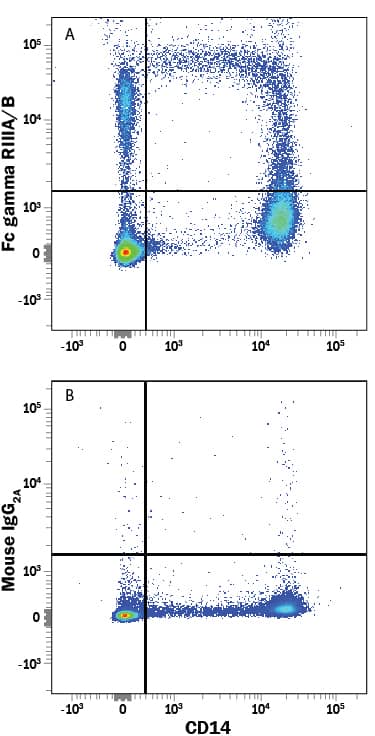
Detection of Fc gamma RIII (CD16) in Human PBMCs by Flow Cytometry.
Human peripheral blood mononuclear cells (PBMCs) were stained with Mouse Anti-Human Fc gamma RIII (CD16) PE-conjugated Monoclonal Antibody (Catalog # FAB2546P) and Mouse Anti-Human CD14 APC-conjugated Monoclonal Antibody (Catalog # FAB3832A). Quadrant markers were set based on control antibody staining (Catalog # IC003P). View our protocol for Staining Membrane-associated Proteins.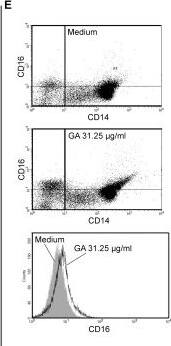
Detection of Human Fc gamma RIII (CD16) by Flow Cytometry
Analysis of monocyte subsets. A–B. Gated monocytes in a forward vs. side scatter dot-plot analysis of peripheral blood mononuclear cells. Monocytes were then gated according to their surface expression of CD14 and CD16. Flow cytometric analysis of phagocytosis revealed that CD14++CD16+ monocytes (gate III) engulfed polystyrene beads more effectively than the other subsets (gate I and II). CI–III. The mean fluorescence intensities represent the amount of incorporated fluorescent latex particles phagocytosed by 3×10⁵ cells. D. Increase in the percentage of CD14+CD16+ monocytes after 4 h and 8 h of treatment with 31.25 µg/ml glatiramer acetate (GA) in MACS isolated monocytes. Data are expressed as mean percentages ± SEM of three independent experiments. Significant effects vs. controls are indicated by asterisks (*p<0.05, **p<0.01, and ***p<0.001 using Bonferroni's Multiple Comparison Test) as determined by one-way ANOVA. E. Slight but not significant increase of CD16 expression after GA treatment. Image collected and cropped by CiteAb from the following open publication (https://pubmed.ncbi.nlm.nih.gov/23284793), licensed under a CC-BY license. Not internally tested by R&D Systems.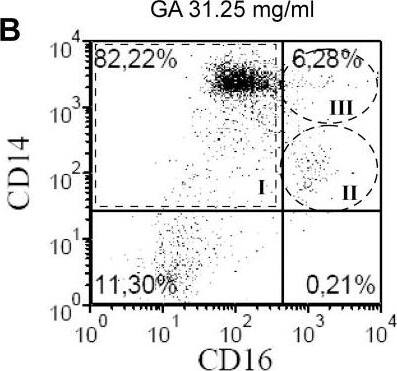
Detection of Human Fc gamma RIII (CD16) by Flow Cytometry
Analysis of monocyte subsets. A–B. Gated monocytes in a forward vs. side scatter dot-plot analysis of peripheral blood mononuclear cells. Monocytes were then gated according to their surface expression of CD14 and CD16. Flow cytometric analysis of phagocytosis revealed that CD14++CD16+ monocytes (gate III) engulfed polystyrene beads more effectively than the other subsets (gate I and II). CI–III. The mean fluorescence intensities represent the amount of incorporated fluorescent latex particles phagocytosed by 3×10⁵ cells. D. Increase in the percentage of CD14+CD16+ monocytes after 4 h and 8 h of treatment with 31.25 µg/ml glatiramer acetate (GA) in MACS isolated monocytes. Data are expressed as mean percentages ± SEM of three independent experiments. Significant effects vs. controls are indicated by asterisks (*p<0.05, **p<0.01, and ***p<0.001 using Bonferroni's Multiple Comparison Test) as determined by one-way ANOVA. E. Slight but not significant increase of CD16 expression after GA treatment. Image collected and cropped by CiteAb from the following open publication (https://pubmed.ncbi.nlm.nih.gov/23284793), licensed under a CC-BY license. Not internally tested by R&D Systems.Applications for Human Fc gamma RIII (CD16) PE-conjugated Antibody
Application
Recommended Usage
Flow Cytometry
10 µL/106 cells
Sample: Human peripheral blood mononuclear cells (PBMCs)
Sample: Human peripheral blood mononuclear cells (PBMCs)
Reviewed Applications
Read 1 review rated 5 using FAB2546P in the following applications:
Spectra Viewer
Plan Your Experiments
Use our spectra viewer to interactively plan your experiments, assessing multiplexing options. View the excitation and emission spectra for our fluorescent dye range and other commonly used dyes.
Spectra Viewer
Formulation, Preparation, and Storage
Purification
Protein A or G purified from hybridoma culture supernatant
Formulation
Supplied in a saline solution containing BSA and Sodium Azide.
Shipping
The product is shipped with polar packs. Upon receipt, store it immediately at the temperature recommended below.
Stability & Storage
Protect from light. Do not freeze.
- 12 months from date of receipt, 2 to 8 °C as supplied.
Background: Fc gamma RIII (CD16)
Long Name
Fc gamma Receptor III
Alternate Names
FcgRIII
Gene Symbol
FCGR3
UniProt
Additional Fc gamma RIII (CD16) Products
Product Documents for Human Fc gamma RIII (CD16) PE-conjugated Antibody
Product Specific Notices for Human Fc gamma RIII (CD16) PE-conjugated Antibody
For research use only
Loading...
Loading...
Loading...
Loading...
Loading...