
Human EPCR Antibody
R&D Systems, part of Bio-Techne | Catalog # AF2245



Conjugate
Catalog #
Key Product Details
Species Reactivity
Validated:
Human
Cited:
Human, Mouse
Applications
Validated:
Immunohistochemistry, Western Blot, Flow Cytometry, CyTOF-ready
Cited:
Immunohistochemistry, Immunohistochemistry-Paraffin, Western Blot, Neutralization, Flow Cytometry, Immunocytochemistry, Binding Assay, Dot Blot, ELISA Development
Label
Unconjugated
Antibody Source
Polyclonal Goat IgG
Product Specifications
Immunogen
Mouse myeloma cell line NS0-derived recombinant human EPCR
Ser18-Ser210
Accession # Q9UNN8
Ser18-Ser210
Accession # Q9UNN8
Specificity
Detects human EPCR in direct ELISAs and Western blots. In direct ELISAs and Western blots, approximately 20% cross-reactivity with recombinant mouse EPCR is observed.
Clonality
Polyclonal
Host
Goat
Isotype
IgG
Scientific Data Images for Human EPCR Antibody
Detection of Human EPCR by Western Blot.
Western blot shows lysates of human skin tissue, human placenta tissue, and HUVEC human umbilical vein endothelial cells. PVDF membrane was probed with 0.25 µg/mL of Goat Anti-Human EPCR Antigen Affinity-purified Polyclonal Antibody (Catalog # AF2245) followed by HRP-conjugated Anti-Goat IgG Secondary Antibody (Catalog # HAF017). A specific band was detected for EPCR at approximately 40-45 kDa (as indicated). This experiment was conducted under reducing conditions and using Immunoblot Buffer Group 1.
EPCR in Human Liver.
EPCR was detected in immersion fixed paraffin-embedded sections of human liver using 1.7 µg/mL Goat Anti-Human EPCR Antigen Affinity-purified Polyclonal Antibody (Catalog # AF2245) overnight at 4 °C. Tissue was stained with the Anti-Goat HRP-DAB Cell & Tissue Staining Kit (brown; Catalog # CTS008) and counterstained with hematoxylin (blue). View our protocol for Chromogenic IHC Staining of Paraffin-embedded Tissue Sections.
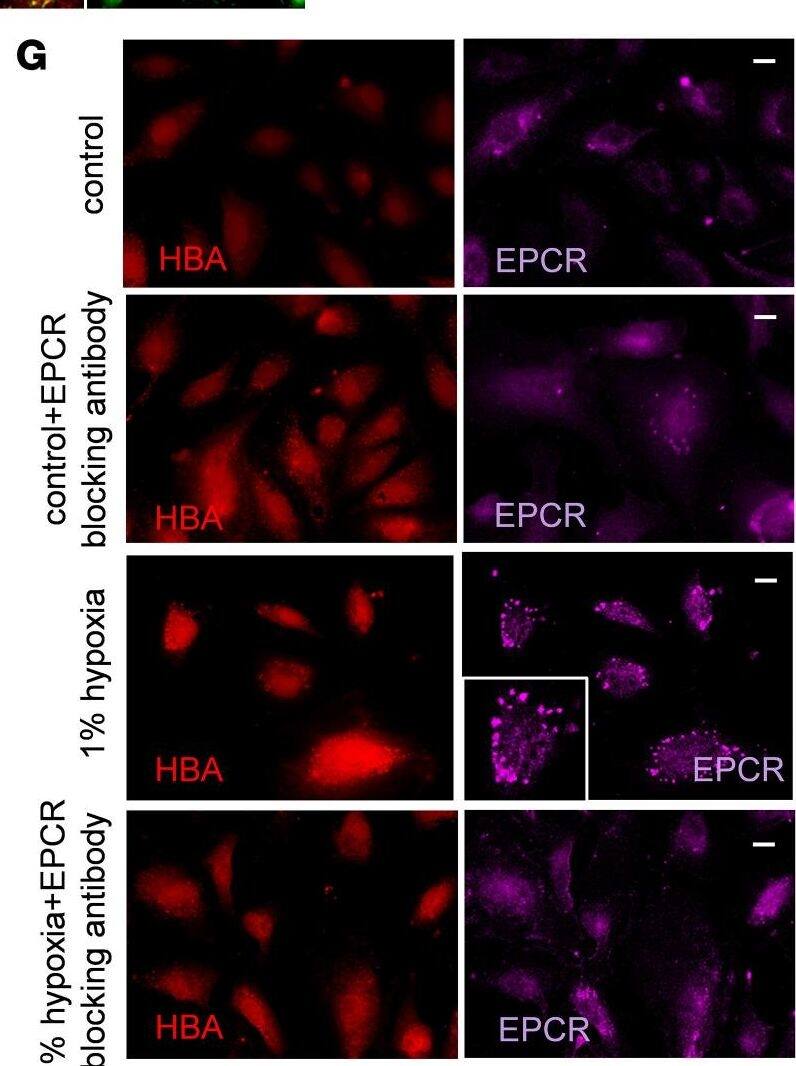
Detection of EPCR by Immunocytochemistry/ Immunofluorescence
Effect of hypoxia on endothelial hemoglobin & EPCR expression.(A) Representative WB of human cardiac microvascular endothelial cultured under hypoxia (1% oxygen) showing HIF1A, NRF2, EPCR, HBA, & ACTB as a protein loading control; n = 3 biological replicates. Values under each blot image indicate fold changes versus results in control (as determined by normalization to the loading control run on same blot). (B & C) Representative immunofluorescent images & quantification of human microvascular endothelial cultured under hypoxia at different time points, as indicated, & stained for HBA (red) & NRF2 (green). Small image in 24-hour NRF2 panel shows overlay image of the cell. *P < 0.05 & ****P < 0.0001 versus control calculated using 1-way ANOVA, Bonferroni’s multiple-comparison test. (D) Representative immunofluorescent high-resolution images showing human microvascular endothelial cultured under hypoxia (1% oxygen) & stained for PAR1 (green) & EPCR (purple) at the left panel or for PAR1 (green), EPCR (purple), & lysosomal tracker (Lyso; red) at the right panel; n = 3 biological replicates. Scale bars: 10 μm. (E & F) WB & quantification analysis of human microvascular endothelial cultured under hypoxia (1% oxygen) showing NRF2, caveolin-1, & beta-actin (ACTB) as a loading control; n = 3 biological replicates. ***P < 0.001 & ****P < 0.0001; 1-way ANOVA, Bonferroni’s multiple-comparison test. (G & H) Representative immunofluorescent images & quantification analysis showing human microvascular endothelial cultured under hypoxia (1% oxygen), treated with EPCR-blocking antibody (20 μg/mL), as indicated, & stained for HBA (red) & EPCR (purple). Scale bars: 10 μm. **P < 0.01, ***P < 0.001, & ****P < 0.0001 versus control ; 1-way ANOVA, Bonferroni’s multiple-comparison test. Image collected & cropped by CiteAb from the following open publication (https://pubmed.ncbi.nlm.nih.gov/35700057), licensed under a CC-BY license. Not internally tested by R&D Systems.
Applications for Human EPCR Antibody
Application
Recommended Usage
CyTOF-ready
Ready to be labeled using established conjugation methods. No BSA or other carrier proteins that could interfere with conjugation.
Flow Cytometry
0.25 µg/106 cells
Sample: HUVEC human umbilical vein endothelial cells
Sample: HUVEC human umbilical vein endothelial cells
Immunohistochemistry
1-15 µg/mL
Sample: Immersion fixed paraffin-embedded sections of human liver
Sample: Immersion fixed paraffin-embedded sections of human liver
Western Blot
0.25 µg/mL
Sample: Human skin tissue, human placenta tissue, and HUVEC human umbilical vein endothelial cells
Sample: Human skin tissue, human placenta tissue, and HUVEC human umbilical vein endothelial cells
Formulation, Preparation, and Storage
Purification
Antigen Affinity-purified
Reconstitution
Reconstitute at 0.2 mg/mL in sterile PBS. For liquid material, refer to CoA for concentration.
Formulation
Lyophilized from a 0.2 μm filtered solution in PBS with Trehalose. *Small pack size (SP) is supplied either lyophilized or as a 0.2 µm filtered solution in PBS.
Shipping
Lyophilized product is shipped at ambient temperature. Liquid small pack size (-SP) is shipped with polar packs. Upon receipt, store immediately at the temperature recommended below.
Stability & Storage
Use a manual defrost freezer and avoid repeated freeze-thaw cycles.
- 12 months from date of receipt, -20 to -70 °C as supplied.
- 1 month, 2 to 8 °C under sterile conditions after reconstitution.
- 6 months, -20 to -70 °C under sterile conditions after reconstitution.
Background: EPCR
Long Name
Endothelial Protein C Receptor
Alternate Names
CCD41, CD201, PROCR
Gene Symbol
PROCR
UniProt
Additional EPCR Products
Product Documents for Human EPCR Antibody
Product Specific Notices for Human EPCR Antibody
For research use only
Loading...
Loading...
Loading...
Loading...
Loading...
Loading...