
Human EGLN1/PHD2 Antibody
R&D Systems, part of Bio-Techne | Catalog # AF7680

Scientific images may be resized, cropped, or adjusted for brightness or contrast for presentation purposes. These updates are limited to presentation and do not affect the underlying scientific interpretation of the data. Where available, additional source data may be provided upon request.
Conjugate
Catalog #
Key Product Details
Species Reactivity
Human
Applications
Western Blot
Label
Unconjugated
Antibody Source
Polyclonal Sheep IgG
Product Specifications
Immunogen
S. frugiperda insect ovarian cell line Sf 21-derived recombinant human EGLN1/PHD2
Gln157-Phe426
Accession # Q9GZT9
Gln157-Phe426
Accession # Q9GZT9
Specificity
Detects human EGLN1/PHD2 in direct ELISAs and Western blots. In direct ELISAs, less than 1% cross-reactivity with recombinant human (rh) PHD1 and rhPHD3 is observed.
Clonality
Polyclonal
Host
Sheep
Isotype
IgG
Scientific Data Images for Human EGLN1/PHD2 Antibody
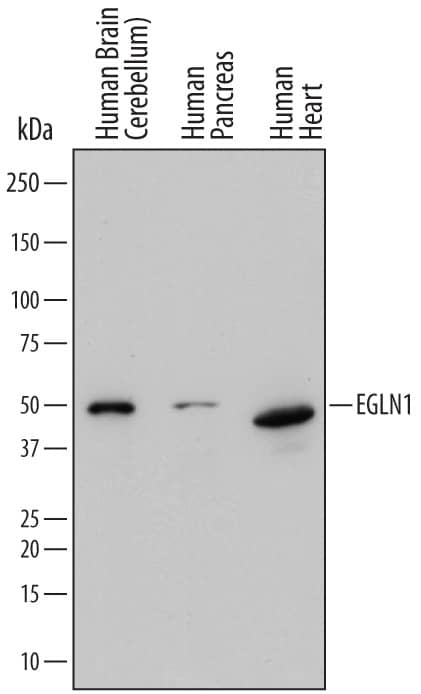
Detection of Human EGLN1/PHD2 by Western Blot.
Western blot shows lysates of human brain (cerebellum) tissue, human pancreas tissue, and human heart tissue. PVDF membrane was probed with 0.5 µg/mL of Sheep Anti-Human EGLN1/PHD2 Antigen Affinity-purified Polyclonal Antibody (Catalog # AF7680) followed by HRP-conjugated Anti-Sheep IgG Secondary Antibody (Catalog # HAF016). A specific band was detected for EGLN1/PHD2 at approximately 45-50 kDa (as indicated). This experiment was conducted under reducing conditions and using Immunoblot Buffer Group 1.Applications for Human EGLN1/PHD2 Antibody
Application
Recommended Usage
Western Blot
0.5 µg/mL
Sample: Human brain (cerebellum) tissue, human pancreas tissue, and human heart tissue
Sample: Human brain (cerebellum) tissue, human pancreas tissue, and human heart tissue
Formulation, Preparation, and Storage
Purification
Antigen Affinity-purified
Reconstitution
Sterile PBS to a final concentration of 0.2 mg/mL. For liquid material, refer to CoA for concentration.
Formulation
Lyophilized from a 0.2 μm filtered solution in PBS with Trehalose. *Small pack size (SP) is supplied either lyophilized or as a 0.2 µm filtered solution in PBS.
Shipping
Lyophilized product is shipped at ambient temperature. Liquid small pack size (-SP) is shipped with polar packs. Upon receipt, store immediately at the temperature recommended below.
Stability & Storage
Use a manual defrost freezer and avoid repeated freeze-thaw cycles.
- 12 months from date of receipt, -20 to -70 °C as supplied.
- 1 month, 2 to 8 °C under sterile conditions after reconstitution.
- 6 months, -20 to -70 °C under sterile conditions after reconstitution.
Background: EGLN1/PHD2
PHD2 (Prolyl Hydroxylase Domain-containing protein 2; also HPH2, EGLN1 and HIF-PH2) is a 45-47 kDa dioxygenase member of the PH family of enzymes. It is ubiquitously expressed, and serves to regulate the availability of the oxygen-sensitive HIF transcription factor. Active HIF1 alpha is a heterodimer of alpha- and beta-subunits and when intact, promotes VEGF and EPO production. The beta-subunit is constitutively expressed, while alpha-subunit levels are regulated by intracellular oxygen concentration. At normoxic levels, the alpha-subunit is hydroxylated on Pro by one of three PHDs, inducing its ubiquitination/degradation. The hydroxylation event requires oxygen, and thus PH activity (particularly PHD2) is a measure of a cell's oxygen concentration. Human PHD2 is 426 amino acids (aa) in length. It contains an NES (aa 6-20), a Zn-finger region (aa 21-58), and a catalytic domain (aa 291-392). There are five nitrosylated cysteines plus one acetylated alanine. Two isoform variants are known, one that shows a deletion of aa 338-359, and another that contains a 17 aa substitution for aa 58-175. Over aa 157-426, human PHD2 shares 93% aa sequence identity with mouse PHD2.
Long Name
Egl Nine Homolog 1/Prolyl Hydroxylase Domain-containing Protein 2
Alternate Names
C1orf12, HIFPH2, HPH2, PHD2, SM20, ZMYND6
Gene Symbol
EGLN1
UniProt
Additional EGLN1/PHD2 Products
Product Documents for Human EGLN1/PHD2 Antibody
Product Specific Notices for Human EGLN1/PHD2 Antibody
For research use only
Loading...
Loading...
Loading...
Loading...
Loading...