
Human DC-SIGN/CD209 Antibody
R&D Systems, part of Bio-Techne | Catalog # AF161


Scientific images may be resized, cropped, or adjusted for brightness or contrast for presentation purposes. These updates are limited to presentation and do not affect the underlying scientific interpretation of the data. Where available, additional source data may be provided upon request.
Conjugate
Catalog #
Key Product Details
Species Reactivity
Validated:
Human
Cited:
Porcine
Applications
Validated:
Western Blot, Simple Western
Cited:
Flow Cytometry
Label
Unconjugated
Antibody Source
Polyclonal Sheep IgG
Product Specifications
Immunogen
Mouse myeloma cell line NS0-derived recombinant human DC‑SIGN/CD209
Lys62-Ala404
Accession # Q9NNX6
Lys62-Ala404
Accession # Q9NNX6
Specificity
Detects human DC‑SIGN/CD209 in direct ELISAs and Western blots.
Clonality
Polyclonal
Host
Sheep
Isotype
IgG
Scientific Data Images for Human DC-SIGN/CD209 Antibody
Detection of Human DC‑SIGN/CD209 by Western Blot.
Western blot shows lysates of human dendritic cells. PVDF Membrane was probed with 1 µg/mL of Sheep Anti-Human DC-SIGN/CD209 Antigen Affinity-purified Polyclonal Antibody (Catalog # AF161) followed by HRP-conjugated Anti-Goat IgG Secondary Antibody (Catalog # HAF019). A specific band was detected for DC-SIGN/CD209 at approximately 50 kDa (as indicated). This experiment was conducted under reducing conditions and using Immunoblot Buffer Group 8.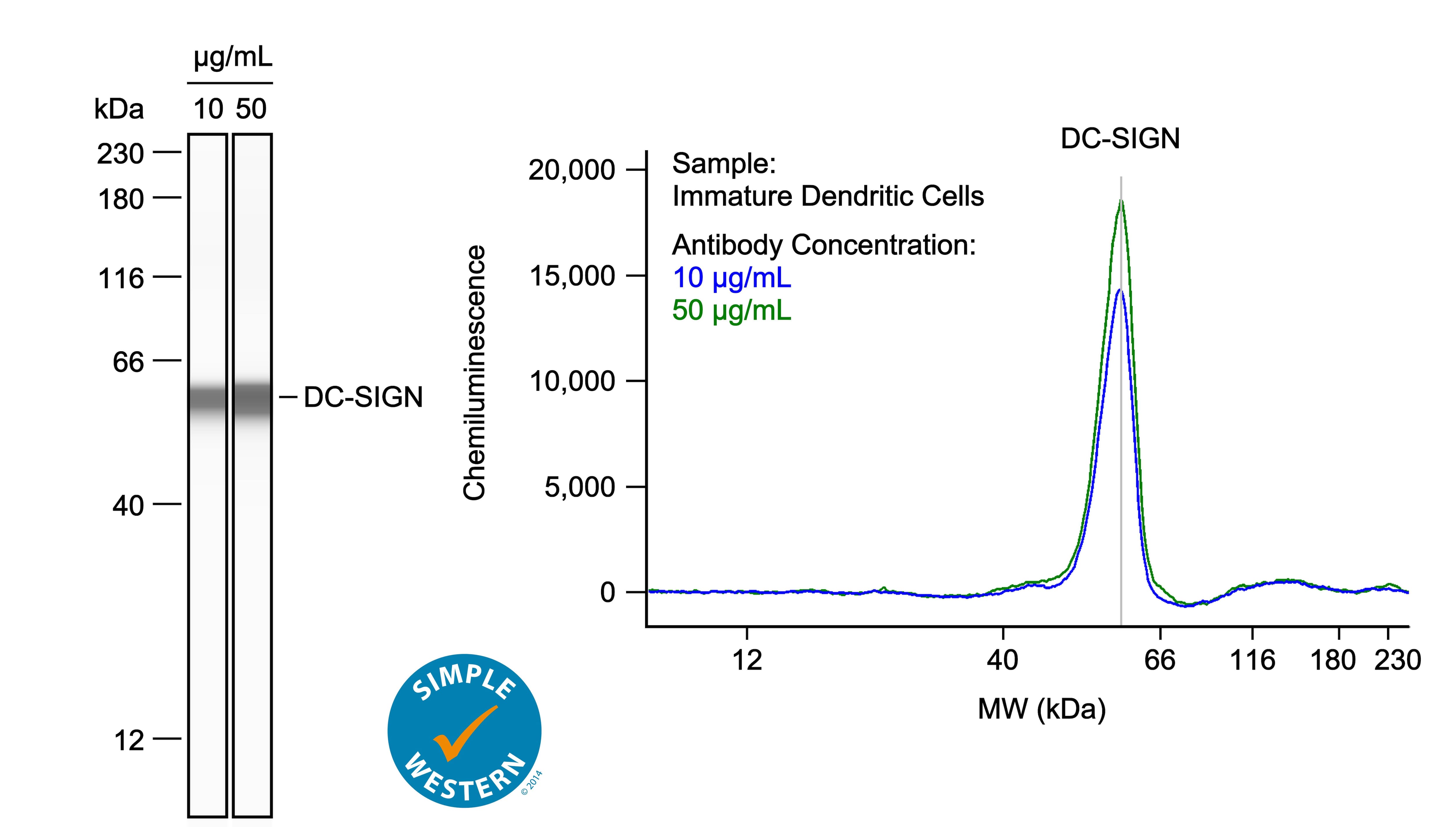
Detection of Human DC-SIGN/CD209 by Simple WesternTM.
Left: Simple Western lane view shows lysates of human immature dendritic cells, loaded at 0.4 mg/ml. A specific band was detected for DC-SIGN/CD209 at approximately 59 kDa (as indicated) using both 10 µg/ml and 50 µg/ml of Sheep Anti-Human DC-SIGN/CD209 Antigen Affinity-purified Polyclonal Antibody (Catalog # AF161) followed by 1:50 dilution of HRP-conjugated Anti-Sheep IgG Secondary Antibody (Catalog # HAF016) in Milk-free Antibody Diluent (Catalog # 043-524). This experiment was conducted under reducing conditions and using the 12-230kDa separation system. Right: Simple Western electropherogram showing the same Sheep Anti-Human DC-SIGN/CD209 Antigen Affinity-purified Polyclonal Antibody (Catalog # AF161) tested at 10 µg/ml (blue line) and 50 µg/ml (green line) in the human immature dendritic cells.Applications for Human DC-SIGN/CD209 Antibody
Application
Recommended Usage
Simple Western
10-50 µg/mL
Sample: Human immature dendritic cells
Sample: Human immature dendritic cells
Western Blot
1 µg/mL
Sample: Human dendritic cells
Sample: Human dendritic cells
Formulation, Preparation, and Storage
Purification
Antigen Affinity-purified
Reconstitution
Reconstitute at 0.2 mg/mL in sterile PBS. For liquid material, refer to CoA for concentration.
Formulation
Lyophilized from a 0.2 μm filtered solution in PBS with Trehalose. See Certificate of Analysis for details.
*Small pack size (-SP) is supplied either lyophilized or as a 0.2 µm filtered solution in PBS.
*Small pack size (-SP) is supplied either lyophilized or as a 0.2 µm filtered solution in PBS.
Shipping
Lyophilized product is shipped at ambient temperature. Liquid small pack size (-SP) is shipped with polar packs. Upon receipt, store immediately at the temperature recommended below.
Stability & Storage
Use a manual defrost freezer and avoid repeated freeze-thaw cycles.
- 12 months from date of receipt, -20 to -70 °C as supplied.
- 1 month, 2 to 8 °C under sterile conditions after reconstitution.
- 6 months, -20 to -70 °C under sterile conditions after reconstitution.
Background: DC-SIGN/CD209
Human DC-SIGN (dendritic cell-specific ICAM-3 grabbing nonintegrin; also CD209) is a member of the chromosome 19 C-type lectin family that includes DC-SIGN, DC-SIGN-related protein, CD23 and LSECtin (1). DC-SIGN was initially reported to be a 46 kDa, 404 amino acid (aa) type II transmembrane protein that contained a 40 aa cytoplasmic N-terminus, a 21 aa transmembrane segment, and a 343 aa extracellular C-terminus (2). The extracellular region contains a distal, 115 aa Ca++‑dependent carbohydrate-binding lectin domain and a membrane-proximal linker segment that is composed of seven 23 aa repeats (2, 3). The lectin domain is believed to preferably bind mannose, either within the context of ICAM-3 (on T cells) or ICAM-2 (on endothelial cells) (2, 4, 5). DC-SIGN expression appears to be limited to dendritic cells (DC) and macrophages (6), and DC interaction with the ICAMs both aids DC cell trafficking and immunological synapse formation (7). Since the original report on DC-SIGN, multiple splice forms have been discovered, generating both membrane-bound and soluble forms (3). There are eight type A isoforms, all of which begin with the same 15 aa of exon 1a. Four contain the transmembrane region of exon II, and four do not (i.e., are soluble). Among these eight type A isoforms, only three retain the entire 343 aa found in the full length form described in reference #2 (the full length form is referred to as type I mDC-SIGN1A) (3). Five additional isoforms utilize an alternate start site, and these are referred to as type B isoforms. These all show a 35 aa cytoplasmic domain. One also has a transmembrane segment; four do not. Two of the five contain full, unspliced extracellular regions (3). All of this suggests enormous complexity in DC-SIGN biology. DC-SIGN is not well conserved across species. Human and mouse show little overall aa identity. In the lectin domain, however, human is 68% aa identical to mouse (8). Human to rhesus monkey, there is 91% aa identity over the entire extracellular region (8).
References
- Liu, W. et al. (2004) J. Biol. Chem. 279:18748.
- Curtis, B.M. et al. (1992) Proc. Natl. Acad. Sci. USA 89:8356.
- Mummidi, S. et al. (2001) J. Biol. Chem. 276:33196.
- Su, S.V. et al. (2004) J. Biol. Chem. 279:19122.
- Cambi, A. et al. (2005) Cell. Microbiol. 7:481.
- Serrano-Gomez, D. et al. (2004) J. Immunol. 173:5635.
- Geijtenbeek, T.B.H. and Y. van Kooyk (2003) Curr. Top. Microbiol. Immunol. 276:32.
- Baribaud, F. et al. (2001) J. Virol. 75:10281.
Long Name
Dendritic Cell-specific ICAM-3-grabbing Non-integrin 1
Alternate Names
CD209, CLEC4L, DC-SIGN1, DCSIGN
Gene Symbol
CD209
UniProt
Additional DC-SIGN/CD209 Products
Product Documents for Human DC-SIGN/CD209 Antibody
Product Specific Notices for Human DC-SIGN/CD209 Antibody
For research use only
Loading...
Loading...
Loading...
Loading...
Loading...