
Human CXCL13/BLC/BCA-1 Antibody Best Seller
R&D Systems, part of Bio-Techne | Catalog # MAB801



Conjugate
Catalog #
Key Product Details
Species Reactivity
Validated:
Human
Cited:
Human, Mouse
Applications
Validated:
Western Blot, ELISA Capture (Matched Antibody Pair), Neutralization
Cited:
Immunohistochemistry, Immunohistochemistry-Paraffin, Western Blot, Direct ELISA, Flow Cytometry, Immunocytochemistry, ELISA Development, Immuno-PCR
Label
Unconjugated
Antibody Source
Monoclonal Mouse IgG1 Clone # 53610
Product Specifications
Immunogen
E. coli-derived recombinant human CXCL13/BLC/BCA-1
Val23-Arg94
Accession # O43927
Val23-Arg94
Accession # O43927
Specificity
Detects human CXCL13/BLC/BCA-1 in ELISAs and Western blots. In ELISAs, no cross-reactivity with recombinant human (rh) CXCL1, rhCXCL2, rhCXCL3, rhCXCL8/IL‑8, rhCXCL10, rhCXCL9, rhCXCL12/SDF‑1 alpha, or rhCXCL12/SDF‑1 beta is observed. In Western blots, no cross-reactivity with recombinant mouse CXCL13/BLC/BCA-1 is observed.
Clonality
Monoclonal
Host
Mouse
Isotype
IgG1
Endotoxin Level
<0.10 EU per 1 μg of the antibody by the LAL method.
Scientific Data Images for Human CXCL13/BLC/BCA-1 Antibody
Detection of Recombinant Human CXCL13/BLC/BCA‑1 by Western Blot.
Western blot shows 100 ng of Recombinant Human CXCL13/BLC/BCA-1 (Catalog # 801-CX) and Recombinant Mouse CXCL13/BLC/BCA-1 (Catalog # 470-BC). PVDF Membrane was probed with 1 µg/mL of Mouse Anti-Human CXCL13/BLC/BCA-1 Monoclonal Antibody (Catalog # MAB801) followed by HRP-conjugated Anti-Mouse IgG Secondary Antibody (Catalog # HAF007). A specific band was detected for CXCL13/BLC/BCA-1 at approximately 12 kDa (as indicated). This experiment was conducted under reducing conditions and using Immunoblot Buffer Group 3.
Chemotaxis Induced by CXCL13/BLC/BCA-1 and Neutralization by Human CXCL13/BLC/BCA-1 Antibody.
Recombinant Human CXCL13/BLC/BCA-1 (Catalog # 801-CX) chemoattracts the BaF3 mouse pro-B cell line transfected with human CXCR5 in a dose-dependent manner (orange line). The amount of cells that migrated through to the lower chemotaxis chamber was measured by Resazurin (Catalog # AR002). Chemotaxis elicited by Recombinant Mouse Anti-Human CXCL13/BLC/BCA-1 (0.05 µg/mL) is neutralized (green line) by increasing concentrations of Human CXCL13/BLC/BCA-1 Monoclonal Antibody (Catalog # MAB801). The ND50 is typically 0.3-0.9 µg/mL.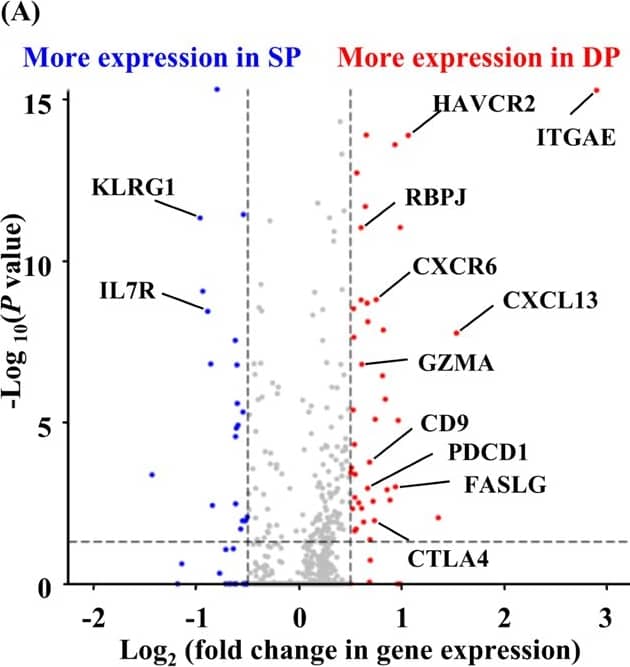
Detection of Human CXCL13/BLC/BCA-1 by Flow Cytometry
Relationship of different CD8+ TRM subset with B cells and TLS in CRC tumor tissues. (A) Volcano plot showing differentially expressed genes between DP CD8+ TRM subsets and SP CD8+ TRM subsets of the GSE108989 dataset. (B) The FFPE CRC tumor tissue slides from patients with CRC were stained with DAPI (blue), CD20 (green), CD8 (yellow), CD103 (orange), and CD69 (red). (C) Relationship between the proportion of different CD8+ TRM cells and the proportion of B cells in CRC tumor tissues detected by flow cytometry (n = 40) and relationship between the proportion of different CD8+ TRM cells and the count of B cells and the count and area of TLS in CRC tumor tissues detected by mIHC (n = 64). Statistical analysis was performed by Pearson correlation analysis. (D) Schematic overview of the transwell migration assay design. (E) B cell migration rate when cultured either alone or with different CD8+ TRM subsets (n = 10) and B cell migration rate when cultured with DP CD8+ TRM cells with or without anti-CXCL13 neutralizing antibody (n = 7). Statistical analysis was performed by non-parametric Wilcoxon’s matched-pairs tests and Friedman test with Dunn’s multiple comparisons test. (*p < 0.05; **p < 0.01) Image collected and cropped by CiteAb from the following open publication (https://biosignaling.biomedcentral.com/articles/10.1186/s12964-024-0199…), licensed under a CC-BY license. Not internally tested by R&D Systems.Applications for Human CXCL13/BLC/BCA-1 Antibody
Application
Recommended Usage
Western Blot
1 µg/mL
Sample: Recombinant Human CXCL13/BLC/BCA-1 (Catalog # 801-CX)
Sample: Recombinant Human CXCL13/BLC/BCA-1 (Catalog # 801-CX)
Neutralization
Measured by its ability to neutralize CXCL13/BLC/BCA-1-induced chemotaxis in the BaF3 mouse pro-B cell line transfected with human CXCR5. The Neutralization Dose (ND50) is typically 0.3-0.9 µg/mL in the presence of 0.05 µg/mL Recombinant Human CXCL13/BLC/BCA-1.
Human CXCL13/BLC/BCA-1 Sandwich Immunoassay
Please Note: Optimal dilutions of this antibody should be experimentally determined.
Reviewed Applications
Read 4 reviews rated 4.5 using MAB801 in the following applications:
Formulation, Preparation, and Storage
Purification
Protein A or G purified from hybridoma culture supernatant
Reconstitution
Reconstitute at 0.5 mg/mL in sterile PBS. For liquid material, refer to CoA for concentration.
Formulation
Lyophilized from a 0.2 μm filtered solution in PBS with Trehalose. *Small pack size (SP) is supplied either lyophilized or as a 0.2 µm filtered solution in PBS.
Shipping
Lyophilized product is shipped at ambient temperature. Liquid small pack size (-SP) is shipped with polar packs. Upon receipt, store immediately at the temperature recommended below.
Stability & Storage
Use a manual defrost freezer and avoid repeated freeze-thaw cycles.
- 12 months from date of receipt, -20 to -70 °C as supplied.
- 1 month, 2 to 8 °C under sterile conditions after reconstitution.
- 6 months, -20 to -70 °C under sterile conditions after reconstitution.
Background: CXCL13/BLC/BCA-1
CXCL13, also known as B-lymphocyte chemoattractant (BLC), is a CXC chemokine that is constitutively expressed in secondary lymphoid organs. BCA-1 cDNA encodes a protein of 109 amino acid residues with a leader sequence of 22 residues. Mature human BCA-1 shares 64% amino acid sequence similarity with the mouse protein and 23-34% amino acid sequence identity with other known CXC chemokines. Recombinant or chemically synthesized BCA-1 is a potent chemoattractant for B lymphocytes but not T lymphocytes, monocytes or neutrophils. BLR1, a G protein-coupled receptor originally isolated from Burkitt’s lymphoma cells, has now been shown to be the specific receptor for BCA-1. Among cells of the hematopoietic lineages, the expression of BLR1, now designated CXCR5, is restricted to B lymphocytes and a subpopulation of T helper memory cells. Mice lacking BLR1 have been shown to lack inguinal lymph nodes. These mice were also found to have impaired development of Peyer’s patches and defective formation of primary follicles and germinal centers in the spleen as a result of the inability of B lymphocytes to migrate into B cell areas.
References
- Gunn, M.D. et al. (1998) Nature, 391:799.
- Legler, D.F. et al. (1998) J. Exp. Med. 187:655.
- Forster, R. et al. (1996) Cell 87:1037.
Alternate Names
ANGIE2, BCA-1, BCA1, BLC, BLR1L, SCYB13
Gene Symbol
CXCL13
UniProt
Additional CXCL13/BLC/BCA-1 Products
Product Documents for Human CXCL13/BLC/BCA-1 Antibody
Product Specific Notices for Human CXCL13/BLC/BCA-1 Antibody
For research use only
Loading...
Loading...
Loading...
Loading...
Loading...
Loading...