
Human CEACAM-1/CD66a Antibody
R&D Systems, part of Bio-Techne | Catalog # MAB2244

Conjugate
Catalog #
Key Product Details
Species Reactivity
Validated:
Human
Cited:
Human, Xenograft
Applications
Validated:
Western Blot, Flow Cytometry, CyTOF-reported
Cited:
Immunohistochemistry-Paraffin, Western Blot, Flow Cytometry, Immunocytochemistry/ Immunofluorescence
Label
Unconjugated
Antibody Source
Monoclonal Mouse IgG2B Clone # 283340
Product Specifications
Immunogen
Mouse myeloma cell line NS0-derived recombinant human CEACAM-1
Gln35-Gly428
Accession # P13688
Gln35-Gly428
Accession # P13688
Specificity
Detects human CEACAM-1 in direct ELISAs and Western blots. In direct ELISAs and Western blots, no cross-reactivity with recombinant human (rh) CD31, rhICAM-1, -2, -3, recombinant mouse (rm) MAdCAM-1, or rhVCAM-1 was observed. In direct ELISAs, no cross-reactivity with rhCEACAM-6, -7, -8, and rmCEACAM-7 and less than 5% cross-reactivity with rhCEACAM-3, -5 was observed.
Clonality
Monoclonal
Host
Mouse
Isotype
IgG2B
Scientific Data Images for Human CEACAM-1/CD66a Antibody
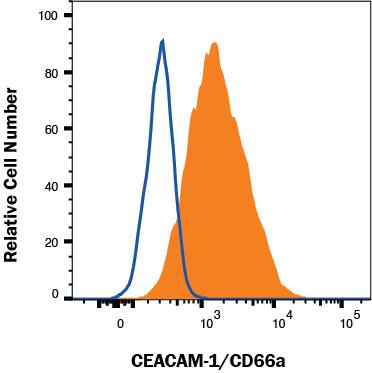
Detection of CEACAM-1/CD66a in HepG2 cells by Flow Cytometry
HepG2 cells were stained with Mouse Anti-Human CEACAM-1/CD66a Monoclonal Antibody (Catalog # MAB2244, filled histogram) or isotype control antibody (Catalog # MAB0041, open histogram) followed by Allophycocyanin-conjugated Anti-Mouse IgG Secondary Antibody (Catalog # F0101B). View our protocol for Staining Membrane-associated Proteins.
Detection of CEACAM-1/CD66a by Flow Cytometry
Analyses of CEACAM1 expression on CD14+ monocytes.(A) Monocytes were incubated with rabbit anti-CEACAM antibody A0115 (black histogram) or its IgG control (grey histogram) followed by secondary PE-conjugated anti-rabbit IgG and FITC-conjugated CD14 mAb. Dotted histogram represents secondary antibody only control. (B) Cells were also labelled with PE-conjugated anti-CEACAM1 mAb (R and D Systems MAb2244) (black histogram) or its isotype control (grey histogram) and FITC-conjugated CD14 mAb. Live CD14+ cells were analysed and the percentages of cells expressing CEACAM1 were found to be 7.2±5.1% using A0115 and 13.9±4.1% using MAb2244. The MFI plots of CEACAMs on CD14+ monocytes are shown on the right (*, P<0.05; **, P<0.01).The three dots in each case represent data from monocytes obtained from three donors. Note the differences in the values shown for the two antibodies could also be assigned to the experiments being performed using two different instruments (Canto II, University of Bristol and Calibur, Shandong University respectively) using different settings. Image collected and cropped by CiteAb from the following open publication (https://pubmed.ncbi.nlm.nih.gov/24599281), licensed under a CC-BY license. Not internally tested by R&D Systems.
Detection of CEACAM-1/CD66a by Flow Cytometry
Analyses of CEACAM1 expression on CD14+ monocytes.(A) Monocytes were incubated with rabbit anti-CEACAM antibody A0115 (black histogram) or its IgG control (grey histogram) followed by secondary PE-conjugated anti-rabbit IgG and FITC-conjugated CD14 mAb. Dotted histogram represents secondary antibody only control. (B) Cells were also labelled with PE-conjugated anti-CEACAM1 mAb (R and D Systems MAb2244) (black histogram) or its isotype control (grey histogram) and FITC-conjugated CD14 mAb. Live CD14+ cells were analysed and the percentages of cells expressing CEACAM1 were found to be 7.2±5.1% using A0115 and 13.9±4.1% using MAb2244. The MFI plots of CEACAMs on CD14+ monocytes are shown on the right (*, P<0.05; **, P<0.01).The three dots in each case represent data from monocytes obtained from three donors. Note the differences in the values shown for the two antibodies could also be assigned to the experiments being performed using two different instruments (Canto II, University of Bristol and Calibur, Shandong University respectively) using different settings. Image collected and cropped by CiteAb from the following open publication (https://pubmed.ncbi.nlm.nih.gov/24599281), licensed under a CC-BY license. Not internally tested by R&D Systems.Applications for Human CEACAM-1/CD66a Antibody
Application
Recommended Usage
CyTOF-reported
This clone has been commercially reported for use in CyTOF®. Ready to be labeled using established conjugation methods. No BSA or other carrier proteins that could interfere with conjugation.
Flow Cytometry
0.25 µg/106 cells
Sample: HepG2 human hepatocellular carcinoma cell line
Sample: HepG2 human hepatocellular carcinoma cell line
Western Blot
1 µg/mL
Sample: Recombinant Human CEACAM-1/CD66a (Catalog # 2244-CM)
Sample: Recombinant Human CEACAM-1/CD66a (Catalog # 2244-CM)
Formulation, Preparation, and Storage
Purification
Protein A or G purified from hybridoma culture supernatant
Reconstitution
Reconstitute at 0.5 mg/mL in sterile PBS. For liquid material, refer to CoA for concentration.
Formulation
Lyophilized from a 0.2 μm filtered solution in PBS with Trehalose. See Certificate of Analysis for details.
*Small pack size (-SP) is supplied either lyophilized or as a 0.2 µm filtered solution in PBS.
*Small pack size (-SP) is supplied either lyophilized or as a 0.2 µm filtered solution in PBS.
Shipping
Lyophilized product is shipped at ambient temperature. Liquid small pack size (-SP) is shipped with polar packs. Upon receipt, store immediately at the temperature recommended below.
Stability & Storage
Use a manual defrost freezer and avoid repeated freeze-thaw cycles.
- 12 months from date of receipt, -20 to -70 °C as supplied.
- 1 month, 2 to 8 °C under sterile conditions after reconstitution.
- 6 months, -20 to -70 °C under sterile conditions after reconstitution.
Background: CEACAM-1/CD66a
Carcinoembryonic antigen (CEA)-related cell adhesion molecule 1 (CEACAM-1; also BGP) is a 160 kDa member of the CEACAM branch of the CEA gene family of the immunoglobulin superfamily (1-3). It is one of seven human CEACAM subfamily genes that are essentially divided equally between type I transmembrane proteins (CEACAM-1, 3, and 4) and GPI-linked molecules (CEACAM-5-8). There is no CEACAM-2 in human. The gene for human CEACAM-1 codes for a 526 amino acid (aa) type I transmembrane protein that contains a 34 aa signal sequence, a 394 aa extracellular domain (ECD), a 24 aa transmembrane segment, and a 74 aa cytoplasmic region (4, 5). The ECD contains one N-terminal V-type Ig-like domain, followed by three C2-type Ig-like domains. It shows considerable glycosylation, including high mannose residues and (sialyl) LewisX (1). The cytoplasmic region shows one ITIM motif and a calmodulin binding site (1-3). In addition to the full length form, ten alternate splice forms have been reported (1, 4, 6-8). There are three soluble and seven transmembrane isoforms, with variations occurring in both the ECD and cytoplasmic region. All ten alternate splice forms contain the V-type Ig-like domain (aa's 35-142). The three soluble forms also contain the first two C2-type Ig-like domains (aa's 145-317), with differences coming in the third C2-type Ig-like domain (6). The seven transmembrane isoforms are highly divergent. Five of the seven contain the V-type plus the first two C2-type domains and then diverge considerably both in the ECD and cytoplasmic region. The remaining two contain only the V‑type Ig-like domain, the transmembrane region, and either a full-length or truncated cytoplasmic tail (1, 8). The actual functions of the isoforms are unclear. Full-length mouse and rat CEACAM-1 are approximately 57% aa identical to human CEACAM-1; in the V‑type Ig-like domain, they are 58% and 56% aa identical, respectively. The full-length molecule is found on neutrophils, bile duct epithelium, activated NK cells, colonic columnar epithelium and endothelium. It is known to act as an intercellular adhesion molecule, forming both homotypic, and heterotypic bonds with CEA and CEACAM-6/NCA (3, 9). On neutrophils, CEACAM-1 also binds to dendritic cell CD-SIGN via its LeX moiety, inducing dendritic cell maturation and a subsequent Th1-type response (10, 11).
References
- Beauchemin, N. et al. (1999) Exp. Cell Res. 252:243.
- Thompson, J. et al. (1992) Genomics 12:761.
- Waggener, C. and S. Ergun (2000) Exp. Cell Res. 261:19.
- Barnett, T.R. et al. (1989) J. Cell Biol. 108:267.
- Hinoda, Y. et al. (1988) Proc. Natl. Acad. Sci. USA 85:6959.
- Kuroki, M. et al. (1991) Biochem. Biophys. Res. Commun. 176:578.
- Barnett, T.R. et al. (1993) Mol. Cell. Biol. 13:1273.
- Watt, S.M. et al. (1994) Blood 84:200.
- Oikawa, S. et al. (1992) Biochem. Biophys. Res. Commun. 186:881.
- Klaas, P.J.M. et al. (2005) FEBS Lett. 579:6159.
- Bogoevska, V. et al. (2005) Glycobiology 16:197.
Long Name
Carcinoembryonic Antigen-related Cell Adhesion Molecule 1
Alternate Names
BGP1, Biliary Glycoprotein 1, CD66a, Cea-1, CEACAM1, Hv-1, Hv-2, MHVR
Gene Symbol
CEACAM1
UniProt
Additional CEACAM-1/CD66a Products
Product Documents for Human CEACAM-1/CD66a Antibody
Product Specific Notices for Human CEACAM-1/CD66a Antibody
For research use only
Loading...
Loading...
Loading...
Loading...
Loading...
Loading...