
Human CD163 Antibody
R&D Systems, part of Bio-Techne | Catalog # MAB11730

Conjugate
Catalog #
Key Product Details
Species Reactivity
Human
Applications
Multiplex Immunofluorescence, Immunohistochemistry, COMET
Label
Unconjugated
Antibody Source
Monoclonal Mouse IgG1 Clone # 1111605
Product Specifications
Immunogen
Synthetic Peptide
Accession # Q86VB7
Accession # Q86VB7
Specificity
Detects a synthetic peptide specific for human CD163 around amino acid 240 in Direct ELISA.
Clonality
Monoclonal
Host
Mouse
Isotype
IgG1
Scientific Data Images for Human CD163 Antibody
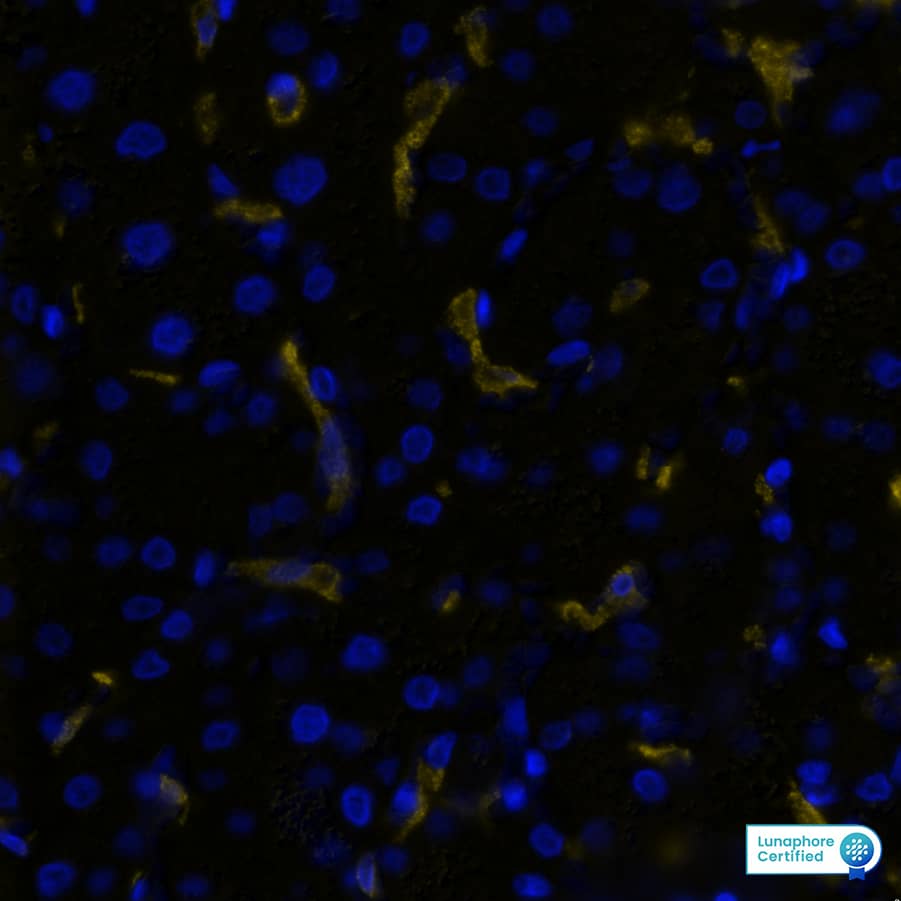
Detection of CD163 in Human Liver via seqIF™ staining on COMET™
CD163 was detected in immersion fixed paraffin-embedded sections of human Liver using Mouse Anti-Human CD163, Monoclonal Antibody (Catalog #MAB11730) at 5ug/mL at 37° Celsius for 4 minutes. Before incubation with the primary antibody, tissue underwent an all-in-one dewaxing and antigen retrieval preprocessing using PreTreatment Module (PT Module) and Dewax and HIER Buffer H (pH 9; Epredia Catalog # TA-999-DHBH). Tissue was stained using the Alexa Fluor™ 647 Goat anti-Mouse IgG Secondary Antibody at 1:200 at 37 ° Celsius for 2 minutes. (Yellow; Lunaphore Catalog # DR647MS) and counterstained with DAPI (blue; Lunaphore Catalog # DR100). Specific staining was localized to the membrane. Protocol available in COMET™ Panel Builder.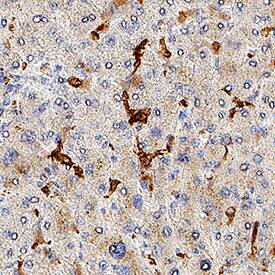
Detection of CD163 in Human Liver.
CD163 was detected in immersion fixed paraffin-embedded sections of human liver using Mouse Anti-Human CD163 Monoclonal Antibody (Catalog # MAB11730) at 5 µg/ml for 1 hour at room temperature followed by incubation with the Anti-Mouse IgG VisUCyte™ HRP Polymer Antibody (Catalog # VC001) or the HRP-conjugated Anti-Mouse IgG Secondary Antibody (Catalog # HAF007). Before incubation with the primary antibody, tissue was subjected to heat-induced epitope retrieval using VisUCyte Antigen Retrieval Reagent-Basic (Catalog # VCTS021). Tissue was stained using DAB (brown) and counterstained with hematoxylin (blue). Specific staining was localized to the cell surface of Kupffer cells. View our protocol for IHC Staining with VisUCyte HRP Polymer Detection Reagents.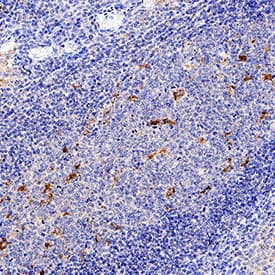
Detection of CD163 in Human Tonsil.
CD163 was detected in immersion fixed paraffin-embedded sections of human tonsil using Mouse Anti-Human CD163 Monoclonal Antibody (Catalog # MAB11730) at 5 µg/ml for 1 hour at room temperature followed by incubation with the Anti-Mouse IgG VisUCyte™ HRP Polymer Antibody (Catalog # VC001) or the HRP-conjugated Anti-Mouse IgG Secondary Antibody (Catalog # HAF007). Before incubation with the primary antibody, tissue was subjected to heat-induced epitope retrieval using VisUCyte Antigen Retrieval Reagent-Basic (Catalog # VCTS021). Tissue was stained using DAB (brown) and counterstained with hematoxylin (blue). Specific staining was localized to the cell surface. View our protocol for IHC Staining with VisUCyte HRP Polymer Detection Reagents.Applications for Human CD163 Antibody
Application
Recommended Usage
COMET
Immunohistochemistry
3-25 µg/mL
Sample: Immersion fixed paraffin-embedded sections of human liver and tonsil
Sample: Immersion fixed paraffin-embedded sections of human liver and tonsil
Multiplex Immunofluorescence
5 µg/mL
Sample: Immersion fixed paraffin-embedded sections of human liver
Sample: Immersion fixed paraffin-embedded sections of human liver
Formulation, Preparation, and Storage
Purification
Protein A or G purified from hybridoma culture supernatant
Reconstitution
Reconstitute lyophilized material at 0.2 mg/ml in sterile PBS. For liquid material, refer to CoA for concentration.
Formulation
Lyophilized from a 0.2 μm filtered solution in PBS with Trehalose.
Shipping
Lyophilized product is shipped at ambient temperature. Liquid small pack size (-SP) is shipped with polar packs. Upon receipt, store immediately at the temperature recommended below.
Stability & Storage
Use a manual defrost freezer and avoid repeated freeze-thaw cycles.
- 12 months from date of receipt, -20 to -70 °C as supplied.
- 1 month, 2 to 8 °C under sterile conditions after reconstitution.
- 6 months, -20 to -70 °C under sterile conditions after reconstitution.
Background: CD163
CD163, previously called M130 or p155, is a 130‑160 kDa type I transmembrane glycoprotein that belongs to group B of the cysteine-rich scavenger receptor family (1‑3). It is essential for clearance of hemoglobin-haptoglobin (Hb-Hp) complexes in the liver, spleen and circulation (4). The human CD163 contains a 41 amino acid (aa) signal sequence, a 1009 aa extracellular domain (ECD) with 9 scavenger receptor cysteine-rich (SRCR) domains, a 22 aa transmembrane segment, and a 39‑84 aa cytoplasmic region (1). The third SRCR domain is crucial for calcium-dependent binding of hemoglobin/haptoglobin complexes (3). Three splice forms (isoforms 2, 3 and 4) vary within their intracellular regions (1, 5), while one isoform (# 4) also has a 34 aa insert between SRCR domains 5 and 6 within the ECD. While all are expressed, isoform 3 is the most abundant, being generally expressed on the cell surface and most active in endocytosis (5). An approximately 130 kDa soluble form of human CD163 (sCD163) is assumed to contain virtually all of the ECD, which shares 74%, 75%, 84%, 86%, 86% and 87% aa identity with mouse, rat, bovine, equine, porcine and canine CD163 ECD, respectively (6, 7). It is released from the cell surface by proteolysis after oxidative stress or inflammatory stimuli, including bacterial endotoxins and activation of the Toll-like receptors TLR2 or TLR5 (7‑10). Expression of CD163 is constitutive, and induced by glucocorticoids, IL‑10, IL‑6 or endotoxin on circulating monocytes, tissue macrophages, and at low levels on monocyte-derived dendritic cells (1, 2, 11, 12). In addition to clearing Hb‑Hp complexes, CD163 is also a scavenger receptor for free Hb (if Hp is depleted) and TWEAK (TNF-like weak inducer of apoptosis), and can function as an erythroblast adhesion receptor (4, 13‑15).
References
- Law, S.K.A. et al. (1993) Eur. J. Immunol. 23:2320.
- Sulahian, T.H. et al. (2000) Cytokine 12:1312.
- Madsen, M. et al. (2004) J. Biol. Chem. 279:51561.
- Kristiansen, M. et al. (2001) Nature 409:198.
- Nielsen, M.J. et al. (2006) J. Leukoc. Biol. 79:837.
- Moller, H.J. et al. (2002) Blood 99:378.
- Droste, A. et al. (1999) Biochem. Biophys. Res. Commun. 256:110.
- Hintz, K. A. et al. (2002) J. Leukoc. Biol. 72:711.
- Weaver, L.K. et al. (2006) J. Leukoc. Biol. 80:26.
- Timmerman, M. and P. Hogger (2005) Free Radic. Biol. Med. 39:98.
- Buechler, C. et al. (2000) J. Leukoc. Biol. 67:97.
- Pulford, K.A. et al. (1989) J. Clin. Pathol. 42:414.
- Schaer, D.J. et al. (2006) Blood 107:373.
- Bover, L.C. et al. (2007) J. Immunol. 178:8183.
- Fabriek, B.O. et al. (2007) Blood 109:5223.
Alternate Names
CD163, GHI/61, HbSR, M130, RM3/1
Gene Symbol
CD163
UniProt
Additional CD163 Products
Product Documents for Human CD163 Antibody
Product Specific Notices for Human CD163 Antibody
For research use only
Loading...
Loading...
Loading...
Loading...
Loading...